Wednesday, 8 June 2016

The Secret to Powerful Products that Sell: Meet Tara Gentile, Creator of ‘Quiet Power’

tara gentile - how to unlock the door between before and after

Tara Gentile is known for helping people grow terrific businesses — without sacrificing ethics or heart.

Tara works with “idea people” — people who have an idea that they want to turn into a product, program, or service, but who may not always see themselves as business owners or marketers. She helps her audience and clients find the right business models, craft marketing that resonates, and structure their businesses for profit.

She calls her approach the Quiet Power Strategy — and it’s a complete reversal of a lot of the “cookie cutter” advice you sometimes see around digital business.

Listen and observe

A while back, Tara spoke with Rainmaker Digital CEO Brian Clark about how to thoughtfully observe your audience in order to strengthen your business.

Listen to Win: How Actionable Observation Provides Profitable Answers

Brian and Tara share a deep focus on listening in order to uncover audience interests, fears, and desires. When you master this, everything about your business starts to work better.

It’s also the key to marketing that doesn’t feel pushy or creepy — because you’re speaking directly to the problems and concerns of your audience, using their own language. Marketing becomes a direct expression of audience empathy.

Listening is the key to building a business based on service rather than selfishness.

“I see [listening] as probably the biggest thing that’s keeping people from creating marketing that works and products that sell easily … and sales processes that don’t feel slimy.” – Tara Gentile

What do they care deeply about?

In Tara’s world (and ours), the journey always starts with the deepest goals and concerns of the audience.

“How are you going to help them go from before to after?” – Tara Gentile

Tara’s process unearths what she calls the Target Conversation. Who are the people having this conversation, and what are they actually talking about?

Most of the time, the road from their problem to the solution you offer isn’t a straight line; it’s a series of somewhat meandering connections. This sequence of relevant ideas will click with the people in your audience where they are right now — not where you wish they were.

Tara calls this step Connecting the Dots: starting with where they are today, then moving purposefully to the next dot … and the next, and the next.

In this way, you create a clear path between your audience’s problems and your solutions.

Solving audience problems … even if you aren’t a renowned expert

“Don’t call yourself an expert … just be helpful. If you’re two steps ahead of your audience on the journey, you’re still a leader.” – Brian Clark

Tara and Brian share the conviction that a business that’s built on solving specific audience problems is far more powerful than starting with a notion of some abstract “market.”

“When you look at real people with real problems — or with real desires — they’ve got blanks. There’s something missing that isn’t allowing them to accomplish what they want to accomplish … There’s sort of a locked door between that before and after … And we’ve got insight into how to open it.” – Tara Gentile

Once you adjust your approach to focus your business’s marketing and products on customer problems and the solutions to those problems, you’ve set yourself up for success.

How to approach writing a promotion

“My best tip for copywriting is to feed your customers’ words back to them … They want to know that you’ve actually thought about what their problem is.” – Tara Gentile

First, Tara listens for the themes and language that come up again and again for her audience. Her promotional copy is then crafted to provide answers and solutions that speak to those specific issues.

She builds each sales page around a single key insight that’s arisen from conversations with her audience and customers. That gives the promotion focus, connecting Tara’s expertise directly to what’s most important to her prospects right now.

Promotions crafted this way stand out from the general background of noise and clutter that we see every day on the web and in our inboxes.

“The opposite of quiet isn’t loud; it’s noise.” – Tara Gentile

Let Tara walk you through her process: 7 Ways to Listen to Your Audience

We’re so happy that Tara will be joining us this October in Denver, Colorado at our live Digital Commerce Summit.

Here’s what Tara had to say about the presentation she’ll be teaching:

“It’s time to stop guessing about what digital product to create (whether it’s your first or your next). It’s also time to stop wasting time and money building the wrong products (i.e. the ones people don’t buy). Learn seven distinct ways to listen to your audience and build a system for turning what you hear into profitable offers. You’ll never have to guess about what people want to buy again.”

Tara’s process is applicable to any business — from selling a single ebook to running a multi-million dollar SaaS.

Join us October 13-14 for a carefully chosen curriculum that will give you the momentum you need to level up as a digital entrepreneur. Tara is just one of 15 speakers who have walked the walk. Over two days, we’ll teach you how to take your digital project to the next level — or how to get something new off the ground.

Click here to get the details and snag the best price on your tickets.

We’re looking forward to seeing you there!

The post The Secret to Powerful Products that Sell: Meet Tara Gentile, Creator of ‘Quiet Power’ appeared first on Copyblogger.


from
http://redirect.viglink.com?u=http%3A%2F%2Ffeeds.copyblogger.com%2F%7E%2F157536113%2F0%2Fcopyblogger%7EThe-Secret-to-Powerful-Products-that-Sell-Meet-Tara-Gentile-Creator-of-Quiet-Power%2F&key=ddaed8f51db7bb1330a6f6de768a69b8

Tuesday, 7 June 2016

The 3 copywriting principles we followed to 2x SweatBlock.com’s revenue

Start with a messaging hierarchy.

Be specific.

Use calls to value, not just calls to action.

Those are the 3 copywriting practices we put into play to optimize the copy on the home page of SweatBlock, a top-rated clinical-strength antiperspirant.

The result? A 108% lift in revenue.

Yup, our copy more than doubled revenue attributed to the home page.

Now, to be clear, when I see numbers like that, I’m as skeptical as the next person. Even I can’t believe copy is as powerful as it is. “Really? Just use specific phrasing and double my biz? Really??”

Yeah, I hear you. I too shake my head at the results, marvel at the numbers, look for holes in the data if only because I can’t really, truly believe that words can do so much for businesses. Then I get an email like this: 

I passionately believe that content is the most important part of CRO but it’s also the most neglected part of websites.

That’s from a conversion optimization expert at Google.

The smartest people in CRO believe in copy.

Yet, in practice, it seems we’re all decidedly skeptical. To our detriment. After all, the data’s good. And the entire world of marketing is based on effective messaging. And it’s terribly easy to believe when the wrong message tanks conversions in a test – so why do we find it so hard to believe that the right message, put the right way, can and will increase conversion rates?? (For a strong product. <– discussion unto itself)

All that to say: Allow yourself to suspend disbelief as you read through how we used li’l ol’ words, placed in the right order, to optimize the copy for SweatBlock’s home page. See why we did it. See how we did it. So you can do it, too, as part of your next round of experiments.

First, Here Are the 2 Home Page Variations We Tested

The SweatBlock home page is an ecommerce one-pager.

That means it acts as a sales page and website all in one.

Which is why it’s so damn long. And which means it’s gotta do a lot.

For your viewing pleasure, here’s the control and variation B:
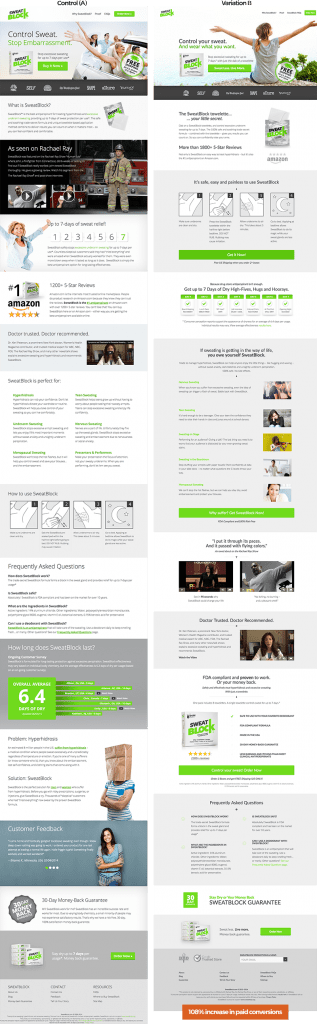
Copy Hackers copy for Sweatblock - winner and control

Our copy brought in more than 2x the sales.

With the help of Sam Woods of Response Copy,* we wrote Variation B, starting with a new messaging hierarchy.

We started by eliminating the “muddle” with the help of a simple messaging hierarchy

What goes on the page?

This is the #1 question you need to answer before you start writing a page.

Now try answering it.

What goes on your home page?

Kinduva broad question, right? It’s so broad, it breeds unhelpful answers. Perhaps you’d answer with, “As much as is necessary to convince the prospect.” Nice consulting-y answer, but not that helpful when it comes to brass-tacks kinda work. So perhaps then you might find yourself jumping to answers like “a hero section”, “a headline”, “the calls to action”, “an explainer video” and “images.”

But what goes in and in-between all that stuff?

When we’re trying to figure out what goes on a page, we’re really looking for our messaging hierarchy: the order in which to organize on-page messages to convince the reader. To arrive at the hierarchy, we need to start with the right questions:

  1. What is our visitor thinking when she lands on this page?
  2. What do we want her to do by the time she finishes with the page?
  3. How does her thinking need to change in the space between the start and the “end” of the page? What do we need to show and tell her to move her from where she was pre-page to where we want her to be now?

The answer to Q3 will dictate what goes on the page and how long it needs to be.

Now here’s how I like to think about the general layout of a page and, accordingly, its messaging hierarchy:

The 10/90 Messaging Layout Rule
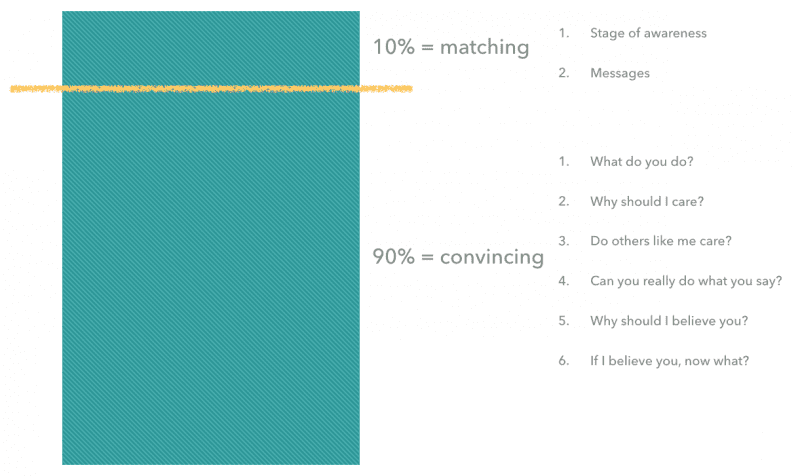
Messaging hierarchy on the page

Roughly the top 10% of the page is all about matching 1) the visitor’s stage of awareness and 2) the message(s) that led her here.

The rest of the page is all about convincing her. To that end, I’ve found it useful to answer these questions, in this order, when writing a page. (Written from the POV of the prospect. Imagine answering one question for your prospect before she moves onto the next question.)

  1. What do you do?
  2. Okay. Why should I care?
  3. Am I alone in caring – or do others (preferably others like me) care?
  4. You’re starting to win me over. But I’m skeptical. So show me: how do you do what you say you do?
  5. And if I believe you and your process / solution, how will my life improve?
  6. I’d like to believe you, but first tell me: why is it safe for me to believe you?
  7. Okay, let’s say I believe you. Now what?

Those questions are not perfect and they do not work in that order 100% of the time. But they’re a solid starting point. Because they create a very simple conversation.

(How much or how little you write to answer each of those questions will vary. So please don’t try to “science the shit” out of your copywriting – it’s formulaic to a point, and then comes, well, art.)

When we first looked at the Control version of SweatBlock.com’s home page, we couldn’t quite follow its hierarchy. A didn’t lead to B, B didn’t lead to C. It was a bit like trying to read a story when the chapters in the book have all been shuffled around.

  • The answer to “what do you do?” kept reappearing.
  • The answer to “do others care?” popped up at least three separate times, seemingly without rhyme or reason, seemingly just because there was some good social proof handy.
  • Risk-reducers were waiting around every corner, even when there seemed no need to reduce risk at that point.

The Control felt like the old saying: “Every story has a beginning, a muddle and an end.”

It had too much muddle.

So we drafted a hierarchy that would better eliminate the muddle, giving every single message on the page real purpose. We used the 7 questions I just showed you to create the following order of messages, with a little extra built in for the top 10%. Here’s how that went down:

>> Matching (in top 10%)

Sweatblock home page optimization

>> What is SweatBlock… why should I care… and do others like me care?

Sweatblock home page 2

>> How do you do what you say you do?

Sweatblock show and tell copywriting

>> If I believe you, how will my life improve?

How will my life improve with Sweatblock?

>> Why is it safe for me to believe you?

Do others like me care? Copy on SB

>> Let’s say I believe you. Now what?

Now-what copywriting

Our copy intentionally moved along with the prospect, thinking like the prospect and anticipating their curiosities, objections and anxieties. Again, it merely tried to have a reasonable conversation with the prospect using these simple questions in this order:

  1. What do you do?
  2. Why should I care?
  3. Do others care?
  4. So how do you do what you say you do?
  5. And how will my life improve?
  6. Why is it safe for me to believe you?
  7. Let’s say I believe you. Now what?

(I’m repeating those Qs so you can write them down, BTW.)

The Control, on the other hand, jumped around, creating what feels like a pretty mad convo between the visitor and the page. If we map the Control messages against what they’re trying to say, we get this:

  1. What do you do?
  2. Why should I care?
  3. Why is it safe for me to believe you?
  4. And how will my life improve?
  5. Do others care?
  6. Why is it safe for me to believe you?
  7. And how will my life improve?
  8. So how do you do what you say you do?
  9. {Make me find my question in your FAQs}
  10. {How long does it last?}
  11. {Tell me again about the problem and the solution}
  12. Do others care?
  13. Let’s say I believe you. Now what?

Slightly chaotic, right?

A messaging hierarchy helped us minimize the Control’s sense of chaos.


avoid chaos! @copyhackers lists 7 questions to craft your messaging hierarchy
Click To Tweet


From there, we turned vague copy into specific copy

Most copy online is entirely vague. It’s summarized. It’s abstracted. …Which makes it really hard to visualize or even understand.

This vague approach to copywriting is nobody’s fault. Getting specific can just seem… scary. What if you’re too specific and no one can relate? What if you’re specific the wrong way, leaving your prospects confused?

Those are perfectly valid questions and concerns. You don’t need me to tell you that – you know they are. But here’s the thing: in my experience, being vague just doesn’t work as well as being specific.

With that in mind, we turned SweatBlock’s summarized, vague-ish messages into specific copy. Compare them and check out our explanation below each set of before-and-afters:

fdsafdsafasdfa

To make the message more specifically tied to the visitor, we added “your” to the first line of the headline. Then we replaced the negative outcome statement (“Stop Embarrassment,” which is a summarized pain rather than a tangible one) with a tangible outcome: “wear what you want.” Finally, we added the line “just the dab of a towelette” to the subhead to help visitors visualize using the product.


add the word “you” or “your” to make your prospect feel spoken to, says @copyhackers
Click To Tweet


How to rewrite a crosshead so it's specific

The Control crosshead was a rather typical sort of crosshead, one we refer to as “placeholder text” here at Copy Hackers. We replaced it with the answer to the question the Control was asking. That is, by the way, a really clean way to get specific with your copy: just answer the questions your old crossheads were asking.


try replacing questions in your copy with their answers, says @copyhackers
Click To Tweet
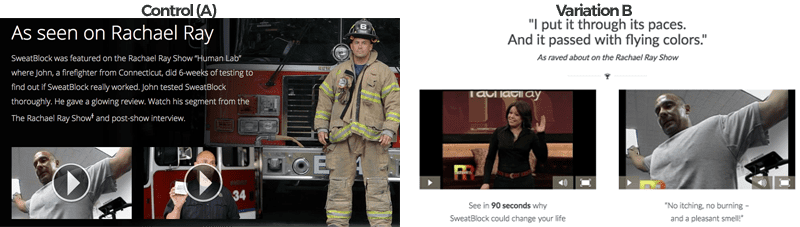

fdsfdadafsa

It may seem like leading with an influencer’s name, as in the Control, is a no-brainer crosshead. But we hypothesized that, if prospects weren’t clicking to buy in the hero section – if they kept on reading – it may be that they were in a solution-aware or pain-/problem-aware stage. As such, they wouldn’t yet respond to persuasion techniques (like proof from authorities), which is great for helping to close people but not so great for getting them to care and connect in the first place. So we replaced the Control crosshead with a specific and even colorful statement about using SweatBlock.


rethink the way you’re messaging that killer piece of social proof you’ve got, says @copyhackers
Click To Tweet
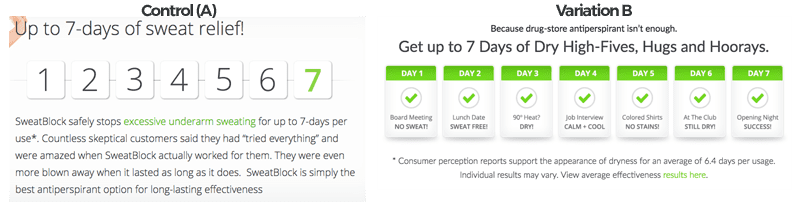

fdsafdsafdsa

“Sweat relief” is good… but the SweatBlock prospect, suffering from excessive sweating, doesn’t come to this page looking for “sweat relief,” does she? In a marketer’s head, sure, she wants sweat relief. But not in real life. In real life, she’s feeling tangible pains: sweating through her expensive clothes, filling her closet with boring dark clothes, shying away from high-fives and hugs. So we put those experiences on the page.

If you wanna learn more about how to get specific (and you certainly should), join me at Mozcon this September, where I’ll be presenting on How to Be Specific.

If you’d love me to test specificity on your site and present the findings at Mozcon (and in other places like this very blog), send Lance an email saying why, saying when and mentioning the split-testing tool you use.

And, finally, we optimized the buttons to include “calls to value”

YES!! BUTTONS MATTER!!

I get soooooooooooo tired of people at conversion conferences dissing button copy tests. No, a button may not do the heavy lifting of persuasion. But, yes, it does the heavy lifting of transporting the visitor through the funnel. If you optimized all the copy on your page – or any of the copy on your page – you’d be a fool not to optimize the button, too. And you’re no fool – no siree.

Depending on where your prospect is in the conversion funnel or path, you’re likely to want to choose from one of these two options for your button copy:

  1. Calls to value, where the button copy amplifies the value of moving forward
  2. Calls to action, where the button copy amplifies the action of moving forward

Here’s a call to value on Variation B for the SweatBlock home page:

Call to value button copy

And here’s a call to action on Variation B for the SweatBlock home page:

Call to action button copy

Now, how do you know which one to use when you’re writing copy?

For starters, you can use both on one page. As long as you’re focusing the visitor on a single goal, the button copy you use can range from value-focused to action-focused.

A call to value is best for people before they’ve decided to buy; it reinforces the value of the offering and works toward convincing the prospect.

A call to action is best for people once they’ve decided to buy; they already understand the value, so it’s time to stop selling and just make it as frictionless as possible for them to give you their email addy or credit card deets.

On the SweatBlock home page, we have the call to action “Order Now” in the header. It’s there for those visitors that have already decided to buy and just want to order now. That same CTA is repeated at the bottom of the page – it’s the last chance to buy.

The rest of the page features calls to value, like:

Sweat less. Live more. 

Why suffer? Get SweatBlock now

Control your sweat! Order now

Additionally, you may have noticed that Variation B has more buttons than Variation A / Control. If we were measuring the success of this test on click-throughs rather than paid conversions, then adding all those buttons would likely impact the results such that VB would win simply because there are more opportunities for people to click. (That’s one of the many tricky things about buttons – people love clicking them.) Thankfully, we measured based on paid conversions.

And the result of all that? Copy that brought in 108% more paid conversions than the Control did.

But it doesn’t stop there.

Variation B became the new Control for SweatBlock…

…and we decided to run another test against that winner.

Later this week, I’ll share with you the second test we ran, how we arrived at it, and how it performed. Did it win by a landslide? Did it sink like a brick?

You’ll find out. But here’s my challenge for you: Tell me (in bullets) what you’d do to optimize the winning copy, which I’m including again for you here…

SweatBlock variation B copy test

Leave your guesses and/or ideas as a comment.

If you nail it by guessing what 1 specific thing we did to optimize the second round of copy – and you just may if you’re familiar with Copy Hackers – we’ll give you, oh, say, a free spot in our upcoming 10x Emails course. Naturally you have to guess right before we publish the follow-up post.

(Valued at $997. Max 2 winners, so we’ll draw names if everyone guesses right. This challenge is not open to members of The Copywriter Mastermind 1 or 2, who’ve heard the skinny on this test.)

~jo 🙂

*Sam Woods was a copywriter for us when we ran SNAP Copy, of which SweatBlock was a client. Learn more about the new SNAP Copy here or about how to hire Sam Woods here.

The post The 3 copywriting principles we followed to 2x SweatBlock.com’s revenue appeared first on .


from
http://redirect.viglink.com?u=https%3A%2F%2Fcopyhackers.com%2F2016%2F06%2Fcopywriting-principles-sweatblock%2F&key=ddaed8f51db7bb1330a6f6de768a69b8

Get More Done and Boost Profits with This 3-Step Process for Hiring Help

gather a team to boost your success

Does your business card proudly proclaim “Content Marketing Professional, Chief Cook, and Bottle Washer?”

Now’s the time to change that to simply “Content Marketing Professional.”

We often take pride in the fact that we’re in charge of every aspect of running our businesses, from doing accounting to changing the light bulbs in the office.

But here’s some shocking news, especially if you’re new to content marketing and are still bootstrapping your way to success: Hiring help — outsourcing tasks you struggle with so you can focus on your strengths — will allow you to grow your business and your income at a crazy-fast pace.

Let’s talk about how to go from “doing it all” to “doing only what you do best.”

Step #1: Determine what you don’t need to do

Is there one aspect of your business that you despise — or that you’re just not that good at?

Chances are, there’s someone else who loves that task and offers it as a service.

And think about it: If you’re doing your taxes, you’re not polishing your prose. If you’re cleaning your office, you’re not sharing your content on social media.

Tasks you may want to delegate include:

Content formatting and finding images

Perhaps you love writing blog posts or email newsletters, but you don’t have a lot of experience formatting your content or finding compelling images. Find someone who does, so you have the time to write more.

Editing and proofreading

Even professional writers benefit from editing and proofreading. The bigger and more complex the project, the more likely you’ll want a second set of eyes on it. I hired a developmental editor for my new book, How to Do It All, and it ended up so much stronger after he took his red pen to it.

Social media management

Too busy creating content to share it on social media yourself? Hire a social media whiz to take care of it for you, so you have more time to do what you do best.

Interviewing

If you need to interview people for case studies, blog posts, or other content — and the idea makes you want to drive spikes through your forehead — there’s no shortage of professional writers who will take this task off your hands.

Check out Copyblogger’s Certified Content Marketers for experienced writers with a wide variety of expertise.

Graphic design

Unless you’re an experienced graphic designer as well, consider hiring a design professional to create stellar ebook covers, custom blog graphics, and infographics.

Outreach

I hired a PR assistant to reach out to bloggers and other media outlets about my new book, and she’s doing a much better job than I would have done. Not only that, you also add a layer of sophistication to your business when someone who represents you approaches big-name podcasters or reporters.

Tax prep and accounting

Take it from me — you will likely save more than you spend.

House cleaning

If you work from home, it can be difficult to focus on your work when you’re preoccupied with the sticky kitchen counters and piles of unfolded laundry in your direct line of sight. Cleaning services help create an environment conducive to working (and earning).

Step #2: Decide you can afford to hire help

Hiring help may sound like a good idea for internet celebs who rake in millions by sending out a single email — but not for little old you.

I disagree, for several reasons:

Hiring help will enable you to work more, and faster

I’ve had months where I labored under 13 magazine deadlines, and that productivity has enabled me to make a damn good living as a writer. I could never have done that if I were attempting to transcribe 40 audio files in a month on top of researching and writing the articles.

In many cases, spending money equals making even more money!

Paying for help motivates you to only accept the highest-paying work

You’ll have a good reason to stop entertaining lowball offers from prospects. For example, I hire a transcriptionist to transcribe my interview files. If I were writing $10 articles for content mills, hiring a transcriptionist wouldn’t make sense — but I try to not accept assignments that pay less than $400, which is how I can afford this type of help.

Your helpers should pay for themselves

A business owner I know once told me that your job isn’t to earn enough to pay for help — it’s the job of the people you hire to pay for themselves. For example, if you pay a content marketer $500, they should bring in many multiples of that in terms of paid gigs or products sold.

It’s not always about money

You may be able to find a local university student who wants to gain experience. Years ago, I found a proficient transcriptionist by contacting the English department at a college near me.

Believe me: I’m far from loaded, and I’ve been hiring most of the types of help listed above since the early years of my business. If I can do it, you probably can too.

Step #3: Find your pro

So, I’ve browbeaten you — er, I mean — you’ve decided it’s time to hire pros to help you with certain tasks. Great!

Now, where do you find these people? And how do you know they’re any good?

Before placing an ad or turning to bidding sites, ask around in your business community. Someone you’ve connected with on social media sites or in an industry forum may be able to recommend the perfect pro.

Whatever you do, don’t make the mistake I recently made …

I tend to be overly trusting when it comes to hiring help because, hey, they’re small businesspeople like me! I ended up getting burned to the tune of $6,500 because I didn’t want to be a hard-ass and question the service provider about what they were offering, how it would work for my situation, and exactly how they were getting it done. (Expensive) lesson learned.

So ask, ask, ask until you’re satisfied, and don’t be afraid of offending anyone. Professional service providers will clearly communicate what they offer and their terms of service — a topic that will be covered in an upcoming Copyblogger post.

Over to you …

Once you’ve hired the help you need, you’ll be able to focus on your strengths, provide the most value to your clients, and generate more income.

Have you hired people to help you with your workload? Share your experiences in the comments below.


Need to hire a professional writer to help with your content marketing?

Browse Copyblogger’s Certified Content Marketers.

If you’re interested in getting certified yourself, the program will reopen to new students sometime soon. You can add your email to our waiting list below to be the first to hear about it.

Find out when our Certified Content Marketer training program re-opens:

The post Get More Done and Boost Profits with This 3-Step Process for Hiring Help appeared first on Copyblogger.


from
http://redirect.viglink.com?u=http%3A%2F%2Ffeeds.copyblogger.com%2F%7E%2F157381647%2F0%2Fcopyblogger%7EGet-More-Done-and-Boost-Profits-with-This-Step-Process-for-Hiring-Help%2F&key=ddaed8f51db7bb1330a6f6de768a69b8

Monday, 6 June 2016

Are You Cheap or Are You Exceptional? How to Price Your Services

how to command higher fees

The success of your service-based business will be built on the bedrock of how you answer this one simple question:

Do I want my services to be perceived as economical — or exceptional?

It seems like a no-brainer, doesn’t it? I mean, of course we want to be perceived as exceptional.

But positioning your offerings as exceptional is more difficult than it sounds. It takes guts, unwavering faith in your abilities, and an unflagging devotion to producing quality work.

I’ve lost count of how many times I’ve sat down with a fellow creative person and said, “Look, you have to start charging more money. Just do it!”

In today’s post, I’m going to have that little chat with you, right here on Copyblogger. If you’re a writer, designer, or any type of service provider, this article is for you.

Why is it so tough to charge what you’re worth?

It seems like it should be easy. You want to charge more? Just charge more!

But in reality, being more expensive than the average service provider means:

  • You’ll lose out on some business.
  • You’ll have to keep a straight face while people overreact to your prices.
  • You’ll have to continue to believe in yourself even when people look you in the eye and tell you you’re being unreasonable.
  • You’ll need to navigate through potentially uncomfortable negotiation sessions.

The first “marketing tactic” many new service providers try is, “I’ll be cheaper than everyone else!”

Bad idea.

Positioning yourself as the bargain service provider sets you up for problems that are way worse than having to sit through some tough negotiations.

The pitfalls of positioning yourself as the “bargain” service provider

Bargain service providers attract bargain-hunting clients. And bargain-hunting clients aren’t your best clients. Actually, they’re going to be your worst clients.

Here’s why:

Bargain-hunting clients need education

Clients who buy services based on price don’t usually know what they need. They go into the process of contracting a service without a firm grasp of the solution that will take care of their problem.

They expect you, the service provider, to help them develop (for free) the solution they’ll pay you (a bargain rate) to create.

I ran my own design studio earlier in my career. It didn’t take me too many sessions of sitting down with clients who’d never worked with a designer before, holding their hands through the process, and receiving their teeny-tiny checks to realize, “Gee, this would be much easier if the client already understood what I offer!”

Bargain-hunting clients don’t appreciate what you bring to the table

Clients with a healthy budget for your services have developed that budget because they have:

  • Bought your type of service before, so they know what it costs
  • Worked on projects using the assets you provide (copywriting, content marketing, design, coaching, etc.)
  • Seen the value your service provides (that’s why they have a budget for it!)
  • All of the above

Bargain hunters, on the other hand, need to be “sold” every step of the way.

Wouldn’t you rather be doing creative work than selling creative work? I know I would.

Bargain-hunting clients view your service as a commodity

Service-based businesses are people-based businesses. And no person I know wants their creative work to be treated like a commodity that is sold to the lowest bidder.

How to begin positioning your business as exceptional — not cheap

Getting the best possible price for your services starts with the right mindset.

The first person who has to be convinced you’re worth what you’re charging is you.

You must go into the pricing process with the firm belief that you provide a quality service. You have to be prepared to walk away if the potential client doesn’t see the value.

Because after all, wouldn’t you rather earn a nice living while serving fewer clients?

That’s what we’re aiming for here: quality clients who value your work — and are willing to pay for it.

Get your mindset right and the rest will fall into place.

What’s the rest?

It’s one thing to believe you’re worth it, and it’s another to price your service in a way that protects you from “scope creep.”

Scope creep is the inevitable growth in complexity and time spent on a project that happens when you don’t carefully nail down exactly what you’ll deliver, when you’ll deliver it, and how you’ll deliver it.

This is the first of three articles we’re going to share on pricing your services. In the next article in this series, Stefanie Flaxman will teach you how to ask the questions and get the answers you need to precisely explain what your client is paying for. And she’ll provide some guidance on how to handle it if your project scope starts expanding.

Then, in the final article in this series, Beth Hayden will appear on her white horse with simple steps for pricing your service that you can apply to almost any business.

Stick around: We’ll be delivering this series to you over the next couple of weeks. We want you to have the confidence, techniques, and tools you need to earn the most you can from the work you do.

Some of our Certified Content Marketers have reported a little “problem”

We’ve noticed lately that some of the writers we’ve certified and are featuring on our Certified Content Marketers page have told us about this little issue they’re having.

Since taking the Certified Content Marketers course, passing their certification exam, and getting featured on the page, their business has exploded.

They can’t handle the volume of work they’re bringing in.

Such a terrible “problem,” right? 😉

It got so bad that we had to create a “Limited Availability” section at the bottom of the page. Click, scroll down, and take a look.

This tells us it’s time to reopen our Certification program so we can train a new group of professional content marketers.

Our Certified Content Marketer training program is for professional writers who want to learn techniques for improving their skills and running a profitable writing business.

We’ll invite a new group of students into the course sometime soon. Sharing your email address below will tell us you want to be notified when the program opens up.

Find out when our Certified Content Marketer training program re-opens:

The post Are You Cheap or Are You Exceptional? How to Price Your Services appeared first on Copyblogger.


from
http://redirect.viglink.com?u=http%3A%2F%2Ffeeds.copyblogger.com%2F%7E%2F157244623%2F0%2Fcopyblogger%7EAre-You-Cheap-or-Are-You-Exceptional-How-to-Price-Your-Services%2F&key=ddaed8f51db7bb1330a6f6de768a69b8

Friday, 3 June 2016

Rainmaker Rewind: A Process for Content Marketing Success

Rainmaker FM rewind

Rainmaker Digital’s Chief Content Officer Sonia Simone knows a thing or two about content marketing.

Tune in to this week’s episode of Copyblogger FM as Sonia navigates the best ways to organize your time and energy so you’re able to consistently produce effective marketing materials.

And be sure to check out the other great episodes that aired on Rainmaker FM during the past week in this edition of Rainmaker Rewind.

Copyblogger FM - A Process for Content Marketing Success

  1. Confessions of a Pink-haired Marketer. Sonia Simone unpacks a four-part process to help content marketers consistently produce great content: A Process for Content Marketing Success
  2. The Digital Entrepreneur. Brian Clark and Jerod Morris welcome Sonia Simone to the show to share her secrets about digital entrepreneurship: Sonia Simone’s Secret to Starting the 1,000-Piece Jigsaw Puzzle of Building a Successful Business
  3. Unemployable. Brian Clark chats with Gary Vaynerchuk about setting the stage for bigger and better things down the road: Gary Vaynerchuk on Playing the Long Game
  4. Zero to Book. Pamela Wilson and Jeff Goins interview Chantel Hamilton, the first editor to work on Pamela’s upcoming book. Chantel shares her “four circles of book editing hell,” a tongue-in-cheek look at the stages any great book goes through in order to come alive: The 4 Circles of Book Editing Hell (and How to Get Through Them)
  5. The Missing Link. Jabez Lebret chats with JD Gershbein about the principles of thought leadership on LinkedIn and how you can find your own competitive advantage: Find Your Competitive Advantage on LinkedIn Through Thought Leadership
  6. Youpreneur. Chris Ducker welcomes the Merrymaker Sisters to the show to talk about their entrepreneurial journey and how they managed to turn their hobby into a six-figure business: Earning 6-Figures in Less Than a Year, with the Merrymaker Sisters
  7. The Showrunner. Jerod Morris and Jon Nastor explain how to use the “Hell Yes” principle to create the best show experience for you and your listeners: Why the ‘Hell Yes’ Principle is the Key to Differentiation That Impacts an Audience
  8. Hack the Entrepreneur. Jon Nastor and Bob Baker explore the importance of finding your “one thing” and staying focused once you do: The Power of Constructive Impatience
  9. The Writer Files. Kelton Reid learns about the habits and habitats of a hyper-prolific fictionist, Dean Wesley Smith, in this fascinating interview: How Bestselling Hybrid Author Dean Wesley Smith Writes: Part One
  10. Technology Translated. Scott Ellis welcomes Joanna Weibe to chat about what split-testing is, how to use it, and other things you should be thinking about when it comes to optimizing your site: How To Use Split-Testing To Move Your Customer To Action

And, one more thing …

If you want to get Rainmaker Rewind sent straight to your favorite podcast player, subscribe right here on Rainmaker FM.

The post Rainmaker Rewind: A Process for Content Marketing Success appeared first on Copyblogger.


from
http://redirect.viglink.com?u=http%3A%2F%2Ffeeds.copyblogger.com%2F%7E%2F156890537%2F0%2Fcopyblogger%7ERainmaker-Rewind-A-Process-for-Content-Marketing-Success%2F&key=ddaed8f51db7bb1330a6f6de768a69b8

Thursday, 2 June 2016

Marketing Automation Defined in 60 Seconds [Animated Video]

content marketing glossary - what is marketing automation?

Ever find yourself in a conversation with your boss or a client and she mentions implementing marketing automation?

Did you understand her request, or did the conversation grind to a halt because you’re not familiar with the term?

If you fall into the second category, you’re not alone.

Marketing automation is a hot topic these days, and its popularity has grown rapidly since 2013, but it can be tricky to define.

What exactly is marketing automation?

Watch our 60-second video about marketing automation

With help from our friends at The Draw Shop, we whipped up 12 definitions from our new Content Marketing Glossary into short, fun whiteboard animated videos.

Here’s our video for the definition of marketing automation:

Animation by The Draw Shop

And for those of you who would prefer to read, here’s the transcript:

Marketing automation refers to software used by people and companies to streamline, automate, and measure marketing workflows by automating repetitive marketing tasks.

In other words, it performs certain manual marketing tasks for you. Night and day. Rain or shine.

Here’s an example of how it works:

Imagine someone downloads one of your ebooks. Marketing automation software will capture the contact information from the form, segment that lead based upon the information it gathered, and then send them an appropriate series of emails over a prescribed time.

Share this video

Click here to check out this definition on YouTube and share it with your audience. You’ll also find 11 additional Content Marketing Glossary videos.

Learn more from the Content Marketing Glossary

We’ll feature the rest of the videos soon, but if you’d prefer not to wait, you can watch all the videos now by going directly to the Content Marketing Glossary.

If you would like to learn more about marketing automation, visit these three resources:

By the way, let us know if there are any definitions you’d like us to add to the glossary! Just drop your responses in the comments below.

The post Marketing Automation Defined in 60 Seconds [Animated Video] appeared first on Copyblogger.


from
http://redirect.viglink.com?u=http%3A%2F%2Ffeeds.copyblogger.com%2F%7E%2F156723897%2F0%2Fcopyblogger%7EMarketing-Automation-Defined-in-Seconds-Animated-Video%2F&key=ddaed8f51db7bb1330a6f6de768a69b8

Wednesday, 1 June 2016

Multiple Streams of Income from Your Digital Business: Meet Joanna Penn, Creative Entrepreneur

joanna penn - author, speaker, and digital entrepreneur

Joanna Penn is known for being an unusually multifaceted author.

Not only does she write thriller novels under the name J.F. Penn, she’s also a nonfiction writer, copywriter, teacher, and content creator … and she’s the “chief marketing officer” for her own career.

And her marketing superpower? Being able to see the myriad business possibilities that a single book can unlock … even for fiction (which most people mistakenly believe is the least profitable form of writing).

Joanna has sold books in 74 countries, as well as created courses, audiobooks, and other profitable models for writers.

“As a creative, you’re creating intellectual property assets that can earn you money for the rest of your life and 70 years after you die.” – Joanna Penn

Business skill … or creativity?

In a recent interview with Rainmaker Digital CEO Brian Clark, Joanna revealed that she has no patience with the myth that creativity and profitability are mutually exclusive:

“I got really annoyed by the fact that I’d wasted 13 years not being creative because people said to me, ‘You can’t make a living out of this.'”

(You can pick up the full interview here: Inside the Lucrative World of Self-Published Ebooks)

Joanna knows that business itself is creative — and that business skills can help creative folks like writers earn a good living from their work:

“If you learn the business as a separate skill — as you also have to learn the craft — you can actually do both … Business is creative.”

Joanna isn’t just a wizard at unlocking business potential with her writing; she’s also implemented a variety of business models that keep her writing business profitable.

She teaches what she’s learned to other writers — with practical insights and clear models that writers can use to make a terrific living doing what they love.

If you’d like to hear from a creative entrepreneur who:

  • Sees the full business potential in every piece of writing, from a novel to a business ebook
  • Has mastered the art of building many revenue streams from a single creative work
  • Keeps an eye on emerging trends as well as evergreen models
  • Has built her business with as much creativity as she applies to her fiction, and
  • Wants to teach all of that to you

… then don’t miss her live presentation at the Digital Commerce Summit.

Creating Intellectual Property Assets: How to Turn One Ebook Into Multiple Streams of Income

Joanna’s session, Creating Intellectual Property Assets: How to Turn One Ebook Into Multiple Streams of Income, will teach you how to turn a single piece of work into multiple streams of income and reach customers around the world. Whether or not ebooks are part of your business model, the lessons Joanna has to teach will apply to every digital business.

Join us October 13-14 for a carefully chosen curriculum that will give you the momentum you need to level up as a digital entrepreneur. Joanna is just one of 15 speakers who has walked the walk. Over two days, we’ll teach you how to take your digital project to the next level — or how to get something new off the ground.

Click here to get the details and snag the best price on your tickets.

We’re looking forward to seeing you there!

The post Multiple Streams of Income from Your Digital Business: Meet Joanna Penn, Creative Entrepreneur appeared first on Copyblogger.


from
http://redirect.viglink.com?u=http%3A%2F%2Ffeeds.copyblogger.com%2F%7E%2F156565613%2F0%2Fcopyblogger%7EMultiple-Streams-of-Income-from-Your-Digital-Business-Meet-Joanna-Penn-Creative-Entrepreneur%2F&key=ddaed8f51db7bb1330a6f6de768a69b8