Wednesday, 8 March 2017

Everybody’s Working for the Weekday

"Find the space where hard work and fun coexist." – Stefanie Flaxman

Why do we spend so much time researching, creating, optimizing, and promoting our content?

“Geez, Stefanie. That’s a silly question,” you might be thinking. “You of all people should know that content marketing helps with our business goals. In fact, you wrote about that last week.”

And you’d be absolutely correct.

But that’s not what I want to focus on today. I want to look at the personal motivations and goals of people who decide to become writers and content marketers — people like you.

The eye-roll heard round the world

When I hear people glamorize writing as a profession, I buy a one-way airplane ticket to Eye-roll-Ville and fly high above the fantasy that writing is a special job.

Writing is hard work and always incomplete.

Why would someone think it’s exciting and “cool” to be a writer?

That’s the question that always brings me back down to Earth because the answer is … being a writer is actually that exciting and cool. I need to remember that.

The hard work part is still real, but the personal joy writing produces is incomparable. “Fulfilling” is an understatement.

Perhaps the most driven to communicate clearly, artists who are writers take on many different roles. They’re teachers, mentors, philosophers, trailblazers, revolutionaries.

They don’t just “do work,” they love the work they do.

Personal goals can fuel business goals

In the 1981 hit “Working for the Weekend” by Loverboy, the sentiment is that we have to get through the week. The weekend is what we look forward to, our reward.

Don’t get me wrong. I’m a big fan of the weekend. And it may seem a bit absurd to dissect the chorus of a lighthearted pop song, but the point I want to highlight is:

If we spend the majority of our time working during the week, shouldn’t we strive to make that time enjoyable as well?

I also support taking breaks during your workday and making it a priority to not get burned out, but those aspects aside, I’ve always been fascinated with the idea of loving the work you do so much that you’re not desperate for an escape.

Writers and content marketers tend to gravitate toward that intersection of personal and business goals.

They first get clear on the “why” that gets them out of bed in the morning and carries them to work each day, and then take steps so that some part of their daily reality (even if it’s not their full-time job) consists of progress that helps them achieve their desired lifestyle.

They find the space where hard work and fun coexist.

So, if you’d like to spend more of your time “working for the weekday,” let’s talk about getting clear on how you can start moving in that direction.

Answer these 3 questions to get clear on what you want

Before a content marketer writes her first word to promote a product or service, that product or service had to be born. Someone had to decide to build something that solves a problem.

In a notebook, write down these three categories across the top of a piece of paper:

  • What do I love to do?
  • What do people need related to those interests?
  • What solutions can I offer that will help establish me as an authority?

Jot down anything that comes to mind for each question.

Don’t hold back here because sometimes you won’t see a brilliant connection between all three categories that will become your content, product, or service concept until you release all of your ideas and get them written down.

I always go through this process with a pen and paper because it’s supposed to be messy. A digital document — that allows you to seamlessly delete some of your answers into oblivion — is too clean and organized for the madness that is necessary to have a breakthrough.

Self-indulgence as either self-care or self-harm

Is doing work you love self-indulgent and worthy of criticism?

Like anyone who chooses to pursue a career path that makes them happy should feel a little guilty … like what makes them so special that they can do work they find fun while other people are stuck at jobs that make them unhappy?

Consider this: self-harm is just as self-indulgent as self-care, but self-harm is often viewed as much more acceptable.

Staying at a job you dislike. Sleeping too little. Drinking too much alcohol. Eating an unhealthy diet. Normalizing all of those choices as just a part of modern life makes taking care of your well-being almost seem out of the ordinary.

Let’s say any self-indulgent action is either considered self-care or self-harm.

Self-care would be an action that helps support long-term happiness, while self-harm would be an action that satisfies a need and/or briefly produces joy, but does not support sustainable contentment.

When someone feels safer on the self-harm side of self-indulgence, clinging to the belief that happiness only occurs in fleeting moments and that the majority of existence is suffering … that’s a choice.

And if we’re willing to overlook those self-harm actions as understandable and necessary to navigate through life, then no one should be criticized for valuing self-care actions and taking the time to explore the interests they want to pursue professionally that would help them serve others.

Help people discover what you have to offer

Passionate writers want to reach everyone who will benefit from their work.

The thoughtful content on your website that you research, create, optimize, and promote is a reflection of your passion — and it attracts the people you aim to serve.

Do you love your work? If not, what can you do today to start moving toward a more fulfilling career? Commit to your next step in the comments below.

The post Everybody’s Working for the Weekday appeared first on Copyblogger.


from
http://feeds.copyblogger.com/~/278587994/0/copyblogger~Everybodys-Working-for-the-Weekday/

Tuesday, 7 March 2017

3 Simple and Effective Keyword Research Tips

"This is not a time to guess or assume you know your audience so well that you know what they’re thinking." – Beth Hayden

Keyword research is always a hot topic in content marketing circles.

It’s one of those subjects that never goes out of style — because wise content marketers know that using the right words in their content will give them a big edge over their competition.

Wondering how to find the “right” words to optimize your business’s content? Here are three quick tips for solid keyword research.

1. Discover the language your prospects use when they talk about your topic

My friend Shawn, whose company Clear Harmonies creates custom a cappella arrangements for vocal groups, learned an interesting marketing lesson after performing some focused keyword research and talking to his customers.

He thought that his prospects searched for the term “a cappella arrangements” when they looked for arrangement services online, but he discovered they actually searched for the term “a cappella sheet music” much more often.

Shawn’s story illustrates why it’s important that you discover the actual language your potential customers use when they search for information about your topic (or look for vendors who provide your services).

This is not a time to guess or assume you know your audience so well that you know what they’re thinking.

In addition to online keyword research tools, you can also:

  • Check out the comments you get from your community members and pay attention to the terms they use when they tell stories, ask questions, and offer opinions about your content.
  • Collect keyword data about the terms people were searching for right before they click on your site from most site statistics or analytics programs. It’s a gold mine for you as a content creator.
  • Conduct interviews or social media discussions to ask your prospects and customers about the terms they search for when they’re looking for information about your topic.

2. Study the content your prospects consume

Great copywriters thoroughly research their topics before they start writing projects.

Copywriters want to make sure they understand the language their prospects use before they craft their copy, because without that knowledge, they know their copy won’t convert.

You need to do the same thing with your keyword research. Read the articles your prospects read and study the language the authors use.

Find out which social media platforms your customers prefer and hang out on those sites. Watch for discussions where people ask questions or debate each other.

Popular videos, webinars, and podcasts in your niche are other resources. You can even review social media ads that target your ideal customer.

This technique will not only enhance your keyword research process, it will also ensure that you’ll never run out of content ideas!

3. Remember that language evolves over time

Search terms are always evolving and the way your customer speaks about your topic will change over time, too.

It’s smart to repeat your keyword research on a regular basis to make sure you stay current on the language people use.

To incorporate keyword research into your content marketing routine:

  • Add reminders to your calendar (quarterly, biannually, or annually) to prompt you to conduct additional keyword research.
  • Try a method you haven’t used before: experiment with a different keyword research tool, monitor conversations on social media, or conduct interviews.
  • Make time for keyword research after a task you already perform regularly, like checking your website traffic stats on a monthly basis.

The multiple (and often overlooked) benefits of keyword research

By discovering the language your customers already use, consuming the content that’s popular with your audience, and cultivating consistent research habits, you keep keyword research at the top of your business’s priority list.

Which is smart, because keyword research doesn’t only help you rank higher in search engines, it can also give you an endless supply of content topics and product ideas.

How has keyword research helped you optimize your content? What are your favorite tips? Share in the comments below.

The post 3 Simple and Effective Keyword Research Tips appeared first on Copyblogger.


from
http://feeds.copyblogger.com/~/278202336/0/copyblogger~Simple-and-Effective-Keyword-Research-Tips/

Monday, 6 March 2017

The Wise Content Marketer’s Guide to Sensible SEO

"Some of us would rather eat a bug than try to figure out what 'headless crawling' means." – Sonia Simone

Search engine optimization — SEO — is one of those “you love it or you hate it” topics.

Some get a charge out of the challenge of keeping up with those wily engineers at Google.

Others would rather eat a bug than try to figure out what “headless crawling” means and which redirect is the right one to pick in months that end in R.

I have to confess, I’m in the bug-eating camp on this one.

Fortunately, although technical SEO is still important for some sites, there’s a crazy-powerful optimization technique that people like me can get really good at.

Yes, it’s content. (You already knew that, because you’re smart.) Yes, it has to be good content. And yes, I’m going to talk about what, specifically, “good” means.

But first, I’m going to talk about my most important search optimization rule.

The great rule of SEO

My first and primary rule, when thinking about search engines, is never to do anything for the sake of SEO that screws up the experience for the audience.

That cuts out some downright dumb behavior, like overstuffing your content with keywords.

But it also helps you evaluate new advice that comes along. If it makes your site less useable, if it makes your message less effective, or if it alienates or confuses your audience … you should probably skip it.

Here are nine SEO recommendations that also work to make your site experience better for the human beings who read your content, listen to your podcasts, and actually pay for your products and services.

#1: Answer actual audience questions

Want lots and lots of people to visit your site, and stick around once they find you? Answer their pressing questions, and you’ll get your wish.

People fire up a search engine because they have unanswered questions. If you’re smart and knowledgeable about your topic, you can help with that.

Tutorial content is wonderful, but also think about questions like:

  • Why is [the thing] so hard to get started?
  • How competitive is [the thing]?
  • How can I get motivated to do more of [the thing]?
  • Is there a community of people who want to talk about [the thing]?
  • Where can I share my own stories about [the thing] and read other people’s?

#2: Use the language they use

Hand in hand with answering real audience questions is using your audience’s language.

That brings us to our friend keyword research. (Check out Beth’s post tomorrow for more on that.)

It’s too bad that some people still think keyword research means looking up a bunch of word salad that makes sense to rooms of computers in Silicon Valley.

Keyword research means figuring out the language that real human beings enter into search engines to find your stuff.

There are great tools out there for finding those turns of phrase. You can also add in some smart social media listening and pay attention to how people talk on the web about your topic. (This is also a good way to find more of those “problems people care about” I talked about in the last point.)

By the way, you don’t have to feel chained to a narrow set of word combinations that you found with your keyword research tool. Use the keyword phrases you find, absolutely, but don’t use them so much that it gets weird. You don’t have to do an in-depth study of latent semantic indexing — just use synonyms.

(Kind of like a real writer does. Golly.)

Use metaphors and analogies. Use a few big or unusual words (if they’re natural to your voice). Flesh out your list of keywords with all of the fascinating and creative things that writers and artists do.

#3: Cover topics comprehensively

Content and SEO experts love to write articles about precisely how long your content should be. Over the years, the recommendations have gone up, and then down, sideways, and any other direction you might think of.

My advice: your content should be as long as necessary to make your point.

Some ideas can be expressed quickly, with punchy, interesting little posts.

Some ideas need more time to develop fully. They deserve a longer format or a content series that gets published over time. You could even dedicate specific months to covering a subject in more depth, like we’re doing this year on Copyblogger. (Have you noticed? Three guesses what March’s topic theme is …)

A strong series can be repurposed into ebooks (or a whole ebook library, once you have a solid archive), podcasts, infographics, SlideShares, videos, and premium products like courses.

Stop falling for the myth of the “goldfish attention span.” Twenty-first-century audiences have plenty of attention for the things they care about, as long as you make the content easy to consume. Which brings us to …

#4: Create a user-friendly experience

It doesn’t matter how brilliant your content is — if it’s published in walls of tiny gray type, without subheads or line breaks, most users will skip it.

It’s actually really simple to take a strong piece of writing and make it much more accessible by formatting it well.

Make sure everything on your site is easy to read, watch, or listen to. Give everything a clear call to action, so people know what to do next. And establish clear paths to the outcomes your users want … using smart content marketing strategy to present useful options at every point along the way.

While we’re on the subject, if your site looks like it was published in 2003, you need a makeover. Immediately. Premium WordPress themes are a massive bargain for the design expertise (and clean back-end code) they give you in a turnkey package.

Also, users and search engines share a hatred of hacked websites. Use secure tools, including reputable themes and quality hosting, and a good monitoring service like Sucuri to make sure nothing funky is going on.

#5: Write about the whole picture

Covering your topic comprehensively matters, but it’s not just about going deep.

There’s also a real benefit to looking around and going wide with your content.

What’s the context for your topic? Who else is publishing about it? What are the trends? What’s changing? How is the larger environment shaping what’s going on? Who do you agree with? Who do you disagree with?

What do people need to know before they dive into your thing? Where do they start? Where do they go next?

If you write about social media marketing, write about people who have given up on it. Write about people who haven’t started yet. Write about how the larger culture and worldview are changing social media … and how social media is changing the world.

Every topic takes place in a larger context. If that context interests your audience, it should be part of your content mix.

#6: Cultivate your community of topic experts

Link-building is one of the most important topics in SEO.

Here’s a secret:

Link-building is community-building.

Even if your competitors aren’t into the whole “co-opetition” idea, there’s a larger community that cares about what you do.

My friend Jim is an orthopedic surgeon who creates YouTube content about surgical procedures. Other surgeons might (but probably won’t) link to him, because he’s a true competitor — you only get your knee operated on once. (We hope.)

But runners would link to him. Skiers would, too. And sites about staying athletic as you age.

Think about the community of web publishers who have the audience you want. Develop relationships with them. Support each other.

This isn’t, of course, about spamming people you don’t know and begging them for links. It’s about making yourself a valued participant in a larger ecosystem.

One terrific way to build amazing connections (and the links that go with them) is to publish guest content on excellent sites. Try it in a lazy, cheap way and it’s spam. Put the effort in to craft genuinely excellent material that serves their audience (and invites them to come check you out), and it’s a winning strategy.

#7: Keep things organized

Good technical SEOs know all about creating a logical site structure that’s easy for search engines to parse.

As I may have mentioned, I in no way resemble a good technical SEO. Instead, I rely on the Genesis framework and common-sense tags and categories to keep my site properly organized on the back end.

But it pays to keep yourself organized on the front end as well. That means making sure your navigation makes sense for what your site looks like today, not two years ago. It means you take your most valuable content and get it somewhere people can easily find it. And it means you link to your best content often, so your audience naturally continues to find and benefit from it.

#8: Quit being so damned boring

You can do everything “right” for SEO and still get no traction.

Why? Because no one links to you, no one visits your site, and no one recommends your content — it’s too similar to a thousand other sites. It’s boring.

If your niche is incredibly narrow and no one else can write about it, maybe you can get away with boring. Even then, it’s risky.

Be interesting.

#9: Don’t rely (solely) on SEO

And the final SEO tip?

Don’t try to make the search engines your only source of traffic.

Relying on one source of customers for your business is unacceptably risky.

Relying on a monolithic megacorporation as your one source of customers is insane.

Google doesn’t care about your business. Not even a tiny bit. Not even if you give them a lot of money every month for ads.

Make sure there are lots of different ways that potential customers can find you. Keep your eyes open for new opportunities. A platform that was a dud for you last year might offer a lot of promise today. And keep growing your email list, so if you do have a traffic hiccup, you still have a way to reach your most loyal audience.

So … let’s talk search engines

While search engine optimization shouldn’t be the only way you get traffic, it can be an important way for great people to find your site. So this month, we’ll be talking about smart ways to optimize your site for search … without messing up what you’re doing well.

Where are you on the SEO spectrum? Do you enjoy it, maybe even geek out about it, or are you in the eat-a-bug category? Let us know in the comments. :)

Image source: Jill Heyer via Unsplash.

The post The Wise Content Marketer’s Guide to Sensible SEO appeared first on Copyblogger.


from
http://feeds.copyblogger.com/~/277832258/0/copyblogger~The-Wise-Content-Marketers-Guide-to-Sensible-SEO/

Thursday, 2 March 2017

It’s Time to Pump You (and Your Content) Up

cb-weekly-red

So, Copyblogger has been running for about 11 years now. And in all that time, we’ve never written a post about Arnold Schwarzenegger, unless you count that one time I compared long-form sales pages to the Terminator.

Until this week. Entirely independently, Brian Clark and I both used the Governator to illustrate two different points about smart content creation.

On Monday, Brian broke down persuasive analogies — citing a particularly effective analogy Schwarzenegger used to make an environmental point.

On Tuesday, Stefanie brought a little relief by making some excellent points about why you lose business to your competitors … and how you can start to crush them. Like grapes.

And on Wednesday, I explained Jonah Sachs’s idea of “freaks, cheats, and familiars,” using good old Arnold as an example to demonstrate all three.

On Unemployable, Brian talked with Robert Bruce about the difference between good marketing automation and the kind that has skinny little arms like a baby-man.

And on Copyblogger FM, I talked about the power of picking the right frame for your content marketing. Kind of like the way the squat rack at the gym provides the perfect frame to do bicep curls in.

Hear me now and believe me later … catch you next week!

(P.S. If today’s Copyblogger Weekly seems more random than usual … you may need a little Hans and Franz to make sense of things.)

— Sonia Simone
Chief Content Officer, Rainmaker Digital

Catch up on this week’s content


the right analogy, at the right time, told the right way, may be exactly what they need to do business with youThe Persuasive Power of Analogy

by Brian Clark


no one cares about how good you are until they know they can trust youWhy a Prospect You Want Chooses Your Competitor

by Stefanie Flaxman


You don’t have to be a born storyteller. Storytelling is a craft, and it can be learned.How to Craft Timelessly Powerful Stories with Freaks, Cheats, and Familiars

by Sonia Simone


Is WordPress the Right Solution for Building Your Online Business?Is WordPress the Right Solution for Building Your Online Business?

by Sean Jackson & Jessica Frick


Are Automated Marketing Funnels a Fail?Are Automated Marketing Funnels a Fail?

by Brian Clark


Choose the Right Frame to Boost the Power of Your ContentChoose the Right Frame to Boost the Power of Your Content

by Sonia Simone


The Two Keys to Successful DelegationThe Two Keys to Successful Delegation

by Brian Clark


How Journalist and Author of ‘The Power of Meaning’ Emily Esfahani Smith Writes: Part TwoHow Journalist and Author of ‘The Power of Meaning’ Emily Esfahani Smith Writes: Part Two

by Kelton Reid


Are You Spending Enough Time Thinking?Are You Spending Enough Time Thinking?

by Jerod Morris & Jon Nastor


The post It’s Time to Pump You (and Your Content) Up appeared first on Copyblogger.


from
http://feeds.copyblogger.com/~/276584584/0/copyblogger~Its-Time-to-Pump-You-and-Your-Content-Up/

Wednesday, 1 March 2017

How to Craft Timelessly Powerful Stories with Freaks, Cheats, and Familiars

"You don't have to be a born storyteller. Storytelling is a craft, and it can be learned." – Sonia Simone

A few weeks ago, I recorded a podcast episode about Jonah Sachs’s book Winning the Story Wars. He had a particularly useful observation about three story elements that pull in audience attention. He calls them Freaks, Cheats, and Familiars.

Sachs explains how these elements can be deployed, like the Hero’s Journey, to make stories much more memorable and engaging.

As I was reading Story Wars, it struck me that there’s a well-known figure who illustrates all three of these elements in one person: legendary bodybuilder, action star, two-term California Governor, and crafter of potent analogies, Arnold Schwarzenegger.

Here’s how it works:

Freaks

Remember when we talked about not being so damned boring?

Sameness is boring. Conformity is boring. You break the brutal cycle of boring by being different.

Sachs’s freaks are story characters who compel our attention because they are different. They might be particularly tall or short, particularly handsome or ugly, or physically distinctive in some other way.

They also might be quite normal-looking people who stand out because they’re in a particular context. Normally we wouldn’t call Justin Trudeau a freak, but he’s almost bizarrely good-looking for a head of state. I’m a quite ordinary-looking person, but my pink hair stands out, particularly in a business context — and it becomes a freak element that people remember.

Schwarzenegger, of course, achieved freak status with his remarkable physique. To this day, he’s one of the most influential figures in bodybuilding history, with five Mr. Universe and seven Mr. Olympia wins.

But there are lots of bodybuilders. I’d argue that it’s Schwarzenegger’s strong Austrian accent that helps make him instantly memorable. That combination — the massive physique with the specific accent — creates a kind of “sketch” of him in our minds, even if we haven’t seen him often.

Freaks make great characters because they have good hooks to make them stick in our minds. A voice, a walk, a scar, a costume. Note that “freak” in this case isn’t pejorative and doesn’t imply that there’s something wrong with the person’s appearance.

One way to determine if you have a freak: if you saw them drawn in a graphic novel, with minimal context, would you recognize them?

Other memorable freaks, from both stories and real life, include:

  • Darth Vader
  • Dennis Rodman
  • The Joker
  • Charlie Chaplin
  • Carrot Top
  • David Bowie
  • Gollum

Cheats

Sachs’s second engrossing element is the cheat.

These are characters who cheat the system — who violate some social norm. They embody the trickster archetype and are notable in that they can be either a hero or a villain. (A few, like the Norse god Loki, manage to be both.)

Good cheats challenge corrupt social norms and undermine them. Martin Luther King, Jr. was a cheat in this sense. So are all those detectives in novels who just can’t seem to follow the rules.

Bad cheats are the ones who undermine the social rules we value. Liars, thieves, betrayers of trust.

Cheats bring massive energy to a story. When we find out that someone is breaking the rules, we’re almost compelled to find out more … and to figure out if this is a brave visionary or a dangerous crook.

Schwarzenegger’s reputation as a trickster started with the documentary Pumping Iron, which showed him cleverly tricking his opponents into sabotaging themselves. His 2003 run for Governor of California revolved around breaking the “business as usual” political norms that voters found boring and unsatisfying.

Whether he was a “good” or a “bad” cheat in that context depended on your politics — but he did manage to win the governorship for two terms. (His opponent, Gray Davis, was a politician whose name perfectly described his political charisma.)

Schwarzenegger continues to bend the political “rules,” as a prominent Republican voice urging action on climate change.

Other memorable cheats include:

  • Han Solo
  • Tim Ferriss
  • Richard Nixon
  • Bernie Madoff
  • Iron Man
  • Bugs Bunny
  • Ulysses

Familiars

So … freaks and cheats are inherently interesting and memorable, but they aren’t inherently trustworthy.

Stories that motivate us to action need another element: familiarity.

If Schwarzenegger hadn’t been a celebrity, it’s hard to envision him as a successful candidate. People knew his name, his accent, and his penchant for thumbing his nose at the establishment. The first person to mimic his famous “Terminator” accent did so about five minutes after the premiere of The Terminator. (Note: I made that up, but you know it has to be true.)

Arnold Schwarzenegger was widely known, so his oddness seemed fairly safe. He helped things along by being willing to play with his own image. He was widely called “The Governator,” by his fans and critics alike. A typical politician couldn’t call the California state assembly “girly men,” but Schwarzenegger, riffing off of the Saturday Night Live parody of characters like him, pulled it off … because everyone understood the reference.

Stories that are populated only by freaks and cheats will feel unnerving. Familiars allow regular people — those who aren’t freaks and cheats — to feel at home in the story being told.

And sometimes, someone like Schwarzenegger with strong “freak and cheat” credentials becomes a familiar simply by virtue of being highly visible over a long period of time.

Familiar characters are relatable. They seem like “real people.” While they may have accomplished amazing things (they could even be freakish in their abilities), they also feel like someone we could know personally.

I’d argue that all of these folks have elements of the familiar:

  • Luke Skywalker
  • Oprah
  • Captain America
  • Peyton Manning
  • Frodo Baggins
  • Neil deGrasse Tyson
  • The Bush family

The trifecta

The strongest stories will often include all three of these elements, but they don’t always come wrapped in the same character.

Schwarzenegger’s not the only one, though, by any means. Neo in The Matrix starts off as a mild-mannered Familiar, becomes an ultra-powerful Freak, and then evolves into the ultimate Cheat who sees through and disrupts the Matrix’s corrupt nature.

Tyrion in Game of Thrones is an obvious “Freak,” whose physical differences cause him untold pain. He’s a Cheat when he scoffs at the norms of his society and manages to talk his way out of situations that would kill off anyone else. And he plays the role of Familiar as one of the few characters who seems to show actual human feelings. (Game of Thrones makes extensive use of the three elements. Notice that two other triple-threat characters, Daenerys Targaryen and Jon Snow, stand out among a cast of ultra-vivid characters as particularly memorable.)

Most comedians also pull all three elements together. Louis C.K., like many comedians, has a speaking voice that’s immediately recognizable (Freak). He gets laughs by poking at social norms, sometimes brutally (Cheat). And he does it as an average-looking guy — digging deep into the psyche of “regular people” (Familiar).

Jonah Sachs didn’t make up “freaks, cheats, and familiars.” He just noticed how they worked to make many, many stories more memorable.

If you’re looking for ways to tell stories that resonate more deeply, that move your audience to action, and that are just plain interesting, give these a try. Don’t think you have to be a born storyteller. Storytelling is a craft, and it can be learned.

Ever use one (or all) of these elements in your content? Let us know in the comments!

Image source: reza shayestehpour via Unsplash.

The post How to Craft Timelessly Powerful Stories with Freaks, Cheats, and Familiars appeared first on Copyblogger.


from
http://feeds.copyblogger.com/~/276210774/0/copyblogger~How-to-Craft-Timelessly-Powerful-Stories-with-Freaks-Cheats-and-Familiars/

Tuesday, 28 February 2017

Why a Prospect You Want Chooses Your Competitor

"No one cares about how good you are until after they know they can trust you." – Stefanie Flaxman

You had trouble sleeping again last night.

Up until the time you got into bed, you were looking at their Twitter feed, their Facebook page, and their website.

It’s your competitor.

You’re completely preoccupied with everything they do … and for a seemingly good reason. Their customer base seems to keep growing and they keep expanding their offerings, while you’re just trying to keep your head above water.

You constantly ask yourself:

“What will it take for my business to be viewed like theirs?”

While it’s natural for that question to arise in your mind, it may stifle your progress if you’re thinking in terms of duplicating their marketing efforts.

Prospects don’t want to see a carbon copy of another business and you don’t want to obsess about competitors anymore, so I’m going to show you how you can immediately become energized about and sharply focused on your own marketing ideas instead.

The heavy lifting content marketing can do for you

Brian’s recent post about how to build trust and Sonia’s post about how to stop being boring are two sides of the same content marketing strategy coin.

The benefits of creating not boring content are essentially everything you wish to achieve with content marketing.

It allows you to build an audience of interested prospects who trust you to solve their problems.

They trust you because they know your personality. They know your sense of humor. They know your favorite analogies. Your word-choice preferences. What irritates you. What warms your heart.

They want to hear from you. You’re their go-to resource.

So, if a prospect chooses a competitor over your business, it’s likely because your competitor has revealed themselves to their audience in ways that you haven’t … yet.

What’s editing got to do with it?

The example we’re going to look at today comes from the service business world — specifically an editor who offers his services to clients — but you’ll be able to see how these ideas can be applied to any niche or product.

There can be a difference between what you think your prospect needs to hear and what your prospect actually needs to hear.

In order to explain why he is qualified to edit a prospect’s writing, an editor might write on his website that:

  • He pays fierce attention to detail.
  • He is a “grammar nerd,” with extensive training and experience.
  • He loves working with writers.

And in order to explain the benefits that prospect will receive from hiring him, the editor might state:

  • Your draft will be flawless when it’s returned to you.
  • It will be returned to you on time.
  • You’ll get feedback about common mistakes you make.

All of those statements sound informative and professional, but here’s a secret about writers:

Every writer thinks their final draft is perfect. Most only have someone else edit and proofread their work for good measure.

If a writer is your prospect, you have to do something else to win her business.

No one cares about how good you are until after they know they can trust you

Those bullet points above don’t impress the prospect, and even if they did, the majority of other editors offering their services on the web make the exact same claims.

When selecting an editor, the prospect is actually concerned about the intimate act of another person — a stranger — reviewing and revising her writing.

She wants to know if she can trust the editor with her draft and if she’d like working with him. She’s less concerned about whether or not the editor knows the difference between “compliment” and “complement.”

How do you get someone to trust you?

Even though you may superficially provide the same product or service as your competitor, you choose to attract the exact right prospects for your business.

When you decide to not be boring, you step into your power as a creative content marketer — an artist who reveals himself to his audience and builds trust.

Like your favorite painter or musician.

This is the fun part.

When you create a variety of content that helps your prospects with the issues they struggle with, the most important thing to remember is:

Information does not equal content.

If someone could find what you create on Wikipedia or your competitor’s blog, your content will not be the type that builds trust over time.

The type that builds trust produces a valuable, entertaining experience for your audience member and has a clear, unique payoff.

Your content is an opportunity for you to take knowledge you’ve acquired and supercharge it with your perspective. Then you’ll share your creations to reach the people who are attracted to your communication style.

The complete package

Now, you do have to provide an outstanding product or service once a prospect accepts your offer.

That’s why an editor should know the difference between “compliment” and “complement.”

All that trust you’ve built won’t help if you don’t fulfill your promise.

But think about the powerhouse force that is in motion when you’ve built enough trust to make a sale — and then meet (or even exceed) your customer’s expectations?

You’ve become the only reasonable choice for that person and made the competition irrelevant.

And when you nurture your existing customer base, you’ll get testimonials to display on your website that further demonstrate your trustworthiness. Those happy customers will also recommend you by word of mouth if someone they know needs a product or service like yours.

It all starts with smart content.

Consider that question from earlier again:

“What will it take for my business to be viewed like theirs?”

If your competitor’s business seems less interesting now … good. You’ll have a lot more free time to get to work.

Image source: Gwen Weustink via Unsplash.

The post Why a Prospect You Want Chooses Your Competitor appeared first on Copyblogger.


from
http://feeds.copyblogger.com/~/275859266/0/copyblogger~Why-a-Prospect-You-Want-Chooses-Your-Competitor/

Cookies To Humans: Implications Of Identity Systems On Incentives!

GreenA story where data is the hero, followed by two mind-challenging business-shifting ideas.

At a previous employer customer service on the phone was a huge part of the operation. Qualitative surveys were giving the company a read that customers were unhappy with the service being provided. As bad customer service is a massive long-term cost – and short-term pain –, it was decided that the company would undertake a serious re-training effort for all the customer service reps and with that problems would get solved faster. To ensure customer delight was delivered in a timely manner, it was also decided that Average Call Time (ACT) would now be The success metric. It would even be tied to a customer service rep’s compensation creating an overlap between their personal success and the company’s success.

What do you think happened?

There is such a thing as employees that don’t really give a frek about their job or company, they just come to work. You’ll be surprised how small that number is. (Likewise, the number of employees that go well above the call of duty, look to constantly push personal and company boundaries is also quite small.) Most employees work diligently to deliver against set expectations.

Reflecting that, in our story, most customer service reps, re-trained, took the phone calls with the goal of driving down Average Call Time. They worked as quick as they could to resolve issues. But, pretty quickly customers with painful problems became a personally painful problem for an individual customer service rep. They hurt ACT, and comp. Solution? If the rep felt the call was going too long, self-preservation kicked in and they would hang up on the customer. Another issue. If towards the end of the week/month your ACT was going to look terrible on your Manager’s dashboard, calls were picked up and hung up right away.

Result?

The success metric, ACT, did go down. The qualitative surveys measuring unhappiness went down even more than before. Likelihood to repurchase, took a painful hit.

What you deem as success creates an incentive for an individual employee, the group/division, your company’s partners, to behave in a certain way. When you choose unwisely, the long-term consequences can be dramatic.

Epilogue: There were lots of reasons for the fiasco above. ACT goals were set imprecisely. Too much emphasis was on Averages (remember averages suck, distributions are better). Reporting/dashboards were terribly created (CDPs anyone?).  That ACT was an activity metric was terrible – if you have a The success metric, it should always be an outcome metric. The closed loop with customer was too slow and loopy resulting in a slower understanding of impact. And, you can’t discount a contribution the quality of leaders. Company did recover, their stock is doing fine. Now.

Humans are pavlovian. Incentives matter. Metrics matter. A Key Performance Indicator (KPI), our industry’s lingo for what becomes The metric, has massive influence.

Let me share a real-world story with you about this phenomenon, how I end up simply framing the problem above, and the solution for my clients.

An amazing blessing of my professional life is the opportunity to work with influential companies around the world. At one such recent opportunity, I wanted to communicate two simple but powerful elements.

1. You are what you measure.

Set better incentives for the org, see above life-lesson. Additionally, I passionately believe that optimal metrics help solve for more than an individual’s behavior. They help incentivize the elimination of siloed thinking amongst teams/divisions, politics, and self-serving execution that naturally creeps into every organization of every size.

If you pick the right metric, you can get people to care about the goals of their neighboring team/division. You can even get them to care about the long-term interests of the company.

2. Obsess about individual humans.

Zeroing in on digital specifically I wanted to create an north-star for brilliance to emanate through solving of tough problems over time.

My solution was two fold: Bring two lovely things into the equation: Profit & Humans!

I encouraged a ladder of awesomeness type shift from third-party cookies to first-party cookies to browser based persistent-id systems (in place today) to cross-device digital ids to a unified online and offline id (I call it nonline id) to finally a named human id pan-all-existences. Truly omg coolness.

Identity is key because currently targeting capabilities far out-strip any organization's ability to take advantage of it. Throw in Machine Learning and I weep at how many glorious sales, marketing, deep relationships initiatives are impossible because companies have not solved identity. (You, I’m talking about you!)

It is not easy. But, it is solvable. See where you are, go up one step. Then one more, then one more. Obsess about identity.

Great ideas are nice. Being able to communicate them simply is hard. As you’ve read in the Forbes article, I love storytelling.

I attempted to communicate the complexity above in a single picture.

Here's what came out of my doodling with crayons…

metrics-incentives

Like perhaps most large organizations, this one was a bit more focused on Cost. While not optimal, it was understandable given the evolutionary stage they were at.

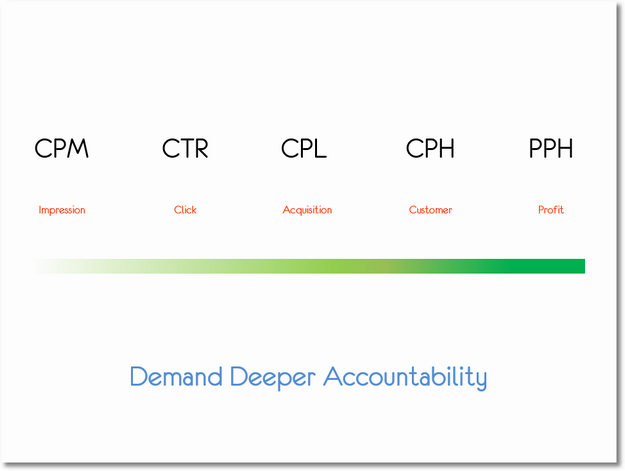
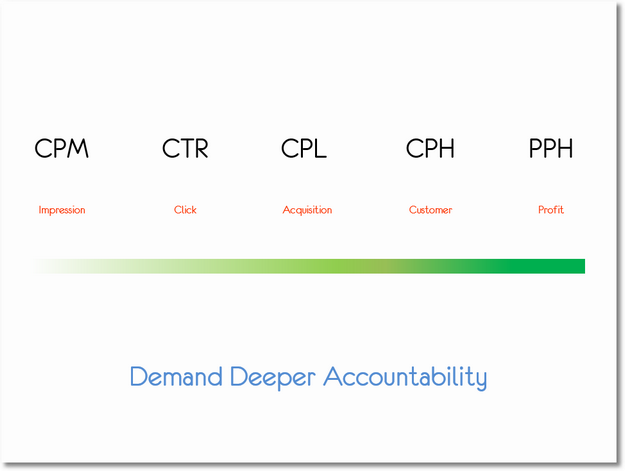
I tried to incorporate their reality, and my picture starts with the metric they used to measure success and quickly moves to the right to metrics I believe are more impactful to the one on the very right that is an impossible dream at the moment (the north star).

Here are the definitions…

Cost Per Impression. An almost, if not entirely, useless metric no matter where it is applied. No one should use this for anything ever. World peace will be hastened by a millennia.

Click-Thru Rate. A little more interesting. Helps shine a light on the ability to do clever targeting, the content in the messages/ads, and smartness in bidding strategies. Good tactical wholesomeness.

Cost Per Lead. An outcome! Yes. In this case this was technically a micro-outcome in this case (conversion is offline). Still, very nice.

Cost Per Human. See the pivot? Per Human. In my definition, this is also online to offline, offline to online or whatever the heck to whatever the heck. It is very hard to do, you have to solve so many tough problems. It also has massively delicious implications in your data, acquisition and retention strategies (ignoring the sweet, heavenly, implications on your customers).

I realize that between CPL and CPH you go from crawling to flying. But, that is what north stars are all about.

Profit Per Human. What every company and non-profit really, really, really need. Why care about something as lame as cost? The only thing that matters is profit. Per. Human.

[Bonus: Remember, you can measure profit everyday in Google Analytics!]

An incredibly complex story, with implications up and down the organization, with smarter tactical and strategic choices, and a long-term hard problem to solve, all wrapped into one simple slide. When you communicate, that is all you need, after all you are the story and not the thing on the screen.

I of course built the story out piece-by-piece, when I was done, this is how it looked…
metrics-incentives-accountability

Imagine for a moment the behavior of your Acquisition team (call it Sales, call it Marketing, call it Tony), if you measure them based on CPM or CPL. Each incentivizes such a different behavior, right?

Applying it to digital advertising…

Shove ads up people’s faces like crazy, who cares if there are 300 words of content surrounded by 18 ads? CPM baby! These Marketers write articles and give conference keynotes that obsess about “viewable above-the-fold ads.” A heartbreaking obsession, but remember it is what they are being incentivized to care about.

Or, worry a ton about the three ad levers you can pull, Content, Targeting, Bids, to ensure you are optimizing for the max leads you can get. Will this marketer give two hoots about “viewable above-the-fold ads”? Only to the extent that their three levers might be influencing less clicks. Instead, they shift that problem to the ad-network (yes!). Let them ensure the ads are showing up in non-crappy-more-relevant sites/apps where the Content and Targeting results in a click to a lead. Good behavior shift.

Extend the above incentive purification and imagine the day-to-day behavior of your Acquisition team if you measure them based on CPH. Or… PPH. See, how dramatically different their execution strategy, their obsessions will be?

Can you imagine why I say team and organization and online-offline silos will be broken as you go further to the right? No one person can succeed without active collaboration, and empathy, with rest of the teams!

That's what you want for yourself or teams that you lead. PPH.

One more thing.

Taking this out of the confines that define the reality of the client, you know that I don’t obsess about Cost this much. It tends to have other unintended consequences (especially lower down in organizations).

Hence.. Here’s an important switch to one of the five metrics to better reflect my worldview…

metrics-incentives-better-accountability

Revenue Per Human.

Subtle change. But, you want people to obsess about Revenue and not Cost. Else people do frustratingly short-sighted things. This is real, from last week: "Our 2017 goal is to reduce the cost of your display campaigns by 20%."

I wanted to die.

Who gives a small kiwi if costs are down by 20% or up by 40%? Are you making more money every day? Are you taking advantage of the complete opportunity to win in the market? Is your competition stealing share by the bucket load while you obsess about cost?

If 10xing your revenue requires that you quadruple your costs, what's the problem?

Remember, we still have PPH to ensure that the revenue we are driving is driving a positive influence on the bottom-line of the company.

Yet, most senior executives in the world incentivize their organizations to solve for cost. Then, they are surprised that they are losing market share or a new competitor crushes them. Hey, costs are lower this year! #winning #not 

But wait, there’s more!

Since I’m now solving for all of you, one more critical evolution to bring this baby home.

If you have read anything I've ever written, you know that I obsess about ensuring every view I have, every portfolio of segments I have, every dashboard I create, every incentive-structure conversation I lead, every business strategy I help craft has to have the three elements that form an end-to-end view: Acquisition, Behavior, Outcomes.

In the picture above, you'll notice I have Acquisition metrics, Outcome metrics, but no behavior metrics.

Not nice. Let's fix that.

There are many candidates, I wanted to have something that _flows_ with the story I was trying to tell… Something that would still incentivize optimal behavior… Something a little unorthodox to push your thinking… Here's my recommendation…

metrics-incentives-best-accountability

Cost Per (unique) Page View.

I said orthodox, did I not. :)

Measure what it cost you to drive every page view (unique). It gives you a sense for content consumption. It will include all the bounced sessions (pain). It will get you to dive deeper into what site/app sections people visit, what they are not reading, what they do read, how many unique page views does it take to get a Lead, what about freshness of content, anything about layout and experimentation, so on and so forth.

Not quite perfect, but an unorthodox start to demonstrate the creativity you can bring to this.

Regardless of the version of the story you use, it is important to create an end-to-end picture for your own company, your own work.

You will matter more to your company as you personally shoot for the right side of the picture. It will be simply because you are solving for a KPI that actually matters when it comes to the fundamental existence of your company.

Got PPH?

Inspiration: The Identity Spectrum, Ideal Solution.

So much of my solution for your huge success (imagine that being said as: yuge success ;) is dependent on identity. That last bit I added above, Human, has meant many different things over the evolution of the web. There are so many different identity mechanisms out there.

To help you traverse through them, and to get you to Human as in an individual warm body, here’s the identity spectrum we have access to today…

Cookies 3rd.

Most advertising networks use third-party cookies (cookies they set inside mobile and desktop browsers on your behalf – but not as you). These cookies tend to be fragile as they are not accepted in many browsers and are more often deleted – by choice or default. In the past they were roughly equivalent to a person as we all had one computer with one browser. They are not the most primitive form of any measurement (though if you only rely on your ad-network for success metrics of any type then you don’t have a choice, you are stuck with this fragile thing, and I offer a heartfelt sorry that your world is sad).

Here’s one metric you might have heard of that relies on 3rd party cookies: View-Thru Conversions. (Cue sad music.)

What can yo do with third-party cookies? Hold yourself, your ad networks, accountable in a narrow silo.

Cookies 1st.

These are set by existences you own. You’ll recognize these most commonly as being set by Adobe or Google Analytics on your site to better track metrics like Sessions and Users. They tend to be a lot less fragile because most personalization and authorizations except this capability. There is still a decay, if you want to get a sense for it checkout the Recency reports in your analytics tool. They are terrible at identity now as we all use multiple browsers on the same machine, and of course we use laptops, desktops, tablets, and phones (sometimes all at the same time with the same digital company!). It is imperative that you get off it as soon as you can.

Pretty much every metric in your Google Analytics reports uses first-party cookies as the identity mechanism. Conversion Rate. Bounce Rate. Visits to Purchase. Pageviews Per User.

What can you do with first-party cookies? Create better experiences in individual browser (as in Chrome) silos. Leverage advertising solutions like RLSA.

Login-ID 1st.

I’m a paying subscriber to my beloved New Yorker magazine. I’m logged into it’s site on my desktop, laptop, tablet, and phone. I’m logged into the browsers and the mobile application. This empowers the people at Condé Nast to dump cookies and use any digital analytics platform to rely on my login-id as identity to stitch my experiences and truly understand my Acquisition, Behavior and Outcome touch-points.

Login-ID is not fragile (for me the site/apps won’t even work without it). For The New Yorker they can easily tie to my name, address, credit card and a more. I know Condé Nast does not  leverage any of this because none of their platforms show any level of personalization, none of their offers for upping the subscription, none of their ads I see anywhere around the web, etc. show any intelligence related to me as a person. Sad. But. At least the possibility exists, and hope that Condé Nast will wakeup one day to the deeper loyalty and delight they could create using this identity.

For most of you, Login-ID might just be an account someone created on the web or a email address that someone used to sign up for your mailing list. In these cases of Login-ID you don’t have the tie to a human like above, but it is still better than cookies! Switch to 1. using an identity system that relies on Login-ID and 2. create meaningful incentives for people to login to their account.

Cookies as an identity are now only for those who don’t care about their digital business. Login-ID (the New Yorker variety or the signed up for an account) should be default.

For the most glamorous amongst you (I of course mean all of you!), you can stitch the third-party and first-party cookies littered around for your individual Login-IDs and paint an even more robust picture. I recommend this not as the default (because it is a lot of work), but rather as something you can do when *all* other business problems have been solved.

[Bonus: Here’s how to use Universal Analytics to implement Login-ID identity on your digital existences.]

What can you do with Login-ID identity? See above New Yorker example. Summary:  Personalized experiences via intent inferred from expressed behavior. Smarter Search, Display. More interesting understanding of Profitability (it will blow what you do with default first-party cookies with Adobe/Analytics out of the water on day one!).

Login-ID 3rd.

For people who can’t do above sometimes tend to rent an identity system from a third-party. This would be you implementing the Facebook identity system on your site, or one from Google or someone else who currently has most of the internet as it’s User.

So, people can log into your website using the Facebook identity system. With it comes the reduction of the pain of getting people to signup, and also additional behavioral data that the identity platform (say Facebook) would like to share. With it also come limitations related to how much of the customer data and relationship with the customer you own, as well as how much of this can you tie to your online, offline systems.

If you simply can’t do Login-ID on your own for any reason, this is a compromise is less worse than simply relying on cookies.

identity_landscape_occams_razor

Nonline Customer-ID.

An improved variation of Login-ID 1st strategy. Most companies (think any retailer for example) still operate their identities in a silo. There is one for online (the one above), there will be another when you call on the phone (it might be your registered phone number), there will be a different one for when you walk into the store, and depending on if they own the store or if it is a channel for them, there might be one more.

Nonline Customer-ID is an identity platform that allows you to tie all of the above experiences down to one.

It could very well be my phone number. If I’m on your website, mobile app, call your phone center, walk into your store, or anything else, you use my phone number to know it is an individual. In this case, you come very, very close to Human.

Soon it could also be a BLE device implanted in my body that, in close quarters only, allows you to identify me when I am on your site (using a reader on my laptop), in your app (reader on the phone), in your store (readers in your ceilings) and so on and so forth.

It could be other things. I’m not opining on the pros and cons of doing this, I’m leaving out how you feel about this. That is for governments, companies and you to decide.

What can you do with Nonline Customer-ID identity? The ultimate deep level of understanding of customer behavior (as in customer), effectiveness of your marketing and service strategies, profitability, and everything else. If you want to imagine how insightful this can be, close your eyes, think of your business, imagine you have a Nonline Customer-ID platform, think of your current marketing data-driven attribution report. You realize how much this current holy grail sucks, right? That’s what I mean. Times 1000.

Nonline Customer-Id is an identity system will finally allow you to behave as one company and understand one person. B2B. B2C. A2P. DJT.

Nonline Customer-Name-ID.

This won’t apply to all companies, but as I’m deeply passionate about delighting every single individual human I wanted to share this purer version of Nonline Customer-ID.

Let’s take the most famous example: Amazon.

Today, Amazon is as close to Nonline Customer-ID as an identity system as you can get. Every touch point from site experience to mobile app to chat to phone (yes, they have that!) etc. play off the same identity.

But, in my family, like perhaps yours, my spouse and I both use the same identity (and both buy and ship things under my name to our home).

Amazon does not understand us individually though. From the recommendations it gives us to greeting her with my name everywhere, it is stuck with just Nonline Customer-ID identity.

But. Amazon has cookies. It has access to device-ids for mobile. It has access to pages viewed. It has access to products shopped from various browser IDs. And more.

They can easily use two or more of those to assign a Nonline Customer-Name-ID to my wife and to me. In one amazing instant, it would understand us individually and be able uniquely deliver deeper personalization, offers, support, and more.

It won’t be perfect. Perhaps it is off by 5%. But, it would be exponentially better than what exists today (which honestly is already better than 90% of the companies on the planet). And, Amazon needs it’s customers to do nothing new.

Additionally, Amazon could understand Home and understand Avinash and Jennie. Imagine all the possibilities that that unlocks.

What can Nonline Customer-Name-ID do for you? Cross-device intent customized smarter experiences that power relationships and not just shopping. Nirvana.

Now you know what it takes to truly get to Human. To real PPH. The only metric that matters (even for a non-profit). And, we’re not just talking about digital.

Got Human?

As always, it is your turn now.

Considering our metrics incentive spectrum pictures above, where is your company in terms of incentives for it’s employees? Are your little team, or your giant division, solving for the global maxima? If you are a leader, what incentives have you created for people who work for you? What element represents your company’s current identity system? What roadblocks do you see in front of you to get to Nonline Customer-Name-ID?

Please share your ideas, struggles, criticism of my ideas, worries and joy via comments below. I’ll be most grateful for the conversation.

Thank you.

Cookies To Humans: Implications Of Identity Systems On Incentives! is a post from: Occam's Razor by Avinash Kaushik


from
http://feedproxy.google.com/~r/OccamsRazorByAvinash/~3/NguzYAUhHhE/