Friday, 9 June 2017

Doors Are Open for Certification (and Other Fun Things)

Doors Are Open for Certification (and Other Fun Things)

Remember all the conversations we’ve been having about the Certified Content Marketer program?

Well, the doors are open — and they’re going to be closing again on Monday, June 12. If you’d like to be featured on our list of recommended writers (and get our most advanced content strategy course), this is how you do it.

You can sign up (or learn more) at the link below — and of course, our usual no-hassle 30-day money-back guarantee applies if it’s not a perfect fit for you.

Program Details for Copyblogger’s Content Marketer Certification

Note: If you’re a member of our Authority community, make sure you’re signed in when you click the link — as an Authority member, you get special pricing. :-)

On Monday, I shared our June content and productivity prompts. Each month this year, we’re focusing on two prompts as a community, improving our creative output and our ability to get stuff done.

This month we’re practicing outreach (finding new contacts, clients, or customers) and getting the help of an imaginary friend when it’s time to do the hard stuff.

On Tuesday, Stefanie offered three hands-on ways to improve your content at the most fundamental level. Inconceivable.

And on Wednesday, I gave a quick back-of-the-envelope explanation of what the Certification program is and who it’s for. If you’re commitment-phobic, you can read that before you go to the page with all the details.

On Copyblogger FM, I shared Brian Clark’s four-step process for developing a compelling marketing idea. Because inspiration is fantastic … but even the most inspired idea can be shaped into something better.

That’s it for this week — have a great weekend! And remember — if you want to join our list of recommended writers, Certification closes on Monday.

— Sonia Simone
Chief Content Officer, Rainmaker Digital

Catch up on this week’s content


2017 Content Excellence Challenge: The June Prompts2017 Content Excellence Challenge: The June Prompts

by Sonia Simone


how do you determine if you’ve written a strong sentence or a weak sentence?3 Advanced Ways to Craft Better Sentences

by Stefanie Flaxman


Apply to join Copyblogger’s list of recommended writersWriters: Doors Are Open for the Copyblogger Certification Program (through Monday, June 12)

by Sonia Simone


How to Develop a Compelling Marketing Idea in 4 StepsHow to Develop a Compelling Marketing Idea in 4 Steps

by Sonia Simone


How Award-Winning Author & Educator K.M. Weiland Writes: Part TwoHow Award-Winning Author & Educator K.M. Weiland Writes: Part Two

by Kelton Reid


The post Doors Are Open for Certification (and Other Fun Things) appeared first on Copyblogger.


from
http://www.copyblogger.com/copyblogger-weekly-36/

Wednesday, 7 June 2017

Writers: Doors Are Open for the Copyblogger Certification Program (through Monday, June 12)

"Apply to join Copyblogger's list of recommended writers." – Sonia Simone, Chief Content Officer

You may have noticed that we’ve been talking up our Certified Content Marketer program lately. We’ve already had some amazing folks join us and get started … but we still have room for you.

Click here to get all of the details.

Here’s the two-minute run-down:

Who it’s for

Strong writers who want to make more money and find better clients.

What it will do for you

  • Teach you solid content strategy, so you can get better results for your clients
  • Give you tools to improve your professionalism with clients, so you look better and do a better job
  • Get featured (if your application passes review) on Copyblogger’s list of recommended writers

What you should do next

Go check out the program details. We have no plans to open the program again in 2017, so if you want in, don’t wait. We’ll close the doors on Monday, June 12 so we can keep our focus on delivering an excellent experience to our students.

If you really want to join us but you worry it might not be what you need — don’t stress. We offer a 30-day money-back guarantee — no questions, no hassles. If you get into the program and realize it’s not a good fit, just let us know in those first 30 days and we’ll part as friends.

Click this link for all of the program details — and I’ll look forward to seeing you there. :)

P.S.

If you’re a member of our Authority community, make sure you’re signed in when you click the link — as an Authority member, you get special pricing. :)

The post Writers: Doors Are Open for the Copyblogger Certification Program (through Monday, June 12) appeared first on Copyblogger.


from
http://www.copyblogger.com/content-marketer-certification/

Stop All Social Media Activity (Organic) | Solve For A Profitable Reality

Life is short.

It is time to point out an ugly truth, and to be the brave person that you are, the intelligent rational assessor of reality that you are, and kill all the organic social media activity by your company.

All of it.

Seems radical, but let’s take it one step at a time.

To give you a sense of the depth and breadth of ideas I’ll cover today, here are the sections in this post:

I urge you to have an open mind. My plan is to challenge your critical thinking skills, and share lessons that will apply broadly across the professional effort you put day in and day out. Most of all, I’m excited to frame an important problem, and present solutions that will transform an important part of your marketing strategy.

Let’s go!

The Promise of Marketing Utopia. 

I hate pimping (what marketing has come to be). I adore building meaningful relationships – the kind of long-term connections where a brand truly gives a f about their customers, and gives something of value in exchange for their attention. I LOVE brands that can pull this off, and support them with my un-asked-for evangelism and precious $$$s.

Hence, you can imagine how gosh darn excited I was at the advent of Facebook and Twitter (first real social networks). There were a billion people there, spending a meaningful amount of time on these wonderful platforms. Excitedly, brands could have a presence (a "page") where they could contribute meaningful updates (info-snacks) in order to be a part of the organic conversations people were already having by the tens of millions.

Daily meaningful brand connections would be converted into brand familiarity, shifts in brand perception, feeding brand loyalty. #orgasmic

If you were a travel company, meaningful would now translate into helping feed wanderlust. The company could contribute info-snacks about where people should go, exposing the coolest places in the world, helping people travel better via tips, pictures, videos… you know… communicating travel love. The one thing a travel company would have in common with travel customers. The most imaginative travel marketers could even extend this opportunity to helping connect the purpose of their existence, selling tickets and hotel rooms, to helping people create moments of happy by crafting day/s of escape from the rough and tumble of life.

Glorious, right? If you work at Expedia or Cathay Pacific, does that not make you want to come to work and, for at least a part of your employment, create meaning? How rare is that!

If you were Cisco, meaningful would mean sharing info-snacks whose entire purpose could be to get Engineers promoted. Share tips, ideas, schematics, usage shortcuts, creative implementations, solutions to top problems that hold Engineers back… you know… understanding your audience deeply and give them something of value in exchange for their attention. The most imaginative B2B marketers could even figure out how to be a part of solving some of the deepest entrenched problems in the industry (STEM education, equal opportunity, + +) and in turn add an entire value-system to their brands.

Amazing, right?

Marketing based on something real, rather than a coupon or company brochure.

The Broken Promise of Marketing Utopia, Implications. 

None of the above transpired on Social platforms.

Businesses of all types, including Google (SMB, Main), got on amazing platforms like Facebook (and Weibo, Instagram, Pintrest etc.) and started pimping. All that their collective imagination could manifest in a Utopia-possible environment was: LOOK ME I AM SO PRETTY!! BUY NOW!!!

Stuff that is a turn off.

Consider the Google’s first FB page above, it is a complete disaster with not a single post in the last six months being of even five seconds of value to any small business. That page, or the main one, is not an overt Buy Now, but if you think critically like the tough Marketer I want you to be you’ll have a hard time finding a single post that’s solving for Google’s human customers. Almost every single one is pimping Google (or pimping random research Google has commissioned – to pimp Google!). The non-value is so transparent, yet they post every single day something that basically is solving for Google (although only God knows what that is). If someone bothers to interact with the post, the posted comment is a spam or totally useless. Yet. They keep posting. Polluting utopia.

Google is not unique in not understanding the promise, checkout your company’s FB page.

This strategy by businesses lead to what I now call the Zuck Death Spiral. ZDS.

Real humans on Social platforms quickly got turned off by these low-grade Social contributions/posts by companies. That meant humans (us!) refused to engage with them. This was noticed by Team Zuck, who started to slowly turn down the presence of company posts in User feeds. This lead to less Reach for brands. Which in turn lead to even fewer customer interactions for content posted by brands. Which was duly noted once more by Team Zuck. Which… you know where this is going, tightened the screws on organic Reach even more. And, here we are in a barren desert for brands on FB.

Most brands get less than 1% Reach via their organic contributions on social platforms. And, less than 1% engagement of any kind from that less than 1% reached (identified using the best social media metrics: Conversation Rate, Amplification Rate, Applause Rate).

ZDS is solving for FB, as FB should, and it is an attempt to solve for FB’s users.

So… If all you can do is overtly or covertly pimp… And, pimping is not cheap (that Google page, and your company’s page, has pictures, videos, an agency deployed, internal company employees with a “social media execution checklist”, senior leadership time committed, and more)… And, all it does is get you 1% Reach, max, with almost no engagement… Why do you still have an active (organic) social media effort?

Why is this reality not smacking some sense into your marketing strategy?

The Broken Promise of Marketing Utopia: Examples. 

Is it difficult to check if your brand is caught up in the Zuck Death Spiral? No.

Do you have access to any data to measure how deeply non-impactful your organic Social Media efforts are? OMG, yes.

Everything you need, data and information, to do an audit is public.

All you have to do is visit your company’s Facebook page (or Instagram, LinkedIn, Pinterest, etc. presence).

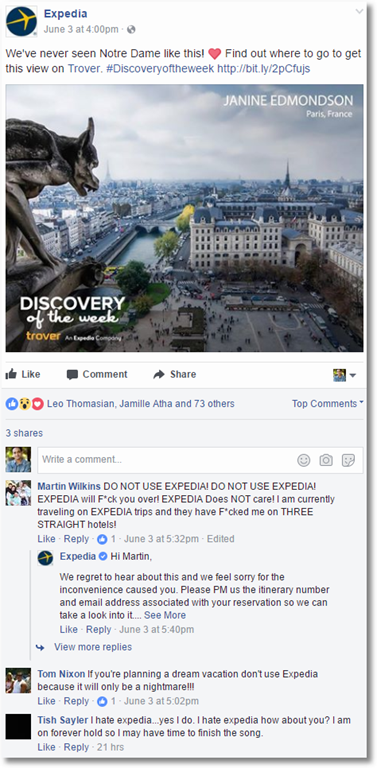
Let me show you what to look for. Let’s start with Expedia. They have 6.4 million Likes as of today. Go look at any post on the page if you are an Expedia employee.

expedia_facebook

First thing you’ll look at is the Applause Rate (likes, other emotions, you’ll see it right under the photo). That number is 75. Divide that by 6,462,977 (potential audience size today).

0.00113%. That’s a painful stab in your heart.

Next Conversation Rate (comments, you’ll see a total at the end of your posts). 7. Divide that by 6,462,977. A sad 0.00011%.

Finally, my favorite sign that you truly added value to a human rather than pimp, Amplification Rate (shares). 3/6,462,977. At this point you are weeping with me: 0.00005%.

To give you some context as to how insanely lame these numbers are, Expedia.com received 59,400,000 Visits in May 2017. This post accomplished 75+7+3. More people walk into the Expedia lobby in Bellevue, WA, every second of every minute.

You might be screaming that is not fair Avinash, the Zuck Death Spiral ensures that a tiny fraction of 6,462,977 are seeing Expedia’s posts! Very fair point. But, is the Social Media Budget at Expedia not justified based on the potential from 6,462,977? Would Expedia commit it’s multi-million-dollar budget to Social Media based on the potential to engage 75+7+3 people on Planet Earth?

One final point. Brand destruction.

Pretty much every single comment on pretty much every single Expedia post is a complaint about how horrible Expedia is (from personal experience I know this is not true). If your Facebook presence is solely to inspire people (see Trish Sayler above) to create clever rhymes about how bad you are… Why are you on Social Media?

Ignore the active smearing of the Expedia brand, let’s go back to data: Is it worth have 75 | 7 | 3 as the value delivered from an organic Social Media strategy for a company with 54,900,000 Visits?

My answer is an emphatic no. Expedia should immediately cease 100% of its organic Social activity.

1/100th of the Social Media budget could be spent on any other random digital strategy to get 75+7+3, and have zero brand destruction!

Oh. And while I’m focusing on Facebook for the sake of simplicity, everything in this post applies to all other Social Media channels. The Utopia failures. The lack of imagination. The small numbers. The uselessness.

Here for example is a post on Twitter by Expedia:
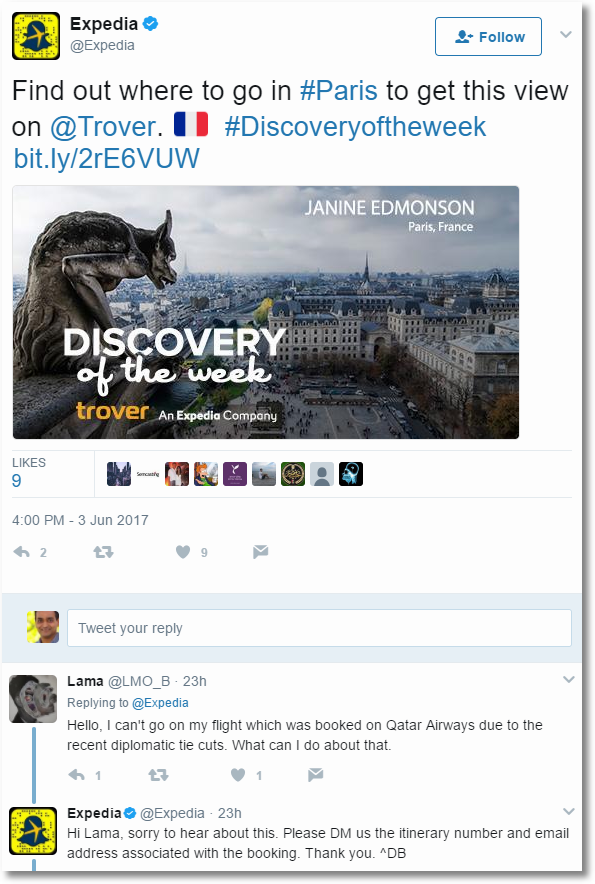
expedia_twitter

The numbers: 9 | 2 | 2. Divided by 391,000 (followers).

You can do the math and assess dent in the universe this content contribution from Expedia is making.

Almost nothing. Technically, perhaps less than nothing.

I hate making recommendations based on outliers, please know that Expedia is the norm. Hence, the title of this blog post.

Here’s a B2B example, a company I think well of… Cisco.
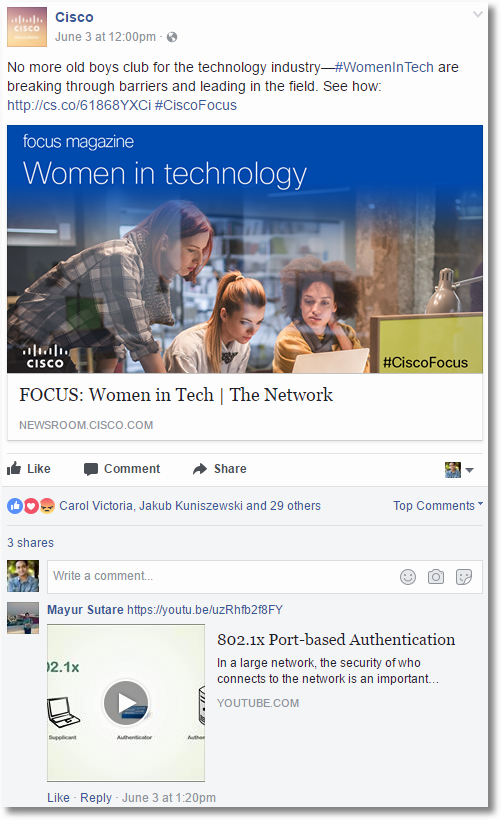
cisco_facebook

Go through the same analysis.

Your numbers are 31 | 1 | 3. Divided by 845,921.

Would you spend a single hard-earned Cisco router and switches dollar to get this as the return from a multi-million dollar Social Media budget?

Like my company, your company, and Expedia, Cisco gets no value from their organic Social Media efforts. Technically, Cisco is getting negative returns once you account for the people, process, tools, agency, leadership investments.

Let’s switch gears and look at a B2C company with a massively positive opportunity to leverage the word Social in every way on these platforms… Chick-fil-A.

chick-fil-a_facebook

Better numbers, as you might expect.

1k | 89 | 73. Divided by 7,775,155.

Consider it. Chick-fil-A could buy the most remnant TV inventory on a channel least watched by humans during the middle of the night and get better Reach. And they can also measure how many of them walked into a Chick-fil-A in the next 12 hours.

Does the above number justify custom videos, images, active posting by Click-fil-A on Facebook?

One final example to bring this home.

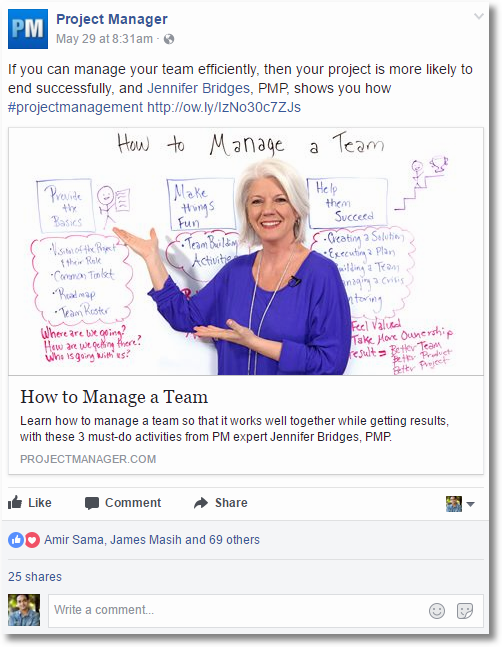
ProjectManager.com is a lovely tool. It is wonderful that they use folks like Jennifer Bridges, Susanne Madsen and others to create very helpful Project Management videos on YouTube. It seems they are a medium-sized business.

Here’s their Facebook page:

project_manager_facebook

69 | 0 | 25. Divided by 62,951.

Pound for pound, better performance than all three (four including Google) companies above. Shame on them.

Still. Are the resulting Applause Rate, Conversation Rate and Amplification Rate enough for a smaller business to use it’s precious marketing dollars on this Social Media strategy/impact?

Consider this as well for all brands… There is no native discovery model on these Social channels. Your content will live for 20 minutes and then it is dead. Not just because of ZDS, but also because there is no Search behavior by users or a method that would deliver Serendipitous Discovery of content you post.

Unlike say on YouTube, or your Blog, where your Subscribers will see the content right away, and then through Bing and Yandex and YouTube itself people will find your content when relevant and keep viewing it. Your content there has a live beyond 20 minutes.

Win Big: Stop Posting Content for Organic Reach On Social Channels. 

Given the numbers above, and be sure to check any other Social Media channel your company is actively investing in, I hope you have the input you need to apply your critical thinking skills.

Let me give you one final push: You have better alternatives to drive short and long-term Profitability for your company (rather than investing in organic Social Media).

Here’s an example.

I write an insightful newsletter with the singular aim of improving your salary. The Marketing < > Analytics Intersect. You should sign up. It is a companion to this blog, I write once a week there and once a month here.

One year into it’s existence, TMAI has 21,246 Subscribers.

Measuring Open Rates for email is difficult (the tiny pixel ESPs use to track opens are not executed by default for most email programs). Even with that flaw in reporting, TMAI has Open Rates of around 9,000 (9,895 precisely for the last one).  Around 1,000 people (912 for the last one) take an action that is of value to me.

A random person, me, can get 9,000 opens of my content, at least a thousand active engagements with my brand whenever I want. I have over 1,000,000 Social Media followers across the five platforms (Twitter, Facebook, LinkedIn, Google+, Instagram). I can’t even get 1/100th the impact.

My simple unsexy email newsletter strategy crushes the on paper potential of one million Social Media followers.

And, beyond the impact… I also directly own the relationships with my 21,246 Subscribers, I own the data, the relationship exists on my platform, and I can use it as creatively I want to use it with no limitation on type of content (text or video or dancing penguin gifs).

Why should your company be on Social Media 5x per day to get a lousy 20 interactions with your brand? How is that acceptable ROI from your investment in a 5 person Social Media team, a Social Media Agency, a Social Media analytics tool, a Social Media auto-posting tool and more?

Could you not get 100x ROI from the 0.25 person that's running your email newsletter?

Could you not just take all that Team, Agency, Tool, money, throw it into AdWords or AOL Display Ads and not get massively higher ROI, of any kind, in 10 minutes?

Could you not get better ROI taking all that money and buying remnant inventory on your local Television channel?

Could you not get better ROI if you just took that money and bought free lunch for the employees in your building every other day?

OMG, you most definitely can.

So. Why are you on Social Media?

Is it fun to shout in a vacuum?

Why does it not feel dirty to go waste your shareholder's money?

Stop it then.

Welcome to the world of higher standards for impact delivered. Feel cleaner and prouder coming to work every day as a Marketer/CMO.

Is the Huge Audience on Social Media Platforms Completely Useless? 

NO!

There are a couple of billion people on Facebook (and billions or hundreds of millions on other Social channels). From an advertising perspective, that’s still an audience that might be of value to your business.

Kill your organic Social strategy completely, switch to a paid Social Media strategy.

Buy advertising from Facebook. I’ll make it easy, click this link!

Buy advertising from Twitter. From Snapchat. LinkedIn. Oh and WeChat and Line.

This simple switch from the fuzzy Organic goals to concrete Paid goals will give the one thing your Social Media Marketing strategy was missing: Purpose.

It is now easy to define why the heck are you spending money on Social Media? To drive short and medium-term brand and performance outcomes.

Fabulous.

Set aside the useless metrics like Impressions and 3-second Video Views. Set aside hard to judge and equally useless Like and Follow counts. Measure the hard stuff that you can show a direct line to company profit.

Define a purpose for the money you are spending.

For the clients I’ve worked with across the world, expressed behavior of the users suggests that the largest cluster of intent is See. There is a little bit of Think and a little bit of Care. (This is why Social marketing strategies that target Do intent yield extremely poor results.)

[Bonus Read: See-Think-Do-Care Business Framework]

If the purpose is to execute See and Care intent marketing strategies (in the old world sometimes incompletely referred to as brand marketing), you can use the following amongst my favorite metrics to deliver accountability:

1. Unaided Brand Recall
2. Likelihood to Recommend
3. Lift in Purchase Intent
4. Shift in Brand Perception (negative to neutral, neutral to positive, positive to proactive evangelism)
5. Lifetime Value

Humans have measured these using primary and secondary research methods for 3,500 years. Quite easy to do the same for your newly focused paid Social advertising efforts.

[Bonus Read: Brand Measurement: Analytics & Metrics for Branding Campaigns]

If on the other hand the purpose of your paid Social advertising is to target Think and/or Do intent, you should measure the impact using the following across your digital – and pan-digital presence:

1. Recency & Frequency
2. Loyalty
3. Task Completion Rate
4. Assisted Conversions
5. Macro-Outcomes Rate
6. Economic Value

We have measured these for a long time on the web. You can use your quantitative tools to measure most of these (Google Analytics, Adobe, True Social Metrics). And. You can measure these for your ecommerce, non-ecommerce, B2B, B2C, pure content, non-profit, or whatever else kind of delicious business you are running.

Now, you’ll hold your agency and employees accountable for delivering business profitability for your Social efforts just as you do for any other advertising effort – Search or TV or Email.

Just as you would do in all those other cases, do more paid Social advertising if the metrics show a business impact and improve/eliminate your paid Social efforts if they don’t.

It will mean a different Social content strategy, different targeting strategy (leveraging rich Social signals), and a different landing page/app strategy. Proper end-to-end user and business optimization. Nirvana, delivered by that magical word… Purpose.

The path to your salary and job promotion is also now crystal-clear. Right?

Is the Idea of Marketing Utopia Permanently Dead? 

I’ve seen the near-future, and I believe we’ll get to Utopia Marketing.

The fact that companies don’t know how to be human, how to take even 20% of their people plus budget and invest optimally in understanding humans and deliver something of value to those humans is deeply heartbreaking.

Yes, I can blame the short-term quarterly focus of the CMOs and the SELL, SELL, SELL MORE incentives they create for you to earn your bonus. But still, how heartbreaking is it that not even 1% of us could convince our CMOs to allow us to do what Social was actually good at? How sad is it that we have such little influence? I blame us.

Still. I am optimistic that Marketing Utopia, as I’ve imagined it at the top of this post, is not dead. I think the solution will be to get rid of the humans from the process!

What? Human marketing by getting rid of humans?

Yes. Hear me out.

I think AI/Machine Learning will solve this problem.

Today, humans and their limited ability to process data, and the finite incentives in place, are the reason we burned Utopia to the ground. We simply can’t process billions of signals across tens of millions of touch points across millions of people, and figure out the best message at every moment and its short, medium, and long-term business value.

Current advances in ML already give me hope that algorithms will understand intent a billion trillion times better than your current employees AND these algorithms will have the inherent capabilities to process billions of data points to truly understand complex patterns of user behavior and a robust understanding across all that to know exactly what delivers business profit.

Companies can then take the equivalent of their Brand and Social budgets and allow smarter algorithms to deliver the right message to the right person at the right time across all clusters of intent. All the while, optimizing for long-term business profitability.

It will help that Machine Learning is not embolden to trivial company politics. :)

[Bonus Read: Artificial Intelligence: Implications On Marketing, Analytics, And You]

Bottom-line.

While I’m recommending you stop doing something, hearing no is not super-inspiring, I hope you’ll see that my goal is help you think more critically about where you spend your personal time and your company’s money.

I also hope you’ll see how the shift in strategy I’m recommending brings Social in line with your other advertising efforts, allowing for a ton more focus on your Social efforts and a billion times more accountability.

Finally, I hope you feel optimistic that around the horizon lurk technological solutions that will allow for the manifestation of the beautiful humanity that exists in your company (even if we have to take human employees out of the equation to get there – don’t worry, they’ll still, for now, be responsible for the novel elements required).

Demand more from Social, because Social can deliver more.

As always, it is your turn now.

If you’ve achieved sustained success from your organic Social Media content strategy, would you please share your example? If you disagree and believe Marketers should invest in organic Social despite poor Reach, ApR, CoR, and AmR, would you please share how you see value/impact? If you’ve successfully dumped organic and pivoted to paid Social, please share stories of your victory. Are you as optimistic as I am that Machine Learning based intelligence will solve optimally for the Utopia opportunity?

I look forward to hearing your smart perspectives and cogent challenges.

Thank you.

Stop All Social Media Activity (Organic) | Solve For A Profitable Reality is a post from: Occam's Razor by Avinash Kaushik


from
https://www.kaushik.net/avinash/stop-organic-social-media-marketing-solve-for-profit/
3 Advanced Ways to Craft Better Sentences

"How do you determine if you've written a strong sentence or a weak sentence?" – Stefanie Flaxman

While the goal of “improving your content writing” may seem complex, it’s not necessarily more complicated than improving each sentence you write.

Better sentences add up to better content.

So, let’s break down content writing into sentence writing.

I’m not about to show you how to write a “perfect” sentence. Instead, these three tips will help you remember that every sentence you write is an opportunity to practice.

And during your writing practice, you can implement smart changes that keep your reader focused on your message.

1. No sentence is an island

Even if you’re examining just one individual sentence, it’s helpful to review the sentences that surround it.

There are two main reasons why:

  1. You may have overused a word. Sometimes you’ll intentionally repeat a word for emphasis or because it fits the rhythm of your writing. But we often overuse words without meaning to. When you review your writing, vary your word choice to create a more stimulating reading experience.
  2. You may have belabored a point. Give each sentence you write a specific purpose. If you communicate the exact same idea in two different sentences, it’s probably wise to delete one.

When you look at the broader context of your writing while aiming to improve one sentence, you kick off a sort of domino effect. Noticing one weakness helps you correct other weaker sections.

2. Writing skin needs exfoliation

The most “advanced” skill you can learn is to examine your own writing with a critical eye.

A critical eye doesn’t mean you’re so hard on yourself that you get discouraged. It just lets you swiftly identify areas of your sentences that either hinder comprehension or lack the details that magnetically hold attention.

I like the comparison to skin exfoliation because rough drafts, like dry skin, are … rough.

For example, you’re probably already familiar with the benefits of using active verbs instead of passive verbs.

Changing a sentence from “Joplin was devastated by the twister” to “The twister devastated Joplin” exfoliates the sentence to make it smoother.

Removing extra words is another form of exfoliation.

Here’s an example from my recent article on finding more loyal readers. I’ve bolded the extra words in the draft of this paragraph.

Edith likes Frank’s article idea, but she needs to consult with him and educate him on the type of content that is the right fit for Cosmopolitan. She’ll give him their writer guidelines so he can use them to match the tone and style of his article to the publication’s specifications.

Here’s the published version of that paragraph.

Edith likes Frank’s article idea, but she needs to educate him on the type of content that is the right fit for Cosmopolitan. She’ll give him their writer guidelines so he can match the tone and style of his article to the publication’s specifications.

To give you one more example, in the draft of this article I wrote, “Here’s the final version of the paragraph that we published.” As you can see above, that sentence turned into, “Here’s the published version of that paragraph.”

Developing an eye for excess will sharpen your writing.

3. “You keep using that word. I do not think it means what you think it means.”

When I edit, I always have a browser tab with a Google search bar open.

Why?

Because I’m constantly looking up the meanings of words or idioms that I don’t consider straightforward — anything that sticks out and makes me question whether or not it is correct.

Even if I’m 95 percent certain, it’s always beneficial to verify that it’s the most appropriate word or phrase.

My Google search browser tab is also helpful for double-checking the spellings of proper names, places, products, and companies.

The bottom line here is valuing professional editorial standards that help guarantee accuracy. Take the time to ensure your readers effortlessly understand your content and aren’t distracted by a misspelling, or the incorrect use of a word or idiom.

Over to you …

How do you determine if you’ve written a strong sentence or a weak sentence?

What are your favorite ways to review your drafts?

Since it’s also content challenge week on Copyblogger, I challenge you to critically examine each sentence you write before you post your comment below.

The post 3 Advanced Ways to Craft Better Sentences appeared first on Copyblogger.


from
http://www.copyblogger.com/craft-better-sentences/

Monday, 5 June 2017

2017 Content Excellence Challenge: The June Prompts

2017 Content Excellence Challenge: June Prompts

There’s something about June … maybe that it’s the sixth month, so you have that reminder that the year is half over. Or maybe it’s the June sunshine (at least in my hemisphere) that makes you want to be ultra productive so you can sneak out for a before-dinner walk.

In any event, I’m feeling rather conquer-the-worldish at the moment, and I hope you are, too. To help with that, here are our community prompts for June.

Each month in 2017, we’re giving you a pair of prompts — one to make you more productive and one to improve your creativity or writing skills.

You can jump in anytime — and let us know about your experiences in the comments!

The June Productivity Prompt

Weekly outreach

Last week I wrote a post about the two ugly problems that plague freelancers, especially when they’re starting out: the lack of clients and the lack of good clients.

One solution to these terrible woes is to put a marketing system into place — a regular, consistent process you follow to find more of what you want.

This could apply to …

  • potential clients
  • potential customers
  • potential blog readers
  • potential podcast listeners

… you get the idea.

Your productivity prompt for this month is to decide on a day of the week and a time. Maybe it’s Thursdays at 10:00 a.m.

Then, every Thursday at 10:00 a.m., do one outreach task. You might use June to experiment with tasks and find one that works for you.

What’s an outreach task? It’s a repeatable process to find and connect with new people who don’t know you yet.

Some possibilities include:

  • Logging in to LinkedIn and connecting with potential customers
  • Setting up or tweaking a low-cost Facebook ad campaign that sends traffic to a strong content asset on your site
  • Cold-calling five good prospects (not a good fit for me, but it is for some — just be sure you do your homework first)
  • Reaching out to a solid web publisher to propose a guest post
  • Participating in an online group in your topic and making yourself useful (not spammy)

The point is to make a weekly habit of reaching out to find your audience, rather than creating content and hoping someone stumbles across it eventually.

I do have an ebook that could be helpful. It’s called Effective Content Promotion, and it’s free when you register for the MyCopyblogger library.

If you’re in our Authority or Certification communities, we’ve also been focusing on outreach (Beth Hayden did an amazing session with us in late May), and we have more workshops scheduled with techniques that will help you actively get out and grow your audience.

Outreach is often one of those tasks that lives outside our comfort zones, so it really helps to figure out precisely what you’re going to do, and then schedule a fixed time to do it at least once a week.

Here are some resources for the whole comfort zone thing:

And a shout-out to Mark Butler, the Budget Nerd, for his recent comments about outreach at a live event that sparked this prompt idea. :)

The June Creativity Prompt

Find your alter ego

We all have areas where we just don’t feel very strong. Like I mentioned above, cold-calling is one of mine. When I’ve needed to do it, I haven’t felt confident or capable — and it showed.

This month’s creativity prompt is to invent an alter ego who’s great at the thing you’re not good at.

You’re going to imagine this person as a character in a novel or a film. Know what they look like, how they talk, what they wear, where they live.

Then, when you’re doing the challenging activity, you’re going to write as that character.

You don’t have to be a fiction writer to pull this off. It’s much easier to do in writing than it is to try face to face or on the phone, although those are also options if you feel ready for Expert Mode.

  • Are you too timid when you discuss your services with a client? Write a pitch using the voice of an ultra confident alter ego.
  • Are you too blunt when you email colleagues? Write an email using the voice of a nurturing, benevolent earth mama.

You don’t have to share what you write — but you may well find that you want to. When it’s time to be tough, or patient, or steely, or suave, it’s handy to have a well-developed alter ego who can handle those states effortlessly.

Let us know how you’re doing with these!

What kinds of outreach have you found valuable? And what will be your day and time to schedule them this month?

What’s your alter ego amazing at?

Let us know in the comments! I’d love to hear more. :)

The post 2017 Content Excellence Challenge: The June Prompts appeared first on Copyblogger.

Related Stories


from
http://www.copyblogger.com/challenge-2017-06/

Friday, 2 June 2017

It’s ‘We Love the Writer’ Week on Copyblogger

It's 'We Love the Writer' Week on Copyblogger

Actually every week is “We love the writer” week on Copyblogger. :) But this one is special, because we’re about to open up the Certified Content Marketer program to a new group of students.

This is a program that turns talented writers into well-paid talented writers. The key pieces are a content marketing strategy course (Brian Clark and I teach that one together), ongoing education to make sure you stay on top of best practices, and — for those who pass the application process — inclusion on our page of recommended writers and content strategists.

If you’re a writer and you’d like more clients, better rates, and a stronger competitive position, the Certification program just might be perfect for you. You can drop your email address here and we’ll get you all the details very shortly.

On Tuesday, Jerod Morris talked about why smart writers think about writing copy and not just text. (This applies even for those who don’t think of themselves as copywriters.)

On Wednesday, Stefanie Flaxman continued the conversation with the factors that helped her during her own six-year freelance career as she moved from earnest but broke to confident and successful (and still earnest).

And on Thursday, I revealed the two most important reasons why really good writers don’t get paid what they’re worth — and how to start addressing both of them.

Over on the Copyblogger FM podcast, I talked about a problem I see a lot in freelancers, but also in all kinds of smart people who want to start businesses: the fear of selling. I talk about what selling actually is (instead of the creepy myths) and how we can put together a sales process that doesn’t make us feel gross.

That’s it for this week — have a great weekend, and we’ll see you Monday. :)

— Sonia Simone
Chief Content Officer, Rainmaker Digital

Catch up on this week’s content


learn how to write words that work and teach people what they need to know to do business with youYour Content Marketing Won’t Work Without This

by Jerod Morris


this skill enables your professional life as a well-paid writerThe Career-Expanding Discovery Many Profitable Writers Have Made

by Stefanie Flaxman


it’s a particularly good time to join our list of recommended writersWriters: Here’s Why You Aren’t Getting More Great Clients

by Sonia Simone


Getting Over the Fear of SellingGetting Over the Fear of Selling

by Sonia Simone


How Award-Winning Author & Educator K.M. Weiland Writes: Part OneHow Award-Winning Author & Educator K.M. Weiland Writes: Part One

by Kelton Reid


Emerging Online Marketing Trends for 2017Emerging Online Marketing Trends for 2017

by Sean Jackson & Jessica Frick


The post It’s ‘We Love the Writer’ Week on Copyblogger appeared first on Copyblogger.


from
http://www.copyblogger.com/copyblogger-weekly-35/

Thursday, 1 June 2017

Writers: Here’s Why You Aren’t Getting More Great Clients

"It’s a particularly good time to join our list of recommended writers." – Sonia Simone

We’ve been saying it for years — writers run the web.

The internet depends on a wealth of content that’s worth reading, watching, and listening to.

And writers are the ones who put those words together. Who create and shape ideas, who teach us, who move us to action … while making all of it interesting and engaging.

It’s difficult work, and it’s necessary work if we want to attract and persuade the people who will become our customers.

So why do so many writers have a hard time making a living?

There are two ugly problems that keep writers from making what they’re worth, and I’m going to talk about both of them today.

Ugly Problem #1

The first ugly problem of freelancing is finding enough clients.

It turns out that getting really good at putting words together doesn’t always translate to marketing our own businesses.

Word-of-mouth can be a great way to find clients — but it’s not necessarily how you’re going to find the right number of clients to fill your schedule, or to find them when you actually need them.

We talk about freelancing as though it’s different from other forms of business … but it isn’t. Every business needs to have marketing systems in place, so you’re putting a compelling message in front of enough people, and converting a sufficient number to customers or clients.

“My clients love me” is not a marketing system.

Some day, if you’re very good, your marketing might be able to rest on your reputation alone.

You don’t have to starve before you get there.

Make sure you have a reliable way to get in front of people looking to hire a good writer. That might be spending time on LinkedIn, it might be cold-calling, or you could do the work to get onto our list of recommended writers.

The important thing is to make yourself visible to the kind of people who hire writers.

There’s another reason professional writers struggle, and it’s even uglier than the first one.

Ugly Problem #2

What’s even worse than not having enough clients?

Not having enough good clients.

Crummy clients burn all of your time, energy, and enthusiasm getting you to do ineffective work for lousy rates.

You won’t have the time, much less the emotional energy, to work on your own marketing. You’ll be too busy writing dreadful listicles for pennies — for people who don’t respect you or what you do.

What causes a lack of good clients?

Bad positioning.

Your marketing can’t just communicate, “Hey, I’m available.”

It has to communicate, “Hey, I’m different.”

Well-paid writers work hard to become true experts. Many of them specialize in desirable formats (sales letters, email sequences) or lucrative niches (healthcare, law). And they understand the structures that make marketing effective.

Well-paid writers don’t write dreadful listicles, because dreadful listicles don’t create great results for clients.

And knowing what kind of content creates results — and what kind of content should be kicked to the curb — is an important part of why well-paid writers deserve those great rates.

How to fix your positioning

Writers need to do two things to improve their positioning:

  1. Get very good at things that clients care about.
  2. Communicate that they’re very good at things that clients care about.

One of those, “sounds simple, is actually really hard” things, I know.

So how do you do it?

Well, getting very good is a matter of becoming a bit obsessed with your craft, and doing a whole bunch of it. Learn everything you can about persuasive copy. Read this blog, listen to podcasts, connect with writers whose voices you enjoy.

Study content strategy, then try it out. Write. A lot. Publish — on your own blog, on someone else’s blog, on any copywriting project you can. Pay close attention to what works and what doesn’t.

Once you’ve got the “being really good” part down, if you’re having trouble getting that across, you may just need a supportive community to get you over the confidence hurdle. In my experience, nothing quiets impostor syndrome better than finding a community of professionals who have your back when you’re feeling low.

So is Content Certification the answer to everything?

Right about now, you probably think I’m going to tell you that our Certified Content Marketer program is going to solve all your problems for you.

Well, it might … depending on what problems you’re having.

  • It will get you in front of people who are looking for writers.
  • It will teach you the strategies that allow you to get better client results.
  • It will give you the opportunity to ask questions about specific hurdles you’re encountering.
  • It will open a door to a supportive community that can help you find your professional confidence.
  • It will show you models for marketing systems to find an abundance of really good clients.

Here’s what it definitely won’t do for you:

It won’t teach you the art and magic of stringing the words together. You have to bring that magic with you. This program is intended for folks who are already solid writers.

This is a particularly good time …

At this point, I’ve seen a lot of writers get fantastic benefits from the program. Which has been a lot of fun to watch, to tell you the truth.

But I have reason to believe that we were just getting started … because once Copyblogger starts offering done-for-you services for the Rainmaker Platform, we think the demand for “our kind of writers” is going to spike pretty dramatically.

Now I don’t have a crystal ball, and I’m not going to make any guesses about precisely what the demand will look like.

But I do know that if I was still freelancing and I had a chance to be on the list of recommended writers right as Copyblogger was ramping up their ability to offer writing services … I’d be all over that.

Here’s how to take the next step

We’re going to be reopening the Certification program in the next few days. Just add your email address below to get all the details, and you’ll be the first to know when we open the doors to our new group of students.

Find out when our Certified Content Marketer training program reopens:

The post Writers: Here’s Why You Aren’t Getting More Great Clients appeared first on Copyblogger.


from
http://www.copyblogger.com/great-writing-clients/