Wednesday, 16 August 2017

We did these 7 things to a SaaS onboarding email sequence, and it tripled paid conversions

The right users may be signing up for your free trials…

They may be activating.

They may be experiencing AHA moments and getting value out of what your SaaS offers. They may be the perfect candidate for a paying customer.

But here’s the problem: too many of them are not buying. They’re not converting from free to paid. They should convert. But they’re just… not.

Could be your free trial is too long. Could be your pricing is wrong. Could be your whole business model is wrong. Or it could be something much simpler – it could be this:

You’re still sending onboarding emails when your trial user is ready for sales emails

There comes a time when your prospect is actually ready to buy.

The nurturing stops. And the closing begins.

This is where it comes down to what you say and how you say it.

It comes down to copy.

As we work to grow Airstory, we see – time and again – that the biz gets stronger when our copy acts like our online salesperson… and results get crappy when our copy doesn’t realize it’s supposed to be selling. Now I know I’m talking about “selling,” which is a trigger word for a lot of people. (“Don’t sell! Teach, and they’ll convert.“) But the fact is that, eventually, you really do have to try to close your prospect. Yes, you’ve gotta have the right strategy, product-market fit, nurturing content, etc. But once that’s settled, it’s all about copy that closes.

Once it’s time to sell, your copy can triple your business… or cut it in half… or destroy it. Copy is that important.

Not long ago, we worked with Wistia on increasing paid conversions for their trial emails. If you know Wistia, you know:

  • Wistia’s product is great. (We’ve been hosting our videos with Wistia for the past 4 years and have happily paid them some $5000 for their service.)
  • Wistia’s brand is strong. If you’ve been to Wistiafest, you know they’re champions of video marketing, and people who make videos know that, too.
  • Wistia’s price didn’t show any signs of being problematic. They were doing some price testing while we worked, separately from our work.
  • The majority of Wistia’s trial users were good-fit users. That is, there was no cause for concern that the prospect was wrong.

But something wasn’t working. In spite of all of that. In spite of Wistia being Wistia.

It was a copy problem. Wistia’s email copy wasn’t acting like an online salesperson. It wasn’t closing. 

So we fixed that. Here’s how.

A side-by-side comparison of how we optimized Wistia’s SaaS email copy to bring in a 350% lift in paid conversions

I’ve spoken about this study at conferences like Mozcon, and I’m gonna keep mentioning it ‘cos it’s such a good study in closer copy. But I’ve never gone through all 8 emails like I’m about to do here. I’ve never shown the before-and-after for each of them. I’ve never gone much deeper than using these emails to teach folks how to “get specific” and stuff like that.

Today, I’m gonna share the long and the short of this SaaS onboarding email study with you. Consider this a crash course in writing copy for SaaS emails, where the goal is to increase paid conversions.

My hope: you’ll take what you read here and rewrite your emails to close.

First, here’s some background on this project.

(You can come back to this part after, if you just wanna skip ahead and see the copy changes.)

  • Wistia sends 3 tracks of emails to trial users. Each track is triggered by an action. You move off of and onto a track based on the actions you take. The first track is the essential onboarding sequence, triggered when a user starts a trial; the second is triggered after an AHA moment has been achieved; and the third is intended entirely to convert the trial user from free to paid.
  • We worked on the third set because that’s the one that’s supposed to close. And I can’t help myself – I wanted to work on it because I like coffee, and coffee is for closers. I get a rush off seeing what makes people buy. I love when the success metric is paid conversions, average order value, average revenue per user – all things revenue-y. So I didn’t want to work on the non-closer emails. 🙂
  • This email track contained eight (8) emails. The trial users who got as far as this email track were likely to be good-fit prospects.
  • The frequency of emails: 1 per day. When a user converted to paid, they were removed from the track.
  • We conducted an assessment of the emails before starting the hands-on rewrites. You can find some of that here
  • We rewrote all eight emails; the core of the changes here were copy changes. The offer didn’t change. We didn’t create any new incentives to convert. We didn’t change the positioning. We didn’t manufacture urgency with countdown timers or create scarcity with a limited number of X. Everything about our rewrites was in keeping with what the controls were already doing. The only “conversion tricks” we used were copy optimizations.
  • We tested our copy against the control using HubSpot, where you can A/B test nurturing / drip campaigns (which is amazing). Wistia’s internal CRO conducted and monitored the test, showing the data to us and reporting the results with confidence.
  • The success metric: paid conversions for the entire sequence.

To help with comparisons, let’s look at all the Wistia emails (Variation A / Control) and then the Copy Hackers rewrites (Variation B). You can click each to see full-size, with detail.

Control, by Wistia:

Variation B, by Copy Hackers: 

So that’s the lay of the land. Now here are the 7 primary ways we edited and optimized this track / sequence, with before-and-afters to illustrate.

Before we dive in, two points.

The first: Wistia’s emails are very well written and smart. We were starting with a strong control. We were also really lucky to be working with entrepreneurs that test risky stuff instead of playing it safe. Swinging for the fence = always the better way to run a copy test.

The second: All the emails labeled Treatment B were part of the sequence that brought in 350% more paid conversions. So when you’re reading through and going “meh, that’s too long” or “there’s no way this would work for us, ” remember: all together, these emails more than tripled paid conversions. So is it worth a test for you? Methinks so.

K, let’s optimize some emails…

1. They’re not emails – they’re sales letters

When I invited Andrew at Wistia to see my proposed copy to test, his first reaction was this:

“It’s longer than we’re used to.”

But he knew we were testing. And he trusted me. So he rolled with it.

Every single email we wrote used more copy than the control. In 7 of the 8 emails, our versions were at least 3x as long as the control. And that’s not because we’ve got major issues with self-editing.

It’s because we weren’t thinking of an email as an email. We were thinking of an email as a sales letter for a single feature.
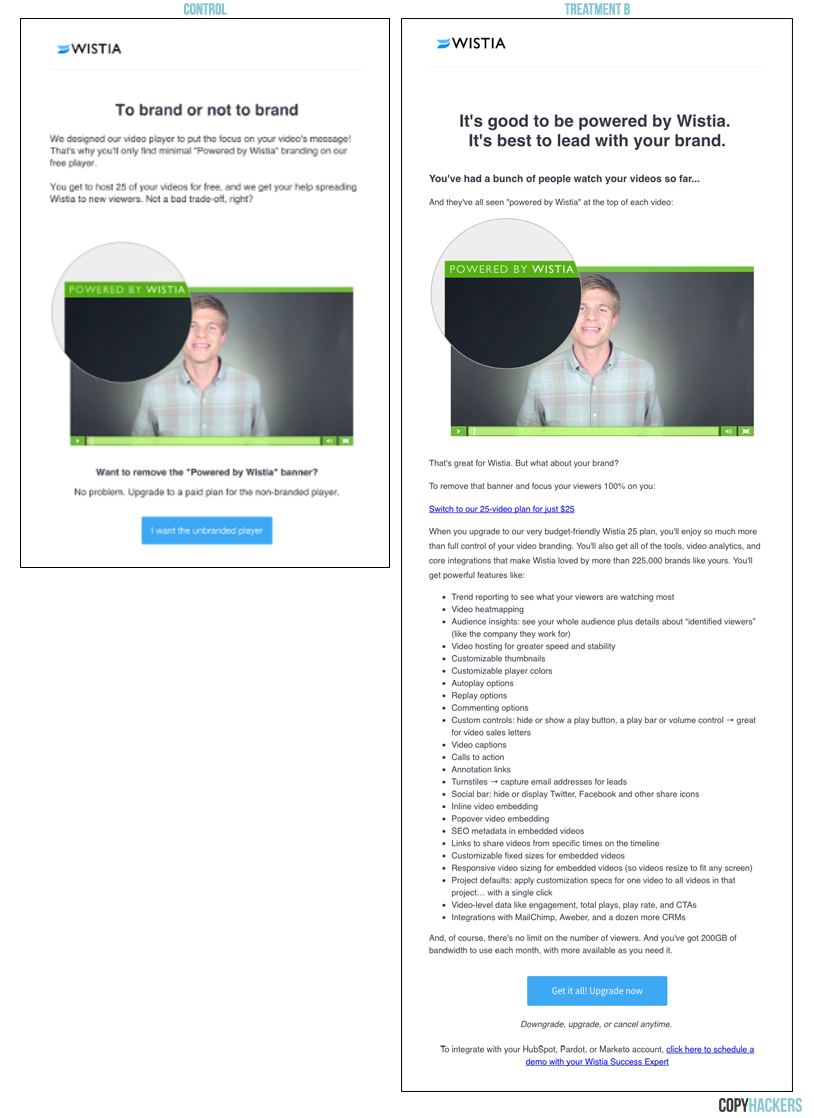
More about this in the next point. But for now, when you’re reviewing your copy, ask yourself:

How is the way I’m thinking about emails limiting what this email can do?

How is my fear of losing subscribers limiting this email’s ability to close?

If I didn’t have a nagging voice in my head telling me to play it safe,
how would I actually write this? 

And when you start writing longer emails, your worry should NOT be that your copy is “too long.” Your worry should be that your copy “doesn’t sell for shit.” Make it sell. Make it close. Use as many words as it takes to earn your cup of coffee.

2. It’s not a collection of random emails – it’s a funnel

A paid conversion happens once you’ve convincingly moved a prospect through the 5 primary stages of awareness, all the way to Most Aware.

Source: Search Engine Land

By the time a trial user started to receive the emails in the Wistia sequence we were optimizing, we had good reason to believe they had strong Product Awareness and were moving toward Most Aware. So the job of the emails was to nurture the prospect the rest of the way. It was to move the prospect from Product Aware to the far end of Most Aware, where closing happens. That was it.

But the control emails weren’t organized to push the prospect along the awareness spectrum.

Instead, they hovered in the Solution Aware > Product Aware space. This is what they were each about:

Email 1: Video analytics (Product Aware)

Email 2: Timeline actions (Product Aware)

Email 3: Wistia vs the competition (Solution or Product Aware)

Email 4: Turnstile case study (Solution or Product Aware)

Email 5: Video analytics case study (Solution or Product Aware)

Email 6: Turn off Wistia branding (Product Aware)

Email 7: Support is available (Product Aware)

Email 8: Player customization (Product Aware)

They needed to be organized to round out Product Awareness and move the prospect to Most Aware. Because we wanted to increase paid conversions. So we reordered them like so:

Email 1: Ego: the vanity play with data (Product Aware)

Email 2: Ease: tweaks (Product Aware)

Email 3: Direct tie to outcome: growth (Product Aware)

Email 4: Differentiator: CTAs (Product Aware)

Email 5: The Pitch (Most Aware)

Email 6: PAS (Most Aware)

Email 7: Incentive: upgrade to annual (Most Aware)

Email 8: New segment: courses

Note that, as we moved the prospect through Product Awareness, we focused not on the features but on the outcome / benefit for the prospect. It wasn’t until Email 4, where the prospect was Most Aware, that we framed our focus around features and incentives.

Emails 1 through 4 were for a Product Aware prospect.

Emails 5 through 7 were for a Most Aware prospect.

And email 8… well, that was our throw-in. 🙂 We felt confident that emails 5 through 7 would convert, and we hypothesized that, if it didn’t convert a user, it may be that that user had specific needs not yet addressed in the emails. For the test, that unknown non-converting user was a course creator using Wistia. And that’s why email 8 feels more like an offshoot of the sequence than a part of it. By design. Here it is, for your reference:

Takeaway: Optimizing your email sequence may be as simple as reordering your existing emails along the stages of awareness spectrum, finishing always with closer emails for a Most Aware prospect.

3. Your copy shouldn’t be as slick as a used car salesman’s hair

In my experience, marketers are happiest with a message when it sounds polished.

But here’s why that’s a problem. What happens when you run your hands over something that’s polished? They slip right off. They don’t stick. Because there’s nothing to stick to.

Same is true for polished copy. If your copy sounds like it’s been reworked until anyone anywhere could say it, that’s a bad thing.

Lemme repeat for the enterprise marketers out there: polished copy is a bad thing.

We want copy that sticks. And that’s almost always going to sound raw. Because it will be pulled from voice-of-customer data and left largely unedited, like in our headline for this email:

The control email features a polished headline. The headline for Treatment B:

  • Plays off a familiar structure (i.e., the black-and-white-and-read-all-over joke) to nudge the reader to engage and actually read
  • Uses language swiped from customer reviews of Wistia and the cofounder’s own words (as said in a podcast he was once on)
  • Sets up a level of intrigue that can rarely be achieved with stock, too-polished phrasing

Both emails are about comparing Wistia to the competition in order to convert the trialist. But only one of the emails makes you care about – and engage in the act of – comparing the two. Only one of them makes Wistia sound like the better option. Only one of them tries to sell the upgrade to paid.

4. At this stage, do NOT ask questions your prospect may not answer the way you want them to

If you ask a yes/no question hoping for a “yes” answer… what happens if your prospect answers “no” instead? You need to phrase all your questions in such a way that the prospect has to answer in agreement with you. And if you can’t do that, delete the question.

Why? Because you do NOT want your prospect to shake their head at you. That ‘no’ interrupts the seduction. It makes them think you don’t actually understand them after all.

In this control email, the opening line of the body copy finishes with this question:

Ready to dive into some data?

Few marketers and video-pros using Wistia and receiving these emails would answer “Yup, I cannot WAIT to dive into some data!” Instead, they’d answer with a shrug, a soft no or a hard no (i.e., close the email, never to return again).

So our version of this email asks questions with more controlled answers.

The first question is this: People are watching your video. Fantastic, right?

Unless the prospect is using Wistia for private videos no one is intended to watch (in which case this email wouldn’t trigger), the answer to that question is very likely going to be “yes.” Even an eyerolling yes. Even an omg-I-hate-myself-on-camera yes.

The next question our copy asks isn’t a yes/no. It’s a question that requires the reader to think about the answer, and it allows us to help her arrive at the right answer.

The question is this: How can you put your new video data to work for you?

We follow that question with an entire paragraph of questions that agitate or dig deep on the topic, with the idea being that the marketer is unlikely to have thought of all the ways video analytics can help them optimize their video content. We’re showing – not telling – that Wistia is stellar because it arms you with optimization-aiding analytics. We’re nudging the prospect to see Wistia as a powerful data solution.

We finish the email by answering the questions we’ve asked.

5. At this stage, do NOT waste time on stories people don’t care about

Case studies are great. As long as you tell the story right.

And by “tell the story right,” I mean be a good storyteller:

  • Open with a hook
  • Lure the reader from one line to the next
  • Start in the middle of the action
  • Create compelling characters
  • Set the story around a central conflict

If you don’t have conflict, you don’t have a story.

If you don’t have a hook, who would read?

In these emails, you can see that the control was based around a case study for a business called Zeeblu. It’s a perfectly fine study. But because we didn’t find the story compelling, we dropped the study and put our hero (the prospect) at the center of the story:

Compare the two emails.

The control wants to tell a story.

Treatment B actually does tell a story. (Hell, it’s even got dialogue.) If our version had a working title, it would be “How you can use Wistia to get more leads.”

  • It opens with a hook
  • It lures the reader from one line to the next
  • There’s no preamble – it starts in the middle of the action
  • It features the most compelling character: you
  • It features a central conflict: how to get more leads without spending more money or creating more content

Wistia’s a brilliant solution, so little wonder they have a lot of case studies. A second case study-based email – this one for MailChimp – appears in the same sequence:

We decided to scrap the Mailchimp story entirely. That’s because we’d already talked about video analytics in this sequence. In its place, we wrote a short closer-focused last-chance ‘offer’ email, where we repositioned an existing offer to sound like a one-time promotion; we scheduled it toward the end of the sequence, when the non-converted trial user is likely to be Most Aware.

It can be hard to say no to using a case study – especially great ones from known names. But if it’s not a compelling story, you will bore your prospect. So don’t waste a sales email on a non-converting email.

Remember: Every email your subscribers open but don’t care about is an email that widens the gap between you and them.

6. Bring your message, value and product to life with specific copy – not vague messages

What does your brain see when you read this line:

Customize the color of your video player appearance.

And what does your brain see when you read this line:

The Wistia video player defaults to grey. Which is nice. But grey. Why stick with grey when you can go with hot pink… or dollar-bill green… or, well, Wistia Blue?

Each of those statements is conveying the same message. But your brain has an easier time grasping one over the other. Is the vague first one easier to grasp… or is the more specific one more likely to form an image or two in your brain?

Okay, let’s try another one.

K, tell me how your brain makes sense of this statement:

18% is a lot. 

Now how does your brain make sense of this:

Getting 18% more views is pretty major. Videos that used to get 100 views a day now get 118 views a day. In a month, that’s an extra 500+ views. 

One is a statement that leaves the reader to figure stuff out. (And maybe even argue that 18% is not a lot.) The other is so specific, it removes the burden of thinking, calculating, pausing, trying to make sense of the numbers. The prospect can just absorb the info. No work required.

The specific copy outperformed the vague copy.

That didn’t happen in just one email I wrote. That happened in all the emails I wrote.

Here’s another example:

As you can see in the two emails above, this control copy wasn’t as specific as it could be:

You can add annotations, create calls to action or collect emails through turnstile – all within the video player!

We unpacked the significance of each of the important points the control was glossing over. That turned into a bullet list filled with specifics about annotations, CTAs and turnstile.

This all goes back to Steve Krug’s old “Don’t Make Me Think” principle. Use specificity to bring concepts, product features, outcomes, benefits and more to life in the mind of your busy reader. When you tell yourself your reader is too busy to read a lot of copy, remember that specific copy is going to engage more than short, vague copy will.

Perhaps (or of course) Don Draper said it best:

“The greatest thing you have working for you is not the photo you take or the picture you paint. It’s the imagination of the consumer. They have no budget. They have no time limit. And if you can get in that space, your ad can run all day.”

7. Edit in the awesome

Your first draft will be crap.

It should be.

This is always true.

You should never expect the first draft of anything you write or someone else writes to be great.

The real magic happens once the first draft is knocked out. Without Wistia’s control emails to work with, we would’ve had to go through God knows how many iterations to get a strong first draft ready to optimize. Thankfully, Wistia’s got stellar marketers and copywriters on their team – so it was easy for us to ‘edit in the awesome.’

With these lessons, it should be easy for you to edit the awesome into your email sequences, as well.

And if you feel like this post is just scratching the surface of what you can do with your email copy (because it is), click here to be notified when our copywriting program 10x Emails reopens

FINAL NOTE: There is no such thing as optimized copy.

The very term “optimized copy” suggests a finality – but optimization is an ongoing thing. It’s never done. Wistia is still optimizing these emails.

That said, when you A/B test your copy, you have the benefit of data to tell you if your optimization efforts paid off in that one moment in time. Did your new copy work? Should you push harder on a new focus in your messaging? That’s what testing can tell you – not necessarily which message is best but where you should keep applying energy…

~jo

PS: When I present this study, I often hear that we didn’t just change the copy – we changed the design. People say I should talk about the design changes, too. That’s cool… but our philosophy is that copy leads design. So when copy changes, design changes. We can’t separate the two. But what I can say, as a copywriter and the lead on this project – as the person who typed the copy into the HubSpot email templates – was that copy changed, and what you’ve seen above are the copy changes.

The post We did these 7 things to a SaaS onboarding email sequence, and it tripled paid conversions appeared first on Copywriting For Start-ups And Marketers.


from
https://copyhackers.com/2017/08/saas-onboarding-email/

Tuesday, 8 August 2017

Don’t Let Go of Expectations … Put Them to Work in Your Marketing

"Are you willing to write like a million people read your words, even if only one person currently does?" – Stefanie Flaxman

We all know the potential trouble associated with expectations:

If you expect something to turn out a certain way — and it doesn’t — you likely end up disappointed.

Subsequently, traditional wisdom has advised that we let go of our expectations to soften the blow of disappointment and train ourselves to be content with the outcome we get.

Even though I hold that outlook to be true most of the time, I wanted to explore how we could use expectations to our advantage in certain situations, rather than try to (unsuccessfully) forget about them.

If you struggle with letting go of expectations for your business, I have three steps you can follow to put them to work in your marketing instead.

Step #1: Get clear about what you want

During this step, you examine each expectation you have and turn it into a goal.

When you don’t deny or downplay what you hope for, you’re free to get specific about what you want. Those specific details can then help you uncover and perform the work you need to do.

Step #2: Assess your current routines

This step can be tricky because it requires a critical evaluation of your current work routines to see if they support your goals.

You want to be open to different options you may have not considered before.

A topic I find fascinating is the difference between people who work hard and meet their goals and people who work equally hard but don’t experience the type of success they want.

If both types of people work hard, why don’t they both see satisfying results?

My hypothesis is that people who succeed are more flexible and acknowledge when something isn’t working for them. They reassess their methods in a timely manner and move toward a similar goal that may be easier.

They keep setting and meeting new goals … until they eventually reach the one they originally wanted or achieve something even better.

The work they perform every time they adjust their focus moves them closer to that initial expectation they hoped for.

On the other hand, people who work hard but don’t meet their goals may get stuck working hard on the wrong things and ignore their great potential in other areas.

Step #3: Align your actions with your goals

Let’s go back to the expectations that helped you set your goals.

Rather than strive to have something you don’t currently have, commit to working like your expectation is already a reality.

When you create your next piece of content, ask yourself:

  • What is one thing my ideal clients and customers need help with?
  • What information will help them?
  • What is the best way to deliver that content?

You may decide to write a content series that also educates them about your business or an ebook that becomes part of your business model.

The idea is to shift from focusing on what you don’t have (yet) to putting out meaningful work into the world. You get to where you want to go by helping other people get to where they want to go.

Channel your expectations into smart work

You have to create content on a professional website as if you already have the audience you want to engage — it’s how to attract the right people to your business over time.

This perspective on how to use your expectations could be summed up with the widely known phrase: “Fake it ’til you make it.”

I find that saying a little trite, but it’s essentially the mindset I’m talking about. 😉

It may not be as concise, but let’s refer to it as:

Your expectations can drive excellent work and direct you to your next milestone as you move closer to your ultimate goals.

The post Don’t Let Go of Expectations … Put Them to Work in Your Marketing appeared first on Copyblogger.


from
http://www.copyblogger.com/put-expectations-to-work/

Monday, 7 August 2017

Making a Living Writing Ebooks: Here’s How It Works Today

"An excellent ebook can provide both revenue and a doorway to greater things." – Sonia Simone

Once upon a time, there was a straightforward solution to “monetizing” your website when you got tired of trying to make AdSense work:

Write an ebook!

Having something of your own to offer, even a simple $7 ebook, virtually always beats trying to monetize your traffic with advertising.

And that’s still true. (In fact, sales of ebooks hit $9 billion in 2015.)

But as more and more people have taken that advice, we need to get a little more strategic to build strong businesses around ebooks.

It can still be done, and I’ll be talking about folks who are doing it. But you can also let ebooks become part of a bigger game, within a larger digital business strategy.

The straight ebooks-for-sale play

We all know that some fiction authors are making a killing selling digital-only books on Amazon.

In fact, a few of those authors are dear friends of ours.

But that’s not what we’ll be talking about today. The world of fiction is a fascinating one in its own right, but the other type of ebook — the somewhat traditional “information product” designed to teach something valuable — is one we have a lot of experience with.

Two powerhouse ebook publishers

It’s getting trickier to build a business around ebooks alone, but if you look at Darren Rowse’s Digital Photography School, that site grew to an ecommerce powerhouse on the strength of ebooks.

(In recent years, DPS has expanded to offer courses as well — a natural evolution that can be remarkably profitable.)

The DPS ebooks each focus on a topic the audience wants to know more about — with titles like Life in Natural Light and Captivating Color.

There are a few keys to the success of their library:

  • The books are gorgeous. Darren’s team does an exceptional job with the design of their ebooks, creating digital equivalents of “coffee table books,” featuring, of course, lots of superb photography.
  • The books are also ultra useful, walking the customer through a specific photography technique so she can get better results in her own work.
  • And the ebooks offer impressive value at just $10 each. That’s a small transaction, but because there are lots of them, and because DPS enjoys a large and passionate audience, the revenue adds up.

Another person who knows a thing or two about ultra-successful ebooks is Brett Kelly, author of Evernote Essentials.

Brett wrote the definitive guide to the popular app Evernote. Despite the fact that there were dozens of $1 and $2 guides available, his (at $29) won the war — because it was, quite simply, massively more useful than the cheaper guides.

Brett has done lots of projects since then. He even worked for Evernote for a while — the company loved his book so much, they brought him on, while allowing him to keep his lucrative digital business.

Both Darren and Brett showcase three features that any successful ebook needs:

  1. Great design
  2. Incredible usefulness
  3. Excellent value for the investment (of time or money)

The low-cost introductory product

With the explosive rise of Amazon’s Kindle, readers have become accustomed to paying just a few dollars for ebooks.

(Note that isn’t always the case — Brett’s pricing, mentioned above, survived because of that book’s excellent reputation and quality.)

If you’re trying to make your entire living with ebooks, a low price point can be tricky. But you can also use the lower price point to your advantage by using ebooks as ultra low-risk entry points to your business.

For example, on Big Brand System, Pamela Wilson uses low-cost ebook guides as launching points to an ongoing relationship with her business.

Titles like Business Name and Tagline Guide and Quick-Start Guide to Branding your Business showcase Pamela’s expertise and give potential clients a taste of how she can help grow their businesses.

Her library of low-cost ebooks creates a list of buyers for Pamela’s pricier offerings, including private coaching slots.

Why is that cool? Because a list of buyers (even if they’ve just picked up an inexpensive item) is always much more responsive than a simple interest list.

Buyers have already made a micro-commitment with your organization, which research has shown often leads to a greater willingness to take similar actions.

For many of your lower-priced buyers, going on to a more intensive offering will be a natural next step. And if you put the work in to make your low-cost ebook exceptional, there’s no better “ad” for how you will handle a larger project or product.

A list of buyers, of course, also weeds out the “looky-loos” who subscribe to lists but don’t read them or are only on the list to get free resources.

The thought leader

For a long time now, writing a book has been a way to open many more doors beyond the revenue you get from the book itself.

Josh Kaufman, author of The Personal MBA and The First 20 Hours, puts it this way:

“Writing a book still tends to have a positive effect on your reputation: if you invest the effort to write a good/useful book, you’ve spent more time thinking about the topic than other people, which makes you rare and valuable to people who are interested in the topic.”
– Josh Kaufman

Given enough time and exposure, an excellent ebook (or series of books) can provide both revenue and a doorway to greater things.

“When we launched Copy Hackers on Hacker News in 2011, we sold $20K worth of ebooks in a few days’ time. That money was everything to me then. It was a signal that our little ebook experiment could turn into a business, that there was a market for what we had, and that the market would pay us for what we knew. Without our ebooks, I would have had to find a job (ugh) at someone else’s business (ugh); with the ebooks, I could afford to try my hand at blogging.

“Years after our launch, our ebooks have become far less about generating revenue. Promoting them on sites like AppSumo and Freelancer has helped us grow our list. And getting them in the hands of makers and influencers has brought us consulting projects, interviews, and speaking engagements.”
– Joanna Wiebe, Copy Hackers

The relationship builder

Many have written about using an ebook as an opt-in reward. In other words, you can use an ebook as an “ethical bribe” to get people to sign up for your email list.

And it works really well for that — but it’s smart to understand the deeper business reasoning.

Offering something valuable, like an ebook, is a reward for taking action. But it also needs to become the cornerstone of an ongoing business relationship.

As any competent sales professional can tell you, before they make a purchase, buyers need to:

  • Know you,
  • like you, and
  • trust you.

An ebook that only gets the prospect to sign up for your email list isn’t living up to its potential.

Those “ethical bribes” need to entice the prospect to take action, and they also need to further the professional relationship to build the case for an eventual purchase.

For example, My Copyblogger is a completely free membership site with an extensive library of free content marketing ebooks.

When we created the free membership library, we took the traditional “trade an ebook for an email opt-in” to a completely new level (and increased our email sign-ups by about 400 percent).

Could we have offered them for sale and made a few dollars? Definitely.

But by using them as the cornerstone of a valuable free membership experience, we’re nurturing relationships for more advanced products like Digital Commerce Academy. (Digital Commerce Academy will reopen to new students on August 21, 2017, so if you’re interested in joining, add your email address to the waitlist below.)

A rose is a rose is a rose

As you’re deciding the role an ebook might play in your business strategy, remember that you don’t actually have to call it an ebook.

In fact, ebooks in other guises can be powerful business-boosters.

So, a values-based, inspirational digital entrepreneur like Chris Guillebeau might (and did) call his ebook a manifesto.

If you offer B2B products or services, at least some of your ebooks will probably be white papers.

At Rainmaker Digital, we’re fans of the special report, but we also like other downloadables like checklists, worksheets, and infographics.

And one of my favorites to play with recently has been the workbook, with the pragmatic, hands-on associations that label brings.

The more flexible you are about how you think about and package your ebooks, the more powerful a tool they can become in your digital business strategy.


Would you like some help with that?

Digital Commerce Academy (DCA) helps you build the business of your dreams by teaching you how to create and sell profitable digital services and goods (like ebooks) without squandering time and money, stumbling to find the right path, or making unnecessary mistakes.

DCA features full-length courses (including Brian Clark’s Build Your Online Training Business the Smarter Way), 20+ webinars featuring in-depth case studies and education on cutting edge tools, as well as Q&As with the Rainmaker Digital team.

The doors to DCA are currently closed, but we are reopening them on August 21, 2017. Join the waitlist below today to get an exclusive offer when DCA reopens.

Enter your Email:


The post Making a Living Writing Ebooks: Here’s How It Works Today appeared first on Copyblogger.


from
http://www.copyblogger.com/professional-ebooks/

Thursday, 3 August 2017

How to Unlock the Door to Effective Content with Your Creativity

How to Unlock the Door to Effective Content with Your Creativity

We definitely had a creativity thread weaving through the week, both on the blog and the podcasts.

On Monday, I continued our “Quick Copy Tips” series by talking about the difference between benefits and features. It’s one of the first topics covered in nearly every copywriting book, but even experienced writers often get it wrong — because it can be so tricky to see with fresh eyes. I gave you a fast way to do exactly that.

On Tuesday, Stefanie addressed that nasty creativity killer: perfectionism. It takes many forms and hides in many disguises. She reminded us of the one thing we all have to do to defeat it.

And on Wednesday, we posted our creativity and productivity prompts for August. We’re offering a new pair of prompts for you every month this year, to help you create stronger work and more of it. This month’s prompts were heavily influenced by Growing Gills, Jessica Abel’s terrific book on productivity for creative people.

Over on Copyblogger FM, we republished an episode on writing (much better) blog comments. Blog comments can be a surprisingly great way to forge connections with web publishers … but there’s definitely a right way and a wrong way. Quit writing flat, stale comments and start leaving comments that actually make an impact.

And in an encore episode of The Writer Files, Kelton Reid shared a fascinating conversation with neuroscientist Michael Grybko about the nature of creativity — where it comes from and how to nurture it.

That’s it for this week — have a great weekend, and we’ll see you Monday. :)

— Sonia Simone
Chief Content Officer, Rainmaker Digital

Catch up on this week’s content


quick copy tipBoost the Relevance of Your Content with Benefits and Features

by Sonia Simone


you can care about quality and produce meaningful work without driving yourself crazyThe Non-Perfectionist’s Guide to Noteworthy Blogging for Your Business

by Stefanie Flaxman


2017 Content Excellence Challenge: The August Prompts2017 Content Excellence Challenge: The August Prompts

by Sonia Simone


How to Write (Much Better) Blog CommentsHow to Write (Much Better) Blog Comments

by Sonia Simone


How to Write (Much Better) Blog CommentsHow to Know Exactly What Content You Should Create

by Jerod Morris


The Best of ‘The Writer’s Brain’ Part One: CreativityThe Best of ‘The Writer’s Brain’ Part One: Creativity

by Kelton Reid


How Website Personalization Grows Your Business Faster, with Brennan DunnHow Website Personalization Grows Your Business Faster, with Brennan Dunn

by Brian Clark


The post How to Unlock the Door to Effective Content with Your Creativity appeared first on Copyblogger.


from
http://www.copyblogger.com/copyblogger-weekly-44/

Wednesday, 2 August 2017

2017 Content Excellence Challenge: The August Prompts

Content Excellence Challenge: August Prompts

Happy August! It’s time for our pair of prompts to make you more creative and more productive.

For those of you who haven’t joined us yet, each month in 2017 we’re providing a pair of prompts: one to make you more productive and one to improve your creativity or writing skill.

Feel free to try one prompt or both. You can join the fun anytime you like. And let us know about your experiences in the comments!

The August Productivity Prompt

This month’s prompt is inspired by Jessica Abel’s excellent book for creative souls, Growing Gills: How to Find Creative Focus When You’re Drowning in Your Daily Life.

I’m presenting the very start of her program here as a bit of a “hack,” but the strength of Abel’s book is that it isn’t a collection of hacks. It’s a smart, flexible, and comprehensive system that lets you make more progress on your creative work — including the kind that you don’t have a deadline for yet.

Our August productivity prompt is:

For the next week or 10 days, keep track of how you spend each hour of your day.

You’re not going to figure out your priorities (yet). You’re not going to decide what to attack during your most productive time (yet). You’re just going to make quick notes as you go through your day about how you’re spending your time.

Just like tracking what you eat or how much money you spend, tracking your time gives you a clarity you won’t get any other way. It lets you get real about what you’re doing hour-to-hour.

If you’re like me, just that act (which takes a few seconds of attention throughout your day) will start to shift how you use your time. Once you’re aware of how much time you spend on mental junk food like Facebook or game apps, you may find that you start making different choices.

I swiped this tactic as the prompt for the month because I find I get a lot out of it, but I advise you not to stop there — go pick up the book for yourself. It really stands out from the sea of silliness in that genre.

The August Creativity Prompt

Your creativity excellence prompt for August is to find a crossroads.

Writing good stuff takes a lot of time, energy, and passion … but you also probably spend some time, energy, and passion on other things.

Maybe you spend a lot of time hiking, or gardening, or training naked mole rats. You might be passionate about Little League coaching, the environment, or Italian food.

This month, bring some of your “off topic” passions into your content.

Now, you still need to make it relevant to your audience. This isn’t a permission slip to create content they don’t care about.

Your job is to look for unexpected connections. How can you bring your passion for Marvel comics into your fitness business? Where are the points of intersection between your love of Mark Twain and your personal finance blog?

Nearly 10 years ago, Brian called this the “content crossroads” — the point at which seemingly unrelated ideas connect. And there are always interesting things to be found at the crossroads.

(If you want some more specifics about how to get there, do check out his post — it’s still highly relevant and useful.)

How about you?

Joining us for one or both of the prompts? Have you ever tried tracking your time in the past? Let us know in the comments!

The post 2017 Content Excellence Challenge: The August Prompts appeared first on Copyblogger.

Related Stories


from
http://www.copyblogger.com/challenge-2017-08/

Tuesday, 1 August 2017

The Non-Perfectionist’s Guide to Noteworthy Blogging for Your Business

"You can care about quality and produce meaningful work without driving yourself crazy." – Stefanie Flaxman

The fear of criticism …

It can certainly discourage you from writing in the first place, and it also can disguise itself as perfectionism when you do attempt to create content for your business.

If you delay publishing your writing — while you try to improve your content before anyone else reads it — you are likely trying to avoid criticism.

The false belief associated with perfectionism is that if everything is “just right,” you’ll protect yourself from someone pointing out something you did wrong or something they don’t like (which is impossible to control).

The pivotal word in the sentence above is “false.” In the pursuit of perfection, you both perpetuate a false belief and prevent yourself from being as prolific of a writer as you could be.

So, how do noteworthy business blogs gain recognition for their remarkable writing without the perils of perfectionism?

Face your true challenge (it’s not criticism)

Let’s imagine a scenario where no one criticizes your writing.

It’s not that far-fetched of a concept because it happens on many blogs every single day … blogs no one reads.

"Please, please, please stop doing this." – Sonia Simone

The downside of a lack of criticism is that your blog probably doesn’t have a substantial number of readers yet or your content doesn’t meaningfully impact the people it does reach.

Criticism can be unpleasant, but it’s not the most harmful thing for your blog. Obscurity is.

The non-perfectionist knows …

When you create content that isn’t boring and forgettable, there will always be someone who doesn’t like what you do.

Keep creating anyway.

Embrace “good enough”

A lot of people say “there’s no such thing as ‘perfect.’”

Here’s how I like to elaborate on that idea:

When you’re passionate about your work, aiming for “perfect” may be necessary. But what you end up with is even better than “perfect” … because it’s a creation you’ve made that no one can take away from you.

You can care about quality and produce meaningful work without driving yourself crazy.

Explore the Content Editor Cosmos to Produce Out-of-This-World Writing

If you never publish anything because you’re worried about making it perfect, you never get to experience the benefits of having your writing available for others to read.

“Good enough” is not an excuse to publish sloppy or uninspired work, though.

It’s simply a marker that helps you assess when your content is ready to be published. With each new piece of content you create, you’ll have a chance to improve and fine-tune your style.

The non-perfectionist knows …

Prolific writers learn how to gauge when their final draft is “good enough.” Missteps or mistakes still might happen, despite your best efforts.

Keep creating anyway.

Build confidence

By now, we’re starting to get comfortable with inevitable things that will happen when you publish your writing:

  • People will disagree with you.
  • A typo will occasionally appear in your final draft, even though you proofread carefully.
  • You’ll change your mind and cringe at something you wrote a year ago.

And as you continue to get comfortable with the uncomfortable aspects of publishing, you strengthen your resilience and build your confidence.

Confidence is vital for content marketers. It’s what enables you to stand for something that matters and attract prospects who identify with your brand.

"True influence isn’t something you borrow. It’s what you embody." – Brian Clark

The more you produce, the less afraid you are of mistakes. Your confidence takes their power away.

The non-perfectionist knows …

Each published piece of content might not be a masterpiece.

Keep creating anyway.

Befriend your blog

Professional business blogs set and meet publishing deadlines.

That’s a lot easier when you like the topics you write about and approach your blog as an outlet to help your community.

If you don’t have readers yet, help the people you want to help even if they don’t know who you are. That’s the only way they’ll eventually discover you.

You have to start even if you don’t feel ready and before anyone is paying attention to you.

Working on one idea always leads to additional ideas for future pieces of content — and new ways to solve problems.

The practice makes you a stronger writer and a better resource for the prospects you want to attract. There’s no substitute for consistent writing practice.

practical tips for practicing your writing

As a former perfectionist who wanted to avoid criticism, it took me a long time to learn that. I actually wrote my first ebook to avoid creating a blog on my business website.

I felt comfortable putting all my perfectionist energy into writing an ebook, because once it was finished, it was finished. A blog was open-ended, and I’d have to constantly put my perfectionist energy into it. It seemed nerve-racking and overwhelming.

But when I eventually made a commitment to my blog, it was a huge step in the right direction for my business. Blog posts resonated with my ideal clients — who previously had trouble telling me apart from other service providers.

Before my business website had a blog, it’s like I was hiding. My blog not only made me visible, it made me the only reasonable choice for many prospects.

The non-perfectionist knows …

Your best writing that connects with the right prospects emerges when you’re actually doing the work. Since you start to reveal more about your point of view, will the wrong people also decide that you’re not for them? Sure.

Keep creating anyway.

Don’t save your (best) ideas

If a good idea fits into a blogger’s strategy, why would they wait to publish a post about it?

It’s typically a desire to wait until they have a bigger audience. Avoid that attitude and remember that everyone starts by serving the audience they currently have (or, when you don’t have any readers yet, the audience you aim to attract to your business).

"You don't have to just wait for your audience to stumble across you." – Sonia Simone

Follow through with your idea, rather than hold off until a seemingly more ideal time.

You’ll always have a chance to write about the topic again in the future — and with new insights.

Is your blog or a different website the best fit for your idea?

As you become your own content editor, you develop skills that help determine the best place for a piece of content. And if you have an opportunity to write a guest post for a site that has a larger audience than yours, you always want to submit your best work.

The non-perfectionist knows …

It’s smart to use ideas that fit into your content marketing strategy right away, even if you wish you were already a bigger influencer.

Keep creating anyway.

Spread your most outstanding work

When you use one of your best ideas and recognize the content is special, repurpose it in different formats to reach more people.

"This is how you increase the likelihood of reaching new audience members with your best work." – Jerod Morris

A blog post will attract readers, but your target audience might also search for videos on YouTube. A version of that blog post that leads viewers back to your website can be put on YouTube so more people can discover and connect with your story.

If you have an outstanding product or service, you should be proud of the content you create to market it.

The non-perfectionist knows …

Even though it may be your goal to build your audience, it can be scary to expose your work to more people.

Keep creating anyway.

Noteworthy bloggers overcome perfectionism

Information is … information.

Content is your chance to creatively position information in a new way — a way that your prospects want to hear it.

Aren’t you more interested in finding the information you need from people you know, like, and trust? Those noteworthy bloggers write despite their perfectionist tendencies or fears of criticism.

So, keep creating the work that gets people to know, like, and trust you.

And publish it regularly on your website.

The post The Non-Perfectionist’s Guide to Noteworthy Blogging for Your Business appeared first on Copyblogger.


from
http://www.copyblogger.com/blogging-for-your-business/

Monday, 31 July 2017

Boost the Relevance of Your Content with Benefits and Features

Quick Copy Tip

One cool thing about being a content marketer is that you tend to become an expert in your topic. You probably know an awful lot about your business, your project, or your subject matter.

In fact, you might actually know too much about it.

It’s called the curse of knowledge. Because we research our topics deeply and spend so much time writing about them, we tend to understand the technical specs inside and out. We have a great grasp of the under-the-hood details that make the thing work. And we think customers want to know all about those details.

But most of your potential buyers? They don’t care.

What have you done for me lately?

To be effective, marketing needs to show exactly what the offering does for the person buying it.

The features of your offer are what make it work. The benefits are the results it creates for the customer.

What transformation does your product or service empower? What does it allow the customer to become that she isn’t today?

Jimmy Choo high heels aren’t coveted because they’re comfortable or well-made. (Even though devotees believe they are.) Women buy them to feel confident and gorgeous.

Hybrid cars aren’t popular because they’re fuel-efficient, money-saving, or environmentally friendly. The real benefits are feeling virtuous and smart, with the warm, fuzzy glow that comes from believing you’re saving the world.

Your content and copy will never be truly relevant to your audience until you translate your features into customer-focused benefits.

The five-minute feature check

Quick, take a look through the last persuasive piece you wrote (blog post, sales page, podcast script) and take note of all of the features you talk about.

  • The process
  • Your qualifications
  • The patented mechanism
  • The policy
  • The dimensions
  • The speed
  • The materials

Copy and paste them all into a fresh document. Then, after each feature, add the words:

so you can …

The final results will be phrases like:

  • I have 10 years of experience helping clients exactly like you, so you can feel confident that together we can solve even your trickiest widget problems.
  • Our course is the most rigorous on the market, so you can leapfrog ahead of your competitors.
  • Our grape jam has 50% less sugar and no weird additives, so you can enjoy it guilt-free.

In about five minutes, you’ll uncover the weak spots in your persuasive content — the places where you were thinking about you and what you offer, and not about them and what they get out of it.

You might not use the words “so you can” over and over again in your final copy — but you will be writing with an understanding of your audience benefits.

Not all benefits are equal

The curse of knowledge can also lead you to focus too much on what some copywriters call fake benefits.

These are the benefits of your product or service that you think are important. And you might be absolutely right. They could be critical to delivering the results your audience wants.

The trouble is, the customer doesn’t particularly care.

These could be things like:

  • Stabilizing blood chemistry levels
  • Improving efficiency of project delivery and implementation
  • Mastering the ability to write a college entrance essay

But that doesn’t tell us what the buyer gets to have, do, be, feel, or become by moving forward with this purchase.

What those customers might actually want could be to:

  • Get slim without feeling hungry
  • Pull off a great project and look like a hero to their boss
  • Feel like brilliant parents because their teenager got into a great college

Features do matter

Features are the specific, convincing details that demonstrate why your solution is effective. As long as they’re tied directly to customer-focused benefits, your buyer will stay interested.

Here are some features that have been translated into benefits and presented as a set:

This nutritional program stabilizes your blood chemistry so you can finally lose weight … without getting hungry.

Our proven process makes you more efficient … and that makes you look like a hero when you deliver your next project in half the time and under budget.

This quick course teaches your teenager how to write a masterful college entrance essay … which could be the deciding factor in whether they get into their first-choice school.

Take another look at your five-minute benefit check. Any fake benefits in there?

Wants, not needs

You’ve got one more check to make before you call it good.

Are the benefits you’ve identified things your audience genuinely wants, or are they things you think they need?

Paying for things we need is boring. Spending money on things we want is a lot more fun. That’s why it’s easier to sell big-screen TVs than life insurance.

When you’re translating your features into benefits, make sure those benefits are driven by wants. Look for emotional drivers like pleasure, comfort, status, and self-image. You can also seek to put a stop to pain, either physical or emotional.

It’s not only hedonistic emotions that can drive behavior — values like patriotism, justice, and fairness can play powerful roles with the right audience. It’s still a pretty good idea, though, to pair them with a little self-interested hedonism if you can. Fair-trade coffee wouldn’t sell nearly as well if those arabica beans didn’t taste so good.

We like to think that logical drivers like efficiency, physical health, preventing future problems, and scientific evidence influence our decisions, but, they typically don’t have much impact. But those “rational” benefits are helpful when they’re used to justify an emotional decision that’s already been made.

The customer who already wants the beautiful high-heeled shoes tells herself that Jimmy Choos will last longer and feel better than a cheaper brand.

The customer who already wants to feel enlightened and virtuous tells himself that the fuel economy of the Prius clearly makes it a sensible choice.

Marketing vs. manipulation

There’s an important difference between putting your best foot forward and crossing the line into manipulation.

The key lies in making two promises:

  1. Don’t say things that aren’t true.
  2. Don’t omit significant things that are true.

The impression you create with your marketing needs to be realistic and truthful. If it isn’t, you’re a con artist and a creep — and your audience will rightly shun you when they figure that out.

If you liked this Quick Copy Tip, click here to read other posts in the series.

The post Boost the Relevance of Your Content with Benefits and Features appeared first on Copyblogger.


from
http://www.copyblogger.com/benefits-and-features/