Wednesday, 12 May 2021

I am an introvert. Here’s how I went from fearing authority to speaking on stages.

I was Patient Zero of losing a personal reputation on a global scale almost instantaneously.

^^ Monica Lewinsky at a Women’s Day presentation I attended in 2017. 

Yes, that Monica Lewinsky. The woman who, by some POVs, almost brought down Bill Clinton’s presidency because she kept a certain blue dress. 

Her presentation was so well crafted on the subject of cyber bullying, I couldn’t stop watching. But it also felt like a warning: visibility can be bad. Making yourself into a household name might not be the business windfall you think it will be. 

And that’s the thing that worried me as I tried to convince my introverted self to start increasing my visibility. 

I’m a conversion copywriter and am the happiest behind the scenes, crafting persuasive copy that makes people money. I never saw myself as a thought leader, but soon realized that if I wanted to scale my business, I had to become one. 

Because I knew that scaling my business is all about getting in front of my ideal customers. It’s about stepping into authority as someone who gets results. It’s about getting those dream customers to find me. 

And that scared the bejeezus out of me.

Stepping into my authority felt like I was purposely opening myself up to criticism and a flood of negativity

Just like Monica Lewinsky became synonymous with infedelity, impeachment and an infamous blue dress, I was afraid that instead of showing prospects what I know, they’d see what I don’t know. 

I was afraid that people would think I am a complete and utter fraud. 

I was afraid people would judge me and find me lacking.

I was afraid I’d get rejected. 

I was afraid. 

So how’d an introverted, awkward person like me, who’d rather be almost anywhere than in the spotlight, turn into an authority builder who’s spoken on stages? (Like, real stages attended by real people – pre-COVID, of course.) And gotten clients from said speaking and other authority-building content?

It all started with a realization

As a copywriter, I do a lot of voice of customer research. One of my go-to questions when I do customer interviews: 

How did you learn about this organization or person?

And I hear responses like:

I’ve been listening to his podcast for years” or “I saw them on stage and what they said really resonated with me” or “I read a blog post that led me to another blog post and before you knew it, I was subscribed to their email list and fell in love with them”. 

Cue proverbial lightbulb overhead. It wasn’t about expensive ads or constantly promoting yourself on social media (because, ugh, social media). It was about branding yourself as an authority and creating the kind of content that makes other people trust you. 

I’d known that authority building was important. After all, I was a 10x Freelance Copywriter alum and heard Joanna tell me far too often that I had to build my authority. Advice that I ignored. 

And if I needed evidence on how well authority building works, consider this: I spent the equivalent of a good used car joining a mastermind of a copywriter I’d been following for years (*cough cough* Copyhackers *cough cough*), begging them to take my money like a bachelor looking for his last lap dance. All without ever seeing a single ad or social media post about it. 

But it hadn’t computed how important authority building was until I began seeing its payoff first hand.

Why do people (even introverts) work so hard to become more visible?

Authority building — the kind of authority building that means doing a lot of things for no guaranteed reward — is the backbone of a great content marketing strategy. It’s top of the funnel stuff (with a huge influence on the bottom of the funnel!) that helps you:

  • Build trust among your prospective customers
  • Generate leads
  • Grow your email list
  • Drive traffic 
  • Increase sales

Aaron Orendorff, VP of marketing at Common Thread Collective, lists the results he saw from a single guest post he wrote for Copyblogger, 

First off, traffic. People followed. Second, my email list grew by leaps and bounds. Third, comments on my own blog increased. Fourth, people shared it all over the place. In fact, it’s still on Copyblogger’s most popular list and it’s been shared nearly 20k times. On top of all that — and this is the real beauty — I landed four new clients from that one post alone.

Authority building content like blogging, speaking, publishing a book and going on podcasts gets you in front of your ideal clients and customers in a non-salesy way. As Copyblogger’s Brian Clark says, 

It really boils down to the demonstration of expertise through delivery of valuable content as opposed to claiming expertise or saying, “We’re number one.” It’s the difference between marketing messages and content that actually creates the experience of authority. This is an important distinction that can be summed up with the short phrase: ‘Show, don’t tell.’” 

So once I was convinced in my own mind how important it was to increase my authority as a copywriter…

It was time to think bigger

Picture how I got my clients when I first started my business:

  1. Someone on Facebook would say they were searching for a copywriter.
  2. I’d respond to the post and send a direct message to the original poster.
  3. So would 187 other people.
  4. Sometimes I’d get a new client but often the type of clients I was attracting chose the lowest bidding copywriter.
  5. Rinse and repeat, all while hopelessly checking my bank balance as sweat broke out on my forehead. 

The hustling in Facebook groups wasn’t working. I was exhausted from the hustle. 

I felt like I had to be constantly searching for posts where someone was looking for a copywriter. Time off was spent scrolling through social media and those leads often had the tiniest budget in the world. 

Enter the experiment that would change how I did business: 

The Authority Project.

AKA a big fat test that was intended to help me actually do the things that would increase my authority. 

In addition to being an introvert, I am also a skeptic. I was convinced logically that building authority was important but I didn’t know if it would work for me. After all, I was the person who’d rather get a failing grade than put my hand up in class to answer a question, even if I knew the answer. 

I came to the conclusion that I was either going to figure out this authority building thing or I was going to have to dust off my résumé and look for a job. Since I had zero desire to head back to the world of wearing pants, you could say I had some pretty big motivation. 

I decided I’d say yes to every authority building opportunity that came my way. If I saw a tweet about a conference, I’d shoot out a pitch for it. If I was on a blog (like this one on Copyhackers…), I’d check to see how to guest post. If I loved a podcast, I sent out a pitch. 

And I was going to track the results so my skeptical mind could see if it actually worked.

The key to building trust isn’t demanding it

You don’t just say “hey I’m an authority” and you are. You don’t just say “hey trust me” and people do. Trust and authority are earned. With authority-building content. 

Authority building content is the kind of content that educates and informs your audience, and, in doing so, shows them why you can be trusted to help them with whatever problem led them to you in the first place. 

As Demien Farnworth says, 

The goal behind authority content is ultimately about empowering your audience. You give them what they need to know in order to succeed, making them the rock stars, as opposed to a lot of chest-thumping about your business, your clients, or your organization.

Authority building content can be anything that shows your target audience that you are a thought leader. Blogging, speaking at conferences or on podcasts, writing a book, etc.

Authority building is a long game –
but will it (eventually) pay off for you?

So, who can benefit from creating authoritative content? 

Anyone. Anyone can benefit from creating high-quality content, either written or spoken. From service providers to founders and everyone in between, great authority content will attract prospects to your website to buy your products or services. 

The team at Animalz says of their blog content

Literally 100% of the content we create is designed to support sales, either through lead gen, talking points for sales calls, assets that can be used during follow-up, etc. We don’t need a ton of traffic to grow, so I don’t really care about pageviews or sessions. I think most companies would benefit from a similar approach—marketing and sales should be in complete alignment.

That said:

The always important truth about authority building is this:

The kind of content that Aaron Orendorff recommends creating in the course Master of Guest Blogging and that Joanna tells us to create in 10x Freelance Copywriter is:

  • Well-researched
  • Well-planned
  • Full of links from other high-quality sites
  • Not just an iteration of your own opinions

As Ross Simmonds from Foundation Marketing says, 

“You’re truly actually helping people when you do it right. You’re creating content, you’re creating assets, you’re telling stories that solve a problem, that fulfill a need. If you can deliver that at scale, it means that you are helping thousands or millions of people do something they want to do. At the end of the day, you’re helping people become better versions of themselves and that’s important.”

When I decided that I was going to say yes to every authority-building opportunity that came my way:

Here’s what 2 years worth of “sure, I’ll speak at that event” and “sure, I’ll be on your podcast” did for this freelancer

But first, have you ever wondered why some companies make sales more easily than others?

As Brian Ainsley Horn says, 

It’s not magic. They’ve simply figured out why authority status is given to some people — and it’s not for reasons you might think. It’s not because they’re the smartest, most educated in their field or the best at what they do. And it’s certainly not because they call themselves the expert, guru or authority.

Take Richard Simmons. After diet pills and super restrictive diets made his hair fall out, he finally lost weight using moderation and fitness. And then he decided to show the world exactly how he did it. 

He’s not the most educated in fitness and diet. He doesn’t have a Ph.D. in nutrition. But he does create daily updated content for his followers. He has a daily messages and inspiration on his website, newsletter, YouTube channel, Twitter and Facebook page.

And all this came after he built up his reputation creating high energy VHS workout videos like “Sweating to the Oldies”. 

In short, he creates a lot of authority building content that actively works to get people into his circle. 

As you build authority, you meet one big competitor who does NOT think you are very smart

Ah, your brain. My brain. Our brains. 

Built to keep us safe. Designed to tell us, “Shut up, idiot. Who asked you?” 

Whoever thought that the biggest thing getting in my way really was me? It’s trite. It’s the stuff of after-school specials, if those were still a thing, which, yes, I wish they were.

The single most important thing I did when I started The Authority Project: hire Linda Perry, a copywriter turned mindset coach. She worked with me to help me understand the reasons why I was so afraid of authority building and how to move past it. 

I knew that fear and rejection and visibility were freaking me out and causing me to do nothing, so it only made sense to work on my mindset. 

I had a lot of things to work through and it took me most of the last two years to change the narrative in my own mind so that I was able to accomplish my goals. 

Along the way, I discovered:

Procrastination was getting in the way – big time

I am a killer procrastinator. Not with client work because I feel confident in the work I produce, but with growing and marketing my business. I could make a short article take a month. 

I could write a long form sales page in a week if I had a deadline breathing down my neck but could make a 750 word article take a month. I had a list of 100 blog ideas along with a list of 25 places to publish said articles… and I did none of it. After all, completing those projects meant that I was either going to get rejected or I was going to put myself on display for all to critique. It was paralyzing. That’s because…

I have insecurities about my insecurities

I tripped over every word I said in a university presentation. I hid in the back of the conference room between the IT guy and the weird woman from HR in management meetings, praying I wouldn’t have to speak. I was awkward. All of that told me that increasing my visibility was a terrible idea. One that was right up there with hiking Machu Picchu without doing a single stroll beforehand. 
Working on mindset meant facing so many of my insecurities (seriously exhausting and made me drink a lot of wine). It meant uncovering the bloopers highlight reel that played inside my mind. It meant feeling the discomfort of doing things that are not in my comfort zone.

My walls needed to come tumblin’ down

I am great at pretending to be a tough guy. If normal people could get Emmys or Oscars for hiding their emotions, I’d be thanking the other nominees during my acceptance speech. But hiding behind my fears and insecurities made me miss out on a lot of opportunities so I came to the aha moment of knowing that I had to not only face my fears but to move past them. 

One of the most profound things was realizing that, despite talking a big game, I was a ‘fraidy cat. I had a fear that others would judge me and find me wanting. That they’d think I am 100% an imposter and don’t know anything. And I was terrified of success and opening myself up for increased criticism. 

So once my mindset was at least partially on the road to recovery, I had other things to deal with, like: 

I was not going to be the first person in history to skyrocket to incredible success without ever experiencing rejection or ghosting from other authorities

Rejection hurts. It feels like a personal judgment that you aren’t good enough. As Geraldine Downey, Ph.D. says about rejection, 

“It communicates the sense to somebody that they’re not loved or not wanted, or not in some way valued.” 

Ouch! 

However, rejection is inevitable when you’re building your authority. 

Sometimes you get rejected. Sometimes you just don’t hear anything. At all. Seriously, those are the worst. I’d rather have hope die immediately than to wonder endlessly while my optimism leaks out of me, hissing like a balloon with a pinhole. 

The first time you get rejected, it pinches and not like when your grandpa pinched your cheeks as a kid. It hurts and can make you feel like a colossal failure both as a person and as a service provider. 

The second time, it hurts a little less. By the fourth time you get rejected, you will probably shrug your shoulders and pour a glass of wine to celebrate. 

The point is, rejection happens to most of us but it’s not personal and it gets easier.

As psychotherapist, Amy Morin says, 

One person’s opinion, or one single incident, should never define who you are. Don’t let your self-worth depend upon other people’s opinions of you. Just because someone else thinks something about you, doesn’t mean it’s true.”

However, people don’t judge you nearly as much as you think they will

Monica Lewinsky is the exception not the rule here. Most of us are not dealing with a high visibility person like the President of the United States, and our transgressions are much easier to forget. 

According to psychologist Jill Weber

The reality is that the human brain has limited data reserves. Although we may make judgments, they are not significant enough to earn a place in our memory banks for eternity. So when someone makes a judgment about you, chances are that moments or days later that judgment will have left their conscious awareness.” 

In the face of my overactive imagination, I could feel the embarrassment I’d feel when the truth came out. That truth: that I don’t have any idea what I am talking about. 

Not true. None of it is true. Not for me and not for you. 

The thing is: we aren’t expected to know everything. The trick is to remember that if you can educate one person and help them with one problem, you can create authority-building content. 

You can’t build lasting, real authority
off a single piece of work

I spoke at Microconf and had a vision of people showering me with accolades while begging me to work with them (for a lot of money). 

That did not happen. Probably because that isn’t usually the way it happens and probably because it was the first time anyone had ever heard of me (it was my first speaking gig and I was pretty new to the Microconf community). 

What did happen was that I got some discovery calls, landed some clients and put my name out there. Same when I published a post on CXL or spoke at a local event. 

It’s the consistency that makes your name known, that makes you build authority. IT’s the continuing to show up. Doing one thing would not have moved the needle for me. And creating one piece of content would not have helped me hone my speaking skills, become a better writer or think faster on my feet thanks to getting weird questions thrown at me when I was on a podcast. 

In 2020, Orbit Media did an annual survey of bloggers and found that,

High frequency bloggers are getting better results. In fact, more than any response to any question in the survey, daily bloggers are the most likely to report ‘strong results’. Conversely, inconsistent bloggers are the least likely to report ‘strong results’.”

And results are kinduv the whole point, right? Results of authority building show up in the form of:

The ROI: More traffic, better leads and easier sales process for bigger projects

Creating authority means your audience will begin to trust you long before you ever sell anything to them. Your prospects are unlikely to buy whatever you are selling if they don’t trust you. Bill Carmody once said: 

The more someone likes you, the more they begin to trust you. This transforms the relationship from one of buyer and seller to the preferred position of subject matter expert and interested party.

But building trust is harder than it seems. A recent survey by Hubspot showed that a mere 3% of consumers trusted marketers. 

Whether you are creating content for new prospects, current customers, industry analysts or someone else entirely, the real purpose behind those efforts should be to build a higher level of trust between the consumer of the content and the brand creating it.

The antidote for a lack of trust is authority building. Conversion content writer Jessica Mehring says that once she started authority building, she built trust among her prospects before she ever talked to them, 

My reputation precedes me in the best sense of the phrase. So when someone reaches out to me about a content project or strategic consulting, the conversation is so much easier. There’s always trust left to build, of course — we’re human, and true trust takes time and experience — but that little bit of trust they already have in me and my company when we first talk goes SO far in making the conversation easier and more valuable for both of us.

Or, as Peep Laja of CXL says, “If you’re the best in the world, or people think that you’re the best, you can charge the premium price.” 

Et voila! 

So how can you begin building authority, especially if you’re an introvert?

1. Create a plan

You have to create a content strategy plan if you want success. The spaghetti strategy of pushing out anything and everything randomly (and hoping it sticks) isn’t going to help you achieve as much success as creating content and publishing on platforms where your audience is likely to hang out. Meaning, you need a plan. 

Your content should be designed to help your audience with a specific topic — whatever your area of expertise is. 

When Abbey Woodcock wanted to get in front of people who needed her launch strategy, she wrote this post for Growth Lab. And she ended up getting tons of leads, affiliate income and course sales. 

10x Freelance Copywriter was where I first learned about authority building (and it’s a great place to start or hone your guest blogging skills IMO). 

2. Consistently create content

According to HubSpot, you should ask yourself the following questions before deciding what kind of content to create: 

  • What do they need from you?
  • What challenges are they looking to overcome?
  • Why do they need your product or service?
  • How can you help them succeed?
  • Where do they spend their time?

Tarzan Kay’s done a ton of authority building, but she says one of her favorite things to do is to be a guest on a great podcast. And she shines when doing it! Like when she was on Jenna Kutcher’s Goal Digger podcast, she gained 1287 new subscribers from that one podcast episode. Clearly, she understands who her target audience is and where to find them. 

3. Promote your content

If you write a fantastic blog post, does it even matter if nobody reads it? The answer is no, it doesn’t. Promote your blog posts, your podcast episodes or show behind-the-scenes of when you spoke at a conference. All of that will help you increase your authority. 

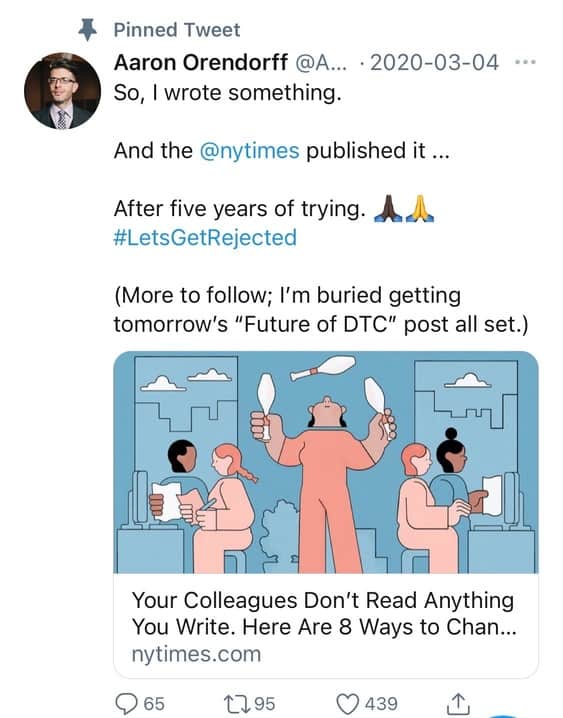
Like Aaron Orendorff did when he fulfilled his dream of publishing in the New York Times. He shared his article on Twitter (and pinned it to the top of his feed so anyone checking him out could see). 
My ROI: Over half my income comes from my authority-building work

I know you are expecting me to tell you all about how I increased my income by a bajillion percent. And I did. I’ve enjoyed steady growth in my business since starting The Authority Project. 

In 2020 — the year of everything effing up everyone’s plans — over half of my income came directly because of authority building, and I increased my income by more than 20%. That’s despite only doing one live in-person event (literally days before pandemic lockdown happened). 

But I ended up with so much more. As soon as I got into the groove of blogging and speaking about copywriting, I gained the one thing I’d been missing for so long.

Confidence. 

That’s because:

  • I honed in on my processes in order to write about said processes. Specifically, I wrote a lot about voice of customer research, which made me more self-assured about it.
  • I got into the habit of asking clients for metrics after launches in order to use the information for case studies and presentations, which helped me feel more confident in what I was producing.
  • Writing about what I knew showed me I know more than I gave myself credit for. Imposter syndrome had nowhere to go but out when I was able to write about complex ideas without wondering what I was talking about. 
  • I got tons of messages from people who said I really helped them understand a complex problem. Like this one:

And I’m not the only one who found myself increasing my confidence the more I wrote authority-building content. As Jodi Harris from Content Marketing Institute says, 

Daily blogging certainly helps to expand a blogger’s own knowledge base – you learn more as you do more research to inform your writing. But there’s another benefit: The consistency helps build your authority on search, making it more likely your work will rank well and get discovered and shared. Ultimately, you’re building your audience’s expectation that your insights will be trustworthy – and worth turning to, directly, when they need expert advice on other related topics.”

Ultimately, I realized authority building isn’t about sales or money or invitations to speak on stages

Monica Lewinsky, the woman best known for saving a blue dress and almost ruining a president, went public because she was ready to begin helping those who were also struggling with bullying

“Perhaps by sharing my story, I reasoned, I might be able to help others in their darkest moments of humiliation. The question became: How do I find and give a purpose to my past?”

That’s perhaps the best reason to increase your visibility. 

And if you do, those sales just might come. 

The post I am an introvert. Here’s how I went from fearing authority to speaking on stages. appeared first on Copywriting for startups and marketers.


from
https://copyhackers.com/2021/05/how-to-speak-on-stages/

Tuesday, 23 March 2021

Analytics On The Bleeding Edge: Transforming Data's Influence

Analytics teams are named for the silos and limitations within which they trap themselves.

Paid Media. Owned Media. SEO. BI. Customer Service. Data Warehousing. Email. And, a thousand other silos (depending on your company size).

One outcome of this reality is that while every team works hard to do their very best work, it is rare that they earn strategic influence from their work. That’s not really surprising, if your view of your scope is narrow… Your impact will be narrow as well.

The other dimension to consider is most Analtyics teams kick into gear after the campaign is concluded, after the customer interaction has taken place in the call center, and after the funds budgeted have already been spent. When you only look backwards, it limits your ability to have an impact.

Finally, few analytics teams obsess about predictive analytics in a way that allows them to dictate future action. This is a huge miss… Left to their own accord, how many companies will make the same decisions data would recommend? Astonishingly few.

Transforming Data’s Strategic Influence.

The above-observed realities were on my mind as I took on a new role to lead Global Strategic Analytics. This time around, my goal was for the analytics team to chart a very different path… To solve for expansive influence, before, during, after, money is spent by the organization.

A key part of how this manifested in our work was doing truly super-advanced machine-learning powered analysis to answer hard questions that few can successfully. This is of course exciting and very cool.

But the difference in the team’s impact comes from the combination of an audacious vision and putting together the people-process-structure that powers our desire for data to have an expansive influence across the company’s decision-making needs.

I lovingly call our strategy analytics on the bleeding edge. It is powered by the union of:

1. intelligent analytics initiatives
2. application in data to new and unexplored areas
3. upgrades to processes to create deeper integration with Finance & Strategy teams
4. power real-time actions and future decision using automation and algorithms

While our team’s journey had many, many, miles to go, I want to share the broad strokes of our vision and execution in the hope that it’ll help spark your imagination – perhaps you can use our core philosophy to reflect on your organization’s current status and future path.

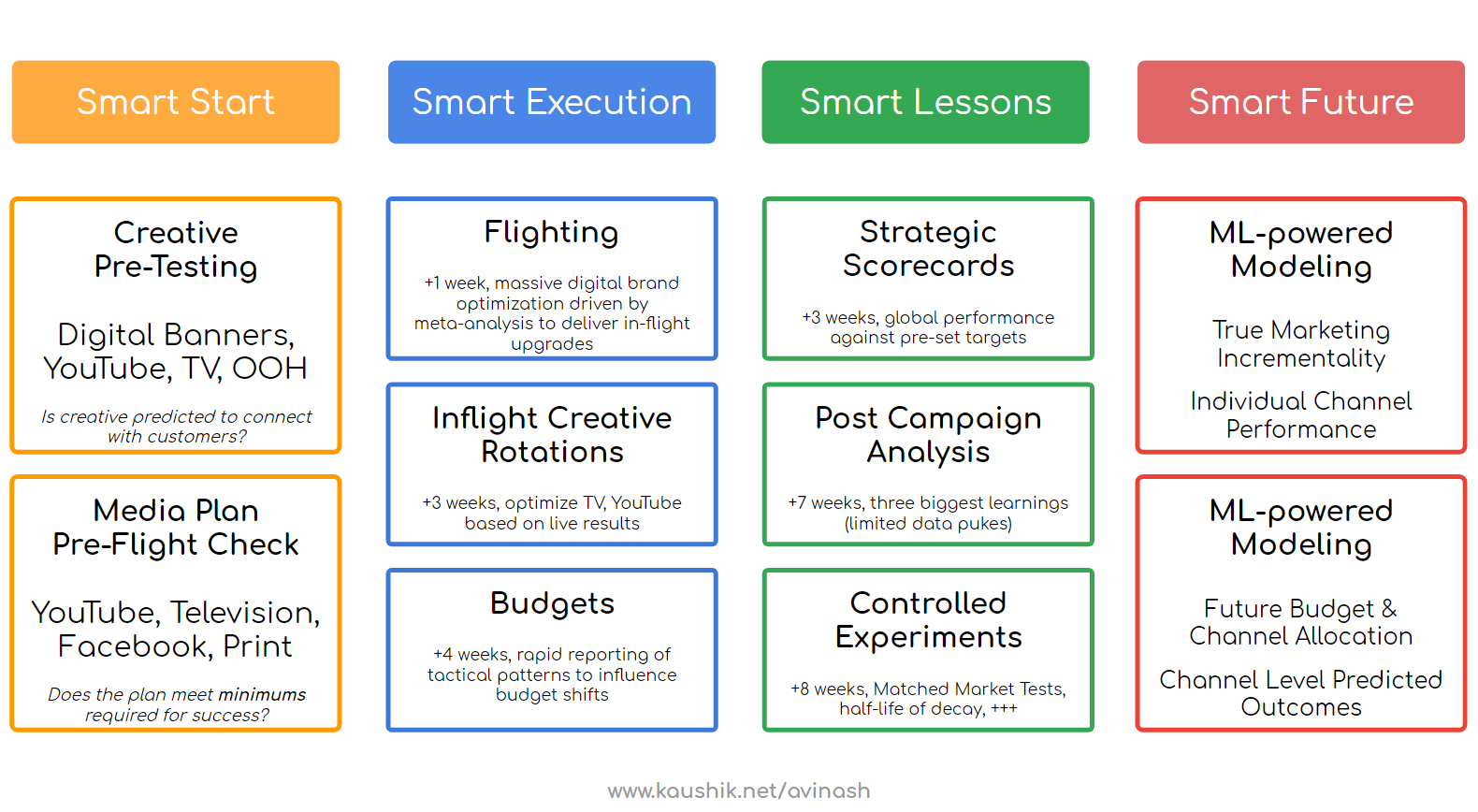
I’ve boiled our approach into four smart clusters. It is most directly applicable to larger companies, but some components do apply to companies of all sizes.

Let’s look at them one at a time… Ready?

Smart Lessons | Analytics Cluster.

Like every good analytics team, we started doing work that you’ll recognize.

Executive scorecards, post-campaign analysis, some limited data puking (only when we absolutely can’t get away with it because someone who influences our existence is asking!), using Google Analytics in a smart way, setting good behavior standards like always having Targets (pre-set, always pre-set) and using methodologies that don’t suck and 90% or higher significance, etc., etc., etc.

Smart Lessons | Analytics Components

What may or may not be as common, but is an integral part of our analytics strategy is the extensive use of controlled experiments to answer life’s hardest questions.

Is campaign strategy x better than campaign strategy y? Because they are both different, both have different executive sponsors and it is insanely hard to know based on data we have which one is better.

Does advertising really have a long-term business impact? Surely you’ve been asked that one before, and there is a short-term answer but the long-term one needs a sophisticated controlled experiment.

What does the diminishing returns curve look like for TV GRPs for our company? More shouting is not really better – and it is expensive!

This is very hard to do, we now have a proven seven-step experimentation process, with one of the coolest algorithms to pick matched-markets (normally the kiss of death of any large-scale geo experiment).

Underpinning our Smart Lessons work is the very basic – incredibly complex – art of picking the right Key Performance Indicator. It underpins every dimension of success.

Hence, if your assessment is that you are messing up Smart Lessons, it is because of this simple reason: Wrong/bad KPIs.

The choices our team helps make are powered by another awesome innovation: The Impact Matrix.

Smart Start | Analytics Cluster.

It has always gnawed at my soul that most companies only turn to data after all the money has already been spent. After the campaign is done. Long after your CRM-powered emails have been sent. Long, long,  after your TV ads have stopped running.

On those non-normal occasions when the campaign did not quite work, it pained me that we were learning after the money had already gone poof!

Hence, in this role, in particular, I've been deeply obsessed with using data before any money was spent. For data to provide a degree (high!) of confidence that, if we spend the money, it would most likely deliver a positive impact on the business.

This cluster, a part of our awesome win before you spend strategy, is called Smart Start.Smart Start| Analytics ComponentsThe first component is a gloriously scaled global creative pre-testing program.

Creative is the thing you see in the ad. The text. The goats. The slow music. The repeated mention of the product (hopefully). The use of a celebrity (or not!). Yada, yada, yada.  It turns out, hold on to your seats, the creative has approximately 60% influence on the ultimate success of your campaign!

Not the audience, not your ad stack, not your targeting strategies, not your obsession with other little bits that are currently sucking up 98% of your attention.

The creative is what matters, and, unfortunately, few people who do modern analytics focus on the creative.

We pre-test pretty much everything in an online labish environment, and predict whether a piece of a TV or Billboard or Radio or YouTube or Facebook creative will be successful. With the support of our progressive CMO, we spend money on creative that passes pre-test.

In a unique feature of our analytics strategy, we practice a trust, but verify approach to lab testing. We routinely put failed in-lab creative in the market and use both passed in-lab and failed in-lab to see how they do in the real world. This helps us understand the quality of signal we get in-lab (it is around 67% for Yes and 89% for No).

Now, our Marketing teams know before they spend money if the campaign’s creative will deliver success.

The other gloriously scaled global practice is our pre-flight check, which we call the Minerva Check – named for the Greek goddess of wisdom. :)

The Minerva Check is a collection of media plan minimums required for success. Reach. Frequency. Duration. GRPs. Passed creative rates. Tactical strategies. Ad unit types. Etc.

We identified these minimums from the massive amount of data we have for our past campaigns. Meta-analysis. Matched market tests. Product/regions/channels. Throw everything in there, and out comes a list of things that every media plan has to meet to be greenlit.

Now, our Marketing teams know before they spend money if the campaign’s creative will deliver success.

It is not perfect (I like perfect). It is not enough (I want more). But, with incredible certainty, we can now say, before any money is spent, that the chance that Media Plan X will deliver success is 3% and the chance that Media Plan X-modified (with Minerva incorporated) will deliver success is 97%.

Intelligently applied data proving its value when it really, really matters – before the company budget is spent.

I’ll give you one guess as to how much our VP of Finance loves this capability. :)

Smart Execution | Analytics Cluster.

For the last year, the thing that I have been obsessed with, along with our small team, is the next cluster: Smart Execution.

Real-time data in the hands of humans is a colossal waste of technical, financial and human resources. It takes too long for humans to process the data through themselves, their team, the bureaucracy, the agencies, and the technology stack to convert real-time data into action.

(From 2006: Is Real-Time Analytics Really Relevant?)

Yet, there are, often literally, tons of signals coming off your ad and analytics stack that you can use to identify if things are going right or wrong and take quicker action – by eliminating humans from the process!

My deep love for this cluster comes from the competitive advantage you can build for your company…

Smart Execution | Analytics ComponentsIn our in-flight optimization journey thus far, we have worked to identify signals that are believable, and identifying at which point they become believable (ex: statistically significant).

The next step was to create a collection of decision trees. It sounds complex, it is not.
Here’s an example. The benchmark for the beautiful metric AVOC is 15.3%. The decision tree is: If it is about 20% for our campaigns, then sing happy birthday.  If it is between 10 – 20%, then raise a flag. If it is below 10%, then stop.

Then, automate the execution of this decision.

Now repeat this across many, many metrics, for many dimensions, in the three clusters you see above.

Boom!

You have the start of a fabulous in-flight optimization engine.

We’ve now made data influential and useful while we are spending money!

You can imagine that excellence in the orange (Smart Start) and blue (Smart Execution) clusters means there is more green coming out of our green cluster (Smart Lessons) than red (bad news).

Another secret agenda: By being excellent at Smart Start (win before you spend) and Smart Execution (win while you spend), you end up making Smart Lessons (the thing that occupies so much of your present life) utterly boring!  By the time you see the results, you pretty much already know what they are going to say. :)

Smart Future | Analytics Cluster.

I hope you got the sense that I am very, very passionate about each cluster above and that they are my favorite children.

That would be a misleading conclusion.

Yes, it is all fantastic work that is obsessive about making data more useful in more novel ways for our company than is common in other companies.

But my favorite child is cluster four: Smart Future.

It answers the hardest questions a CMO asks:

What is the true incrementality of all my marketing spend?

What is the bottom line (ex., sales) impact of my brand marketing?

How does the portfolio of all our activities – owned, earned, paid media, promotions etc. – work together, and how do the channels complement each other?

How effective are our efforts in the context of all the actions our competitors are taking to impact our company?

I see you nodding your head. You are being asked these questions, and you know the depth of analytical difficulty.

Our innovative approach…

Smart Future | Analytics ComponentsDue to non-public IP, it is a cluster I can’t tell you much about.

Except to say that most companies, when they attempt to answer the aforementioned questions, take the approach of using existing statistical approaches that require explicit programming. We’ve chosen to use machine learning algorithms that learn from the underlying structures inside massive amounts of our datasets without explicit programming. That’s the magic.

As the second box indicates we not only use this approach to look backwards. Rather, delightfully, we also look into the future. We have the ability to model scenarios, budgets, channel allocations to maximize effectiveness and efficiency for our future campaigns.

It is very unique and difficult work.

Analytics on the Edge.

So what does a strongly proactive and truly influential data strategy at the bleeding edge look like?

Machine learning algorithms help to create the optimal budget and channel allocations that flow into Smart Start programs, ensuring core elements of marketing are pre-wired to deliver success. The data then flows through automated decision trees, making decisions in close to real-time maximizing success in the real world. The end result is data stories and scorecards that help our leaders get a unique view into marketing’s impact.

Data not as a side-show. Data as an influential core.

Analytics on the Edge | Smart Clusters

Cool, eh?

We are not perfect, we are not complete, we have miles to go, but I am so proud of the work the team has done and the business impact delivered.

There is so much packed in each box, I could write a 98-page book for each. :)

A reflective assignment for you.

How expansive is your analytics strategy? How much influence does it have on the marketing (or product or customer service or HR or whatever else) that your company undertakes?

Print out the image below.

Sit down with a pen for when you have a calm 20 mins to think.

Write down across each cluster how and where your analytics efforts are being applied today.

Smart Clusters Worksheet

If you see that you have something filled in each of the Smart Start, Smart Execution, Smart Lessons, and Smart Future cluster, raise your hand up because I’m high-fiving you at that very moment!

Well done.

If you found that not all the boxes are filled, no biggie. Start to sketch proposals to take to your leadership.

If you see that your efforts are mostly centered in the green Smart Lessons cluster, be happy. That is where most companies are. But, also be hungry because you want more.

I hope that in this note you’ve found enough very specific starting points, informing you about what you need to do in order to get to the bleeding edge or of analytics and, ultimately, implement a strongly proactive and truly influential data strategy.

If you want my recommendation for the best next cluster to focus on, it is Smart Start. Influence the company with data before any money is spent, and untold love will shower on you (along with promotions and extra headcount for your team!).

Bottom line.

It is very hard in a modern corporation, which, still, primarily runs on opinions, to make data influential. (Not the be-all and end-all, influential.)

Yet, we have so much data, we have such vast opportunities as Analysts to have a material impact on the company’s profitability and even the direction of the business. We just need to unlock our imagination.

It is not easy. But, nothing worth having is.

Carpe diem.

As always, it is your turn now.

Please share your feedback on my ideas and lessons from your anatlyics journey, via comments below. Thank you.

The post Analytics On The Bleeding Edge: Transforming Data's Influence appeared first on Occam's Razor by Avinash Kaushik.


from
https://www.kaushik.net/avinash/analytics-on-the-bleeding-edge-data-strategic-influence/

Monday, 8 February 2021

How To: Be A Good Employee, Be A Great Boss | #winningcareers

Like many of you, I am both an employee and a people leader.

At different points of the day, sometimes from one minute to the next, I have to switch gears so that I can be fully present as both a good employee and a good people leader. This constant quest for excellence, from one email to the next, from one meeting to the next as context changes is… taxing.

From observing behavior closely, and from my own experimentation and failure, I've noticed consistent patterns in what great employees do and great bosses do. In my long professional career, I’ve tried to emulate these patterns and to build on them as I try to deliver a non-normal impact to my employers.

While obsessing about Marketing and Analytics here on Occam’s Razor, I want to share the habits and behaviors encoded in these patterns so that you can have a non-normal impact in your chosen field as well.

[At the end of this post, you’ll find my guidance summarized in a printable infographic.]

I’ll cover the ten good employee patterns:

And follow that with six great boss patterns:

Ready to boost your career to a new orbit?


How to be a Good Employee.


1. Never bring problems.

Even if you are a fresh intern, never bring problems alone to your boss.

For any employee – at any level of seniority – I do not expect (as a people leader) that you will know everything, or that you will be able to articulate the perfect solution to any problem. But, please bring a solution(s). Or recommended next step(s) that you feel are a way out of the problem you've identified. At a minimum, succinctly describe the context, i.e., what have you already tried, and why won’t it work? Help your boss out.

At the very least, a boss has 18 other things on their plate at any given moment, 5 to 40 other employees to worry about, and 3 big things that are 2 weeks late already. When you bring a solution(s) along with the problem, in addition to demonstrateing empathy, you've gifted your boss some starting points for a productive conversation.

It is also an excellent demonstration of your proactiveness (especially if you explored some of those solutions with others in the team or other stakeholders). It also shows ambition. It shows you are different. This is invaluable.

[Bonus Tip: When you present your solution/s to the problem you’ve identified, be sure to explain the framework you used to think of. The solution may or may not be great, getting your boss’ feedback on how you think is super-precious. And, great bosses love frameworks! (See some of my favourite frameworks in item #4 in the boss section.)]

2. Be thorough.

Our time is so fragmented. Our lives are so stretched. Even as I'm writing this post at midnight work emails are flowing and I'm trying to be a good employee/boss by responding with value-added perspectives.

The first casualty of fragmentation is that an employee becomes a surface skimmer. This is the person who takes in just the minimum amount you need to complete a task. It is so damn easy for the corrosive tl;dr to become your fundamental approach.

I love people who are thorough – and I’ve always tried to emulate them.

They do more research than is required. They talk to one more expert than I expected. They find the external author of the statistical algorithm I want them to use, and ask them for guidance. They proactively end up taking free training courses. They instinctively ask for assumptions in any dataset/argument (I adore this!). They go deep into problems to identify causal factors and not correlations – which is why their solutions have a non-normal impact.

This is hard to do. It takes time and a lot of conscious practice. But, If you choose to do it, you'll be an outlier amongst your peers.

3. Care about little things.

Caring about little things is a different way to demonstrate your competence – and attention to detail.

As a people leader, I should not have to spend 30 minutes fixing alignment in your slides. Or, check for spelling errors. Or, request that you fix shifting altitudes in your analysis (a true crime!). Or, request that you tailor the analysis for the audience/s (context!). Or, remind you not to be on your phone in a team meeting. Or, triple check the formulas in the analysis from the Agency. Or, tell you there is already a tool that does what you want to build.

Look, I’m happy to fix all this for you – they might seem small but they really matter. But consider two things: 1. If I’m fixing your small mistakes, what’s my opinion of you. 2. Imagine how much joy I’ll feel as a people leader when I, repeatedly, notice your attention to detail (no matter how small the detail).

Also, it is not just work little things. Caring touches all sorts of interactions you’ll have.

Here’s a great example: We had a little emergency at the office. While in my area, I rushed to get it fixed for a very senior leader. Two days later a thank you note arrived. It felt special. And, I know this leader is really busy, he did not have to write a note. I would not have noticed. But he did. He cared about little things. It spoke volumes about their values.

Another example: I had a meeting with someone on our team today. It was at 1500 hrs. She brought me lunch. She’d peeked at my schedule and had realized I would not have eaten. Little thing, big message.

4. Look beyond the near future, see the full landscape of opportunity.

Your world is smaller than your boss's. By design. You have a core area of focus. Your team peers will have theirs. That entire superset is your boss's world. It is much bigger, has a higher altitude, and contains additional strategic responsibilities (some obvious to you, others perhaps not).

An error occurs when an individual employee looks at their finite view and assumes that is all there is and proceeds to create solutions with that view. Or, identify problems with just that view. Or, unwisely, jump to conclusions based on that view.

You should always seek to look over the horizon, and expand your view.

Ask your boss to share with you how they see a particular situation. Ask your boss to more regularly share her/his strategic view of the landscape. Have a quarterly skip level with your boss's boss. Talk to the Director of an adjacent team and ask them questions about their goals, problems, objectives, solutions. Listen to your CEO's quarterly earnings calls. Make it a habit to not just see six or nine months out (be the person who can see three years out).

All this context will help you become a strategic thinker, you'll learn how to extract nuance, you'll be less upset with something short-term upsetting because you have the capacity to see the long view. Your boss will be appreciative, because your ideas will be strategic, more widely applicable, stronger.

This is an incredibly hard skill to learn. (And when it exists in a person, it makes them super-precious. If you have it, we are hiring!)

5. Create your personal board of directors.

Our bosses and immediate teams end up taking too much of our mind-share. It can be mayopic, at times even suffocating. It impedes your growth.

Find four other people in the organization (not outside, though that can serve a different purpose) who you can talk to once every few months. You can bounce new ideas off them. You can ask them for unbiased advice. You can ask them how they tackled situation x or y. You can ask them where the snakes are and where the ladders are in the organization's bureaucracy.

Aim to have a diverse mix in your personal board. Perhaps someone at your level, and someone three levels higher. Someone in an entirely different part of your org. Someone in HR (if you are not in HR). Someone in Strategy. You can see how I’ve picked my board.

Have lunch with them (individually is best). Email them a simple question. Do a video chat if you are in the middle of a problem.

They are there to show you that your world is bigger than your boss's. (#1 reason people quit their team/company is a bad boss.) They are there to give you context. They are there to nudge your career in an optimal direction.

And, remember Dr. Cialdini’s first principle of influence: Reciprocity. Hence, don't forget to seek opportunities to give back to each person on your board.

6. Do at least one thing outside your immediate team/scope.

This is a lesson from Google's 20% philosophy. Spend some of your time at your employer working on an entirely different project/team. It can be related to your core job or adjacent to it or entirely different.

I work on Analytics in team x, I can work on an Analytics project in Verily, an Alphabet company, as I did the first six months of the CV-19 pandemic. I work in Marketing, I can take on a project in Sales or HR or Engineering.

A huge benefit is that it diversifies your view/job/thinking/culture/problem space/people you work with/joy sources. It is rejuvenating. A 20% project also exposes you to new company leaders (can't hurt, and maybe one of them will join your personal board). You might end up in a new job (!). Your company benefits because you are adding value in a new space, while accumulating new skills.

I'll warn you that my 20% projects at Google are tacked on top of my already long work hours. But, I'm happy to make the commitment because I derive such joy from them, and sincerely believe they are part of my personal growth.

In your current job, do you have a 20% project? 10%?

If not as a part of your current job, do you have a “20% project” outside of work? I cannot recommend enough the immense value of having a side hustle.

7. Invest in yourself.

Many of you are blessed that your company will invest in your growth. They'll make training available to you, they'll send you to a yoga+statistics retreat in Santa Cruz to make you an even better analyst, or they might even send you to a week-long course in presentation design at UCSD.

If your company offers these opportunities, proactively grab them. Create your own calendar with precise dates when you will do each of the above things (aligned with your career growth goals).

Chances are, your company is not going to care. Chances are, what they want you to learn is to get better at extracting coal just as the entire planet is abandoning coal.

In these cases, you are on your own. I still encourage you to take a leaned-in posture towards investing in yourself.

There are half-a-million free courses online in your job area, seek them out. There are people in your company who are the world's best at thing x, they will probably put something together for you to learn from. If your circumstances allow, there’s definitely a course at your local community college or local university that will cost you a bit but allow you to learn something new – you’ll have to pay some fees, but almost always you’ll make this back easily in the near-term if you apply what you learn.

The hard truth is, if you want to future-proof your career the responsibility for that is entirely in your hands. Only you care about you.

8. Ask for more responsibility, vs. asking for a promotion.

I love this topic. LOVE.

So much so that I wrote 1,241 words on this brilliantly critical concept in my Premium newsletter. You can read it for free here:

I do not say this lightly: You are going after your next promotion all wrong. And, your boss is not too happy about it.

9. Stay weird.

In corporate cultures, there is usually immense pressure to conform. This is not how we do things around here.

You would think that in order to be a good employee I’ll request you to be cognizant of cultural norms, adapt, blend in.

You would be wrong. I want to emphatically encourage you to be yourself.

Transparency: This is the thing I've struggled with the most, and remains deeply important to me (and I postulate it should to you as well for your long-term mental well-being).

I’ve covered this crucial topic in my newsletter, you can read it here:

As you navigate your long professional career, eliminate the possibility you’ll wake up one day and wonder who you are.

10. Solve for the company, not just your boss.

We, rightly, take directions from our boss and solve for them. Often, even when we realize that is the wrong decision for the company.

Actual conversation:

Me: Why would you approve that decision and support it? You realize it is wrong and will lead to a very large amount of money being wasted.

She: It is the wrong decision, but I was told by my boss that it is what he wanted to happen.

Heartbreakingly common.

If you find yourself in this position, ask your boss for more context as to why they are pushing for something that from your expertise seems wrong. Perhaps there is a valid business reason you don't know.

If none exists, on occasion, show courage. Stand up for the right decision for the company, bring your expertise and facts with you. It is unlikely to make you popular, but you'll sleep better and you'll be a good employee.

[My guidance to our team: Don't solve for me, don't solve for my boss, don't solve for my boss's boss, solve for Sundar. It gives us a clear True North, a global maxima driving decision-making aid.]

Pause.

That seems like a lot, no? Complex problems in life rarely have simple solutions (and if they do, they are almost always wrong).

The ten patterns on how to be a good employee above are not an exhaustive list. I wanted to write about the importance of developing a super sharp ability to say no, the value of learning that some fights are worth losing, and more. But, I hope ten are enough to spark new thinking in you.

Let me switch hats now…


How to be a Great Boss. 


Being a great boss is much harder. Exponentially harder.

Here are lessons from my career, and from careers of bosses I’ve admired.

1. If you hire Michelangelo to paint the Sistine Chapel, don't hold his hand while he is painting.

We all start as individual contributors, and we are good at technical competence – that narrow collection of skills you need to be a coder, a cook, an accountant. Over time, you go from good to great (because you read my list above!).

Then, you get promoted and pretty soon the boss role requires general competence (being good at a lot of different things, particularly human-related). Hence, over a surprisingly short period of time you’ll discover that if you are becoming a good boss that you are no longer exceptional at coding/cooking/accounting (areas in which you had technical competence). People in your team will surpass your technical skills (in fact if you are a good boss, you’ll hire people like that).

It is actually a good thing that you trade-off technical competence for leadership competence. You are becoming really good at leading a team, at strategic thinking, at slaying bureaucracy, at opening new thoughtscapes for the organization, and more.

Confreakingratulation!

With that inevitable switch from deep technical competence to general competence, a common, astounding, mistake bosses make is to apply technical criticism based on their general competence. They tell a coder how to write advanced code. They have no current analytical skills and tell the measurement team what their strategy should be. Etc.

Given the power dynamics, this boss makes their employee(s) work worse. They restrict, rather than expand.

Your job as a boss is to hire the very best that will come work for you. To create a culture of excellence. And, to bring hard problems to them. Then… Get out of the way and let your stars shine.

You've hired people who are better than you at the job they are doing. Then, for the sake of all that is holy, please let them do their job. Know your personal limitations.

2. Explain strategy. And, critically, why that strategy.

Most employees will have narrow roles which ends up giving them narrow views of the universe of possibilities. Often, it is hard for them to understand why the company decided on strategy x or y. Or even why suddenly View Time is the #1 KPI of the whole company.

You have a higher perch. You know all this (/much of this).

Your number one job is to set aside time on a continual basis to expose all this strategic thinking and decision making to your team.

Go into as much detail as you can. Particularly help them understand the nuances at play, why it was so difficult to decide between A and B. If you can, example and share into your thought processes to make the strategy/decisions better – there is rich learning there for your team members.

With this teach a human to fish gift, you've provided your employees with invaluable context that will help them be more effective at their jobs. And, you've contributed to the body of knowledge that an employee will need one day to be a great leader.

Be super proud of yourself.

3. Your #1 job is your employee's career growth.

[See how many #1 jobs there are for a boss? Heavy is the head that…]

Honestly other than making sure you are the glue between long-term company strategy and short-term tactical execution, your only other job is to help your employees grow. Job title. HR level. Salary. Professional skills. % of mental satisfaction time.

Advocate for them in HR Ratings dogfights. Did I say dogfights? I meant sessions.

You have a sense of their strengths and opportunities, convert that into your personal recommendations for internal and external classes they can take.

Support having a % of work time dedicated to learning. (20%!)

Create sessions where everyone can learn from each other.

(Ex: For my last team we had one full day every quarter in each office location dedicated to radical candor. We would put up our best work, and we would all have a go at it to figure out what we could have done better. It was brutal. It required an unbelievable trust in me (hard to critique your boss in public). These sessions fueled everyone's drive for excellence!)

On that note, sometimes as a boss you just have to have a tough conversation. Look, doing x is simply not going to cut it. I'm sorry but there is no path here that aligns with your long term outcomes. Let me help you find a different one. This is going to be painful, but we need to talk about z. It is entirely possible the employee will not like it, but this is a part of truly caring (and a demonstration of your courage).

One tip for bosses when having tough conversations: Don't make it about you, make it about them. Seems obvious, I'm astounded how rare it is.

4. Teach how to think, not how to do.

The very best leaders teach how to think, how to expose nuance, the value of looking beyond the horizon, how to bring people along, the difference between a bug and a feature, and more.

Teaching people how to think will outlast your time in the team. Doing things for them, giving specific how instructions solves a short-term pain but leaves little beneficial residue with the employee.

This is why, as a boss, I love frameworks so, so much! Care-Do-Impact for storytelling. Acquisition-Behavior-Outcomes for dashboard. See-Think-Do for Marketing. And more 2x2s than you can shake a stick at. All of these frameworks you've read on Occam's Razor came from my attempt at contributing to teaching the team how to think (or more precisely, how I think).

Frameworks codify thinking. Then, your employees don't need you!

That quite literally is the best thing you can do for yourself as a boss, because you are now ready to be promoted to a bigger challenge/team.

5. Set extraordinary standards, live them yourself first.

Both parts are important.

For any group of individuals to live up to their personal best potential, they have to have stretch goals. There has to be a component of normal is not enough. There has to be a spark that unlocks intrinsic motivation for excellence. Your job is to create a culture that's uncomfortably exciting.

Here's my current (overall) boss doing that:

"Lots of companies don’t succeed over time. What do they fundamentally do wrong? They usually miss the future. I try to focus on that: What is the future really going to be? And how do we create it? And how do we power our organization to really focus on that and really drive it at a high rate?"
-Larry Page.

Not wanting to miss the future is such a big part of why I wake up and come to work every day – uncomfortably excited.

You can't just create something you don't live.

Incredible employees rarely rise from teams led by lazy bosses.

If you are not personally learning or growing, they are unlikely to want to. If you are not showing attention to detail, they won't either. If you live a do as I say and not as I do… Well, if they do what you say it might only be under some punitive threat.

Walk the talk. You'll be exceptional.

6. Consciously invest in self-awareness.

Even the best leaders (self-included) over time lose their connection to reality.

We are high up the ladder, so full of caviar (is caviar vegetarian?) and frequently flying private jets (do they have premium economy?) that we end up with an odd view of ourselves. Sometimes it is imprecisely inflated. Sometimes it is entirely wrong. Sometimes you don't realize the true strengths you have as a leader.

I don't need to tell you how dangerous this is – the well-trodden path of every (ultimately) bad boss. The good news is that the fix is obvious, even if it takes conscious effort.

Ask for feedback, constantly. (And, create an environment where someone two levels below you in the HR ladder can be honest with you.)

If you can't ask for feedback, ask your employees (or personal board of directors) what can I work on next to be better? Leave it open-ended like that.

It is super effective: Shadow your employees for a day (or week), feel their pain, see their glory. Shadow a group in an entirely different part of your organization (I love call centers), try to do their job.

Consciously observe what other leaders do unconsciously that makes them so effective. Do the same for leaders who are disappointing, and reflect on what makes them so.

My friend Paul shared that he writes a few sentences in his journal each night – one thing that went really well that day and one thing that did not. Then, at the end of the month, he looks for patterns and it fuels his self-awareness. What a brilliant idea.

What do you do as a boss to invest in improving your self-awareness?

Pause.

The list for being a good boss is shorter because it is a list for being a great boss. It is harder.

It is not an exhaustive list. I wanted to write about 360° loyalty, building trust, truly understanding the difference between people and resources, and more. But, I hope six are enough to spark new thinking in you.


Bottom line. 


Every human is a work in progress. I am good at some of the things above, great at a couple, and still struggling with some.

The important thing is to be aware of the patterns, create goals, and keep working on being better.

As always, it is your turn now.

What are two things, from either list, that you'll choose to focus on in order to be an even better employee/boss? What did I miss in either list that you consider essential?

Please share your feedback, and answers to the above questions, via comments below. I look forward to the conversation.

Thank you.

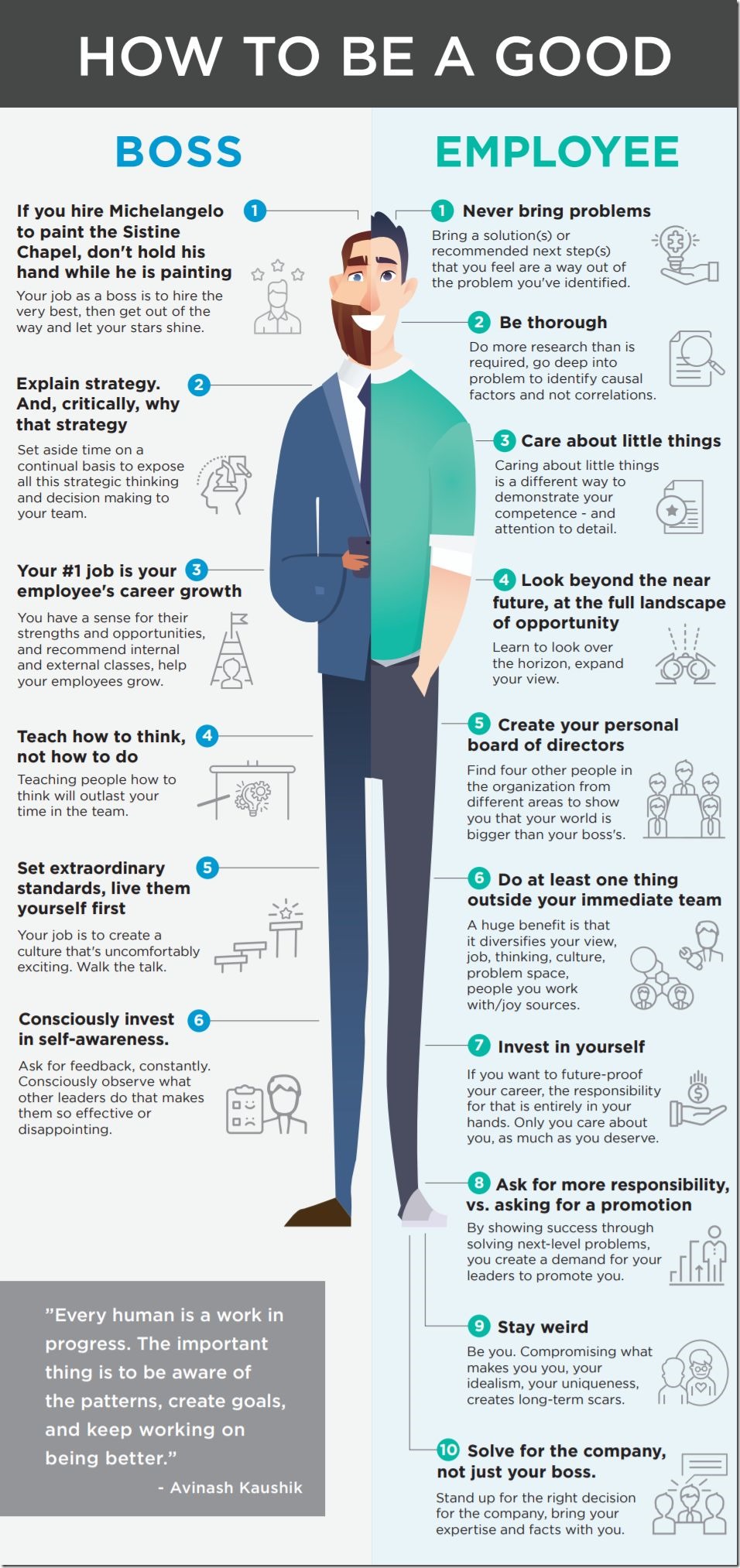
PS: Something very special for you. John Fox of Venture Marketing generously created an infographic with the above reflections…

how_to_be_a_good_employee_and_good_boss

You can also download a pdf version if you would like a higher resolution for printing.

The post How To: Be A Good Employee, Be A Great Boss | #winningcareers appeared first on Occam's Razor by Avinash Kaushik.


from
https://www.kaushik.net/avinash/how-to-be-a-good-employee-be-a-great-boss-winning-careers/

Monday, 4 January 2021

Simple Tricks To Up-level Your Analytics Reports.

Like you, I consume a whole lot of reports every day – company data, public data.

Many are acceptable, some are very good and all the rest leave me extremely frustrated with both the ink and the think.

People make so many obvious mistakes. Sometimes repeatedly.

Just yesterday I was quietly seething because none of visuals included in the report contained any context to understand if the performance I was looking at was good or bad.

Rookie mistake.

The graph could be going up, down, all around and I as a consumer had the job of figuring if something was good, bad or worth ignoring.

​The heartbreaking part is that most executives will take a look, realize the difficulty in interpretation in 15 – 20 seconds, and go back to shooting from the gut. Even if the report has hidden gold.

In a move that might not surprise you, I sat down with the person for 90 minutes going visual by visual, table by table, directing changes that would ensure everything had context.

A report usually has a hard time explaining why something is going awry or going really well. (That is why you have job security as an Analyst!)

A report can usually be very good at clearly highlighting what is going well or badly.

Your #1 job is to make sure your reports don't fail at this straightforward responsibility.

So today a simple collection of tips that you can use to up-level your reports – to allow them to speak with a clear, and influential, voice.

For many of you a reminder of what you might have let slip, for others a set of new things to implement as you aim for your next promotion.


#1. Context, Context, Context!

One of the biggest reporting mistake is not making clear if the performance is good, bad, or otherwise. It’s missing context.

Your challenge is that senior leaders will always only ask for data. It is your job as the Analyst to understand the needs and wants enough to complement data asked for with context.

I recommend five strategies to provide context in your reports:

1. Use Pre-Set Targets.
2. Use Industry Benchmarks.
3. Use Averages.
4. Use Like-Type Time Periods.
5. Use Segments.

They are roughly in priority order, from the most valuable (hardest to do) to the little less valuable (easiest to do).  You can choose multiple ones sometimes.

An additional benefit of providing context: You are packaging a little bit of your brilliant brain in your reports – that is invaluable

Here’s a blog post with more detail, and examples: In Web Analytics Context Is King Baby! Go Get Your Own.

#2. Know the difference between Metrics & KPIs.

A metric is a number. Usually good for tactical and diagnostic purposes. Moves small things.

A KPI is a metric that helps you understand how you are doing against your objectives!

Big difference.

If your reports are not being admired, or you suspect no on is even looking at them, a big contributor is the fact that that all it contains are metrics (with lower value insights).

As much as possible your reports should only contain KPIs – especially as they go up the chain of command.

You, your agency, your IT team, your search marketing co-worker, your email optimization co-worker, all the folks who make tactical decisions need to see metrics. Include them. Make sure the tactical optimizations happen.

But, even there, make sure you include the one or two (max) KPIs that provide a direct line of sight to business bottom-line for all those metrics. (Yes. Context again!)

Here’s a blog post with definitions of seven crucial analytics concepts: Web Analytics 101: Definitions.

#3. Be a ruthless killer.

Sounds exciting, right.

It is.

To up-level your reports, ruthlessly kill metrics, dimensions, time periods, segments, pages, visuals, data that's only there to show how clever you are, etc.

No one receiving your data is going to love it as much as you do. So why send them so much of it?

Why not try to send them just enough that they'll immediately understand the glorious glory and that they really need you… And, they come chasing for you!

Imagine that.

Our CMO Dashboard is one table with six KPIs. Three inputs KPIs (to identify who to blame). Three output KPIs (to identify success/failure clearly). For a super-large company.
It was not easy to do it, but it is possible and I hope you see it as a template.

We obsessivly apply the Konmari method by consisntely tidying up our reports, and keep only those elements that speak to the heart and discard items that no long spark joy.

: )

#4. Include recommended actions.

For analysis being shared with executives (via email, presentation, slack), I recommend my Insights-Actions-Business Impact (IABI) model of storytelling with data.

The Actions bit is about being clear in terms of what you want the recipient to do based on the analysis being sent. This is invaluable (because none seeing the data after you will understand it as much as you do).

With reports, this is hard to do. When you automate data production, it places huge limits in your ability to include your brain (Actions) with it.

Still, here's how you can up-level even your reports with a focus on Actions:

Where possible, recommend stopping things. For example, where campaigns fall 3x below-average conversion rate, have your report automatically populate that list separately under a column "Recommend Stopping."

Where possible, recommend amplifying activity. For example, pages with low bounce rate but above average traffic (recommend them as landing pages for relevant campaigns). The referrers with the lowest checkout abandonment rate, recommend figuring out how to get more traffic from there.

You catch my drift.

By building alerts into your reports, you can solve for the Actions, and when you do that your smarts are packed into your reports.

Here’s a blog post that goes deeper into the IABI model (in the “solution” section): Digital Dashboards: Strategic & Tactical: Best Practices, Examples.

#5. Don't make silly mistakes.

Executives hate acronyms. We, Analysts, love nothing more than converting things into acronyms, so much more efficient! How can you not love CPIL! Everyone knows CPIL.

No.

It is a small thing, but in the footer or someplace accessible, spell out your abbreviations.

Better yet, include a cover page explaining them in English.

Here's of ours KPIs:

% Budget Passed PFC

Is it clear to you what it means? Of course not. It would be hard for most people inside our company to know what that means.

Here's what it says on the cover page:

Did the channel budget meet the minimums required for success?

English. Plain English.

(For some of you far away from our team, perhaps that is still too cryptic. I ask for your trust that people inside our company – with very little knowledge of analytics – would understand the above.)

A rapid fire…

Please for the sake of all the holy water in the world insure all numbers in a table are at the same altitude. Don't mix 3.5 mil with 964 k. It makes me so mad.

Please don't switch the scale on axis if two graphs are there for me to compare!

Please use sensible time periods. A daily graph for three months is almost always useless.

Please don't hideous colors in your stacked bar charts.

Please don't include pie charts.

Please, please, please, use consistent fonts and font sizes.

And, a hundred pleases, ensure every cell in a table has the same alignment!!

If you are a part of our team, you know I have thousand more of these. But, I'll stop now.

Little mistakes steal your credibility. You are star, you don't deserve that.

#6. Literally up-level your reports.

Are your reports going to the right people?

It is not uncommon to see reports end up with everyone but the person with the responsibility to drive change.

When was the last time you checked how many people get each report (and if they are still an employee of your company), how many opened it, and when was the last time someone asked you – the report creator – a non-obvious question?

Six months?

Look, if report recipients are not asking you non-obvious questions, assuming you did the 11 things above, then no one is digesting your reports. A big cause of that, assuming they are good reports, is that they are not ending up with the right person.

Do the audit.

And, find the highest possible person who can make a decision on the data, and make sure they are getting the report.

If they are very senior (say 4 levels above you), then consider including a cover page with a summary of the two critical KPIs (contextualized). That will increase the chances they'll turn to page two.

#7: Sort by interestingness.

A lot time ago when I was but a young lad, I'd worked with my peers on a feature in GA that ended up being called weighted-sort.

The source was an observation that so very often, across time periods, the top ten rows of anything only changed a little bit. Top ten referrers. Top ten unhappy customers. Top ten best performing promotions. Top ten anything.

When the top ten don't change all that much (head < > tail issue), how can a report with top ten be useful?

Of course things below the top ten or top twenty were changing a lot. It is just that showing 20 or 50 rows is basically asking people to go on a fishing expedition!

I remember saying we should have an option to sort tables by interestingness.

Weighted-sort became one of the ways in which we surfaced what was hidden below the surface AND showed promise of being important for the business.

Often what's worth paying attention to hidden in your data. Explore options to sort by interestingness to surface those valuable insights.

#8. Be brave.

No one likes to get bad data.

No one likes to get new data that shows old problems.

No one likes to share reports that challenge the CMO's orthodoxy.

You will feel the pressure to change things. To not include a metric. Or include a different metric. Or to eliminate some context. Or to outright BS. Or, happens all the time, compromise your integrity.

Try to be brave. Try to fight for the data. Try to fight for your company's customers to show how your company is disappointing them. Try to fight for the truth.

You'll up-level the impact your reports have.

You won't always win.

Sometimes there is such power asymmetry between you and the person asking you to compromise your integrity that you have no other choice. I've had to. :(

But try.

Sometimes you'll win. And, even when you lose you'll sleep a little better.


Bottom line.

You are a star.

You work so hard at a very hard job.

The data you produce, the ambition you have for that data to have an impact is admirable.

I hope you'll use the tips above to live your best analytics life.

Good luck!

The post Simple Tricks To Up-level Your Analytics Reports. appeared first on Occam's Razor by Avinash Kaushik.


from
https://www.kaushik.net/avinash/tricks-to-up-level-your-analytics-reports/

Tuesday, 27 October 2020

29 Quotes That Perfectly Explain What Copywriting Means

If you’re not sure what copywriting means, start here:

Copy is the words businesses and people use to sell something.

And copywriting is salesmanship in print.

The Short Version:

  • Copywriting moves people to action
  • Copywriting is a conversation between you and one person
  • It isn’t creative – it’s about selling and making a new “control”
  • It sells outcomes and value, not products or prices
  • Copy is the name for the words you write
  • When you write copy, you are a copywriter

As John McIntyre puts it:

“Copywriting is using words to persuade people to take some kind of action, such as clicking on an ad or purchasing a product. For this reason, it’s one of the most important aspects of marketing. It’s also why professional copywriters are the highest-paid writers on the planet.”

Which means, online, copy is your scalable salesperson. Copy:

  • Addresses a specific audience,
  • Offers a unique benefit or promise,
  • Gives strong proof,
  • Calls the reader to take action and
  • Is tested and tweaked over time to improve results.

As Neville Medhora puts it, copywriting is about:

Getting them to WANT to engage with you….not spamming them with offers. Generously giving something valuable to the person….not just “greedily asking” for stuff. Getting them to WANT to buy from you….not out of pressure, but because they enjoy your content and help.1

Wikipedia defines copywriting like so:

Copywriting is the act or occupation of writing text for the purpose of advertising or other forms of marketing. The product, called copy or sales copy, is written content that aims to increase brand awareness and ultimately persuade a person or group to take a particular action.

What Copywriting Means: Quotes from Copywriters

Now that you know copywriting is the art and science of using your words to get a person to take action, here are quotes from copywriters to help you truly understand what copywriting is and why it matters so much.

It’s a conversation.

“Copy is a direct conversation with the consumer.” – Shirley Polykoff


It’s salesmanship.

“To properly understand advertising or to learn even its rudiments one must start with the right conception. Advertising is salesmanship.” – Claude Hopkins

“Anything you write is, at its core, selling something. Maybe that something is a product or service. Maybe it’s you.” – Kira Hug


It’s not “creative.”

“When I write an advertisement, I don’t want you to tell me that you find it ‘creative.’ I want you to find it so interesting that you buy the product.”  – David Ogilvy


It changes your reader.

“Decide the effect you want to produce in your reader.” – Robert Collier


It makes you nervous NOT to act.

“The best advertising should make you nervous about what you’re not buying” – Mary Wells Lawrence


How Pro Copywriters Write Copy

Don’t write. Assemble.

“Copy is not written. Copy is assembled.” – Eugene Schwartz


Make the product interesting.

“You must make the product interesting, not just make the ad different. And that’s what too many of the copywriters in the U.S. today don’t yet understand.” – Rosser Reeves


Outperform the current control. 

“Probably the biggest thing or biggest ‘aha’ moment I had with the process of copywriting was when I realized that copywriting was more than just being creative. …I didn’t start becoming successful, in my own eyes, until I said, ‘No, my clients are not hiring me to be creative; they’re hiring me to deliver a control.’” – Carline Anglade-Cole


Know your prospect.

“Your job is not to write copy. Your job is to know your visitors, customers and prospects so well, you understand the situation they’re in right now, where they’d like to be, and exactly how your solution can and will get them to their ideal self.” – Joanna Wiebe


Sell value, not discounts.

“A big reason so many businesses compete on price is because they can’t prove what value they offer, so they’re stuck with the one selling point that’s a breeze to communicate: cheapness.” – Mish Slade

“We have become so accustomed to hearing everyone claim that his product is the best in the world, or the cheapest, that we take all such statements with a grain of salt.” – Robert Collier


Create a mood in your reader.

“In writing good advertising it is necessary to put a mood into words and to transfer that mood to the reader.” – Helen Woodward


Use easy words.

“Make your copy straightforward to read, understand and use. Use easy words; those that are used for everyday speech. Use phrases that are not too imprecise and very understandable. Do not be too stuffy; remove pompous words and substitute them with plain words. Minimize complicated gimmicks and constructions. If you can’t give the data directly and briefly, you must consider writing the copy again.” – Jay Abraham

“Make it simple. Make it memorable. Make it inviting to look at. Make it fun to read.” –  Leo Burnett


Don’t write copy for search engines.

“Do you ever want to sacrifice tone and feel for what you know the search engines are looking for on a page? That answer is no.” – Heather Lloyd-Martin


If a control is working, don’t try to “fix” it.

“I’ve learned that any fool can write a bad ad, but that it takes a real genius to keep his hands off a good one.” – Leo Burnett


To Write Copy, First Understand People

All prospects are people first (not roles).

“A business man is no different from any other kind.” – Robert Collier

“A copywriter should have an understanding of people, an insight into them, a sympathy toward them.”  – George Gribbin


Bring a single desire to life at scale.

“Tap a single overwhelming desire existing in the hearts of thousands of people who are actively seeking to satisfy it at this very moment.” – Eugene Schwartz


Sell outcomes.

“Here’s the only thing you’re selling, no matter what business you’re in and what you ship: you’re selling your prospects a better version of themselves.” – Joanna Wiebe


Tap into the imagination.

“The mind thinks in pictures, you know. One good illustration is worth a thousand words. But one clear picture built up in the reader’s mind by your words is worth a thousand drawings, for the reader colors that picture with his own imagination, which is more potent than all the brushes of all the world’s artists.” – Robert Collier

“The greatest thing you have working for you is not the photo you take or the picture you paint; it’s the imagination of the consumer. They have no budget, they have no time limit, and if you can get into that space, your ad can run all day.” – Fictional character Don Draper (Mad Men)


Find the emotion.

“It has long been my belief that a lot of money can be made by making offers to people who are at an emotional turning point in their lives.” – Gary Halbert


Use your audience’s words.

“There is your audience. There is the language. There are the words that they use.” – Eugene Schwartz


Write to one person.

“Good advertising is written from one person to another. When it is aimed at millions it rarely moves anyone.” – Fairfax M. Cone


Be interesting enough to be read.

“Nobody reads ads. People read what interests them. Sometimes it’s an ad.” – Howard Gossage

Find more copywriting quotes on this blog, here and here.

~jo

NOTE: Copywriting is not the same as “copyright,” which is about legal trademarks and intellectual property.

window.rmpanda = window.rmpanda || {}; window.rmpanda.wpvars = window.rmpanda.wpvars || {};

var debug = (window.rmpanda || {}).debug || /rmdebug=1/.test(window.location.search); var logger = {}; Object.keys(console).forEach(f => { if (typeof console[f] === 'function') { logger[f] = function() { debug && console[f].apply(console, Array.prototype.slice.call(arguments)); }; } });

function pipelistToArray(pipelist) { return (pipelist || '').replace(/^\||\|$/g, '').split('|'); }

function arrayToPipelist(array) { return '|' + (array || []).join('|') + '|'; }

function createLeaderboard(cachedPosts, dataKey) { var leaderboard = {}; var totalRead = cachedPosts.length;

cachedPosts.forEach(function(pageview, idx) { var pID = pageview[0]; var slugs = pageview[1][dataKey]; var score = 0.5 + ((1.0 - (idx / totalRead)) * 0.5); slugs.forEach(function(slug) { leaderboard[slug] = leaderboard[slug] || 0; leaderboard[slug] += score; }); });

return leaderboard; }

function findLeaderboardWinners(leaderboard) { var winningScore = 0; var winners = []; Object.keys(leaderboard).forEach(function(candidate) { var candidateScore = leaderboard[candidate]; if (candidateScore >= winningScore) { winningScore = candidateScore; if (candidateScore > winningScore) { winners = []; } winners.push(candidate); } }); return winners; }

window.rmpanda.wpvars = {};

var cachedPosts = JSON.parse(localStorage.getItem('rmCachedPosts')) || [];

var categoriesLeaderboard = createLeaderboard(cachedPosts, 'categories'); logger.log("CATEGORIES LEADERBOARD:", categoriesLeaderboard);

var tagsLeaderboard = createLeaderboard(cachedPosts, 'tags'); logger.log("TAGS LEADERBOARD:", tagsLeaderboard);

window.rmpanda.wpvars.favoriteCategorySlugs = arrayToPipelist(findLeaderboardWinners(categoriesLeaderboard)); window.rmpanda.wpvars.favoriteTagSlugs = arrayToPipelist(findLeaderboardWinners(tagsLeaderboard));

localStorage.setItem('rmCachedPosts', JSON.stringify(cachedPosts));

The post 29 Quotes That Perfectly Explain What Copywriting Means appeared first on Copywriting for startups and marketers.


from
https://copyhackers.com/2020/10/29-quotes-that-perfectly-explain-what-copywriting-means/