Tuesday, 21 June 2016

Cracking the Abundance Code: Sonia’s in a New Documentary!

live an abundant life

Some people believe in a magical “secret” that will grant them anything so long as they wish hard enough.

I do not believe in this.

But I do know that good luck is partly a matter of perception — and it can be optimized.

My friend Julie Cairns has filmed a new documentary about business, mindset, self-reliance, and — yes — abundance, and it’s called The Abundance Code. And I’m in the film!

Many months ago, Julie and I sat down together (virtually … she lives thousands of miles from me, in Australia) and talked for about six hours about living a meaningful life and developing businesses on our own terms.

That footage was winnowed down and combined with conversations from 16 other folks into a 90-minute film on the theme of creating more abundance in your life.

You can check out the film (it’s premiering on the web for free) at TheAbundanceCode.com.

You can also snag some of my thoughts on luck, business, and living with purpose over on my podcast episode about the film. You can find that here:

Up All Night to Get Lucky: Sonia’s in a Documentary!

I don’t believe that abundance and good fortune belong only to those who are already fortunate. And in fact, the ideas that Julie and I talked about are particularly applicable for people who are too often left out or marginalized in “traditional” workplaces.

I hope you’ll check out the film — and use some of the ideas you find there to create something fantastic for your life.

The post Cracking the Abundance Code: Sonia’s in a New Documentary! appeared first on Copyblogger.


from
http://redirect.viglink.com?u=http%3A%2F%2Ffeeds.copyblogger.com%2F%7E%2F160129324%2F0%2Fcopyblogger%7ECracking-the-Abundance-Code-Sonias-in-a-New-Documentary%2F&key=ddaed8f51db7bb1330a6f6de768a69b8

The Beginner’s Guide to Writing Facebook Ads

Let me start with the bad news: with Facebook, images matter more than copy.  

Images are everything in Facebook ads.

Consumer Acquisition found that images are so important, they’re responsible for some 75 to 90% of an ad’s performance. Because of this, Consumer Acquisition recommends that – before you think about optimizing your ad copy – you first test 10 to 15 images, keeping the copy the same across all variations.

In fact, copy is so pitifully unimportant in Facebook ads (compared to how important it is everywhere else, especially in AdWords) that Facebook recommends de-prioritizing copy. Here’s the order of operations they suggest:

  1. Identify your business goal
  2. Identify your audience
  3. Choose a topic
  4. Choose an image
  5. Write your copy <– way down at the bottom of the list

To be fair, you should start every marketing initiative – not just Facebook ads – with steps 1 and 2 above. If you write Google ads, you’re probably also used to step 3.

So it’s really only the introduction of step 4 into the mix that makes a Facebook ad a rather different beast. Or does it? Is the seemingly new focus on the image in FB ads any different from every other ad on the planet… except Google ads? Perhaps Google ads are the different beast. Perhaps Facebook ads are rather similar to what we’ve seen for decades in modern advertising.

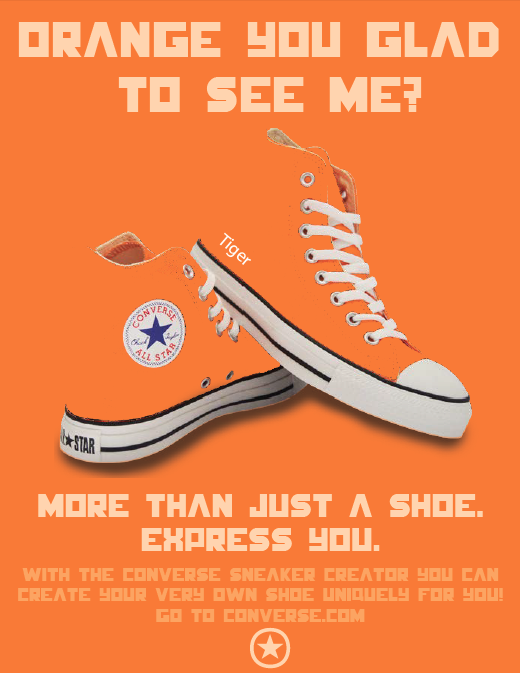
Consider a pretty typical print ad for shoes:

Converse print ad

Now consider an AdWords ad for shoes:

Orange running shoes google ads

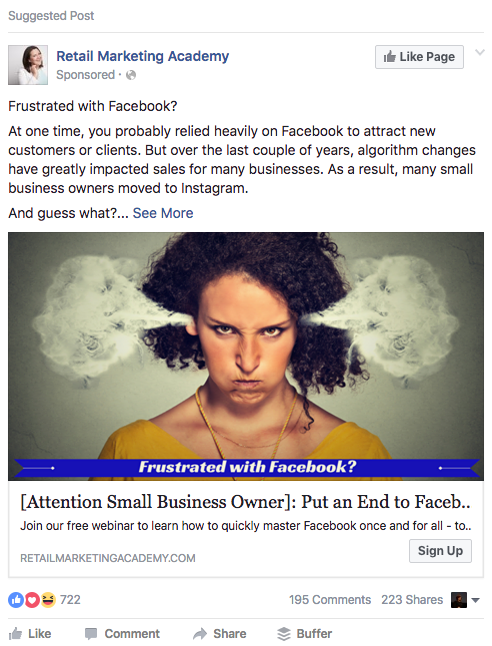
And a Facebook ad for shoes:

Facebook ad for shoes

Are Facebook ads more like print ads than we give them credit for?

Your eye goes to the image in both a print ad and a Facebook ad. Their general composition is similar, with copy and art present. Both can be used to attract prospects at every stage, from unaware to coupon-shopping. So perhaps we can say that writing Facebook ads is a lot like writing print ads. At least, it may be more like writing a print ad than it is like writing an ad that will show up on the SERPs.

But here’s the thing: In print ads, copy and art work together. If you’ve ever worked in an agency or a creative department – and I’ve paid my dues in both – you know that copy generally leads art, in a harmonious way. That is, to generate ad campaign concepts:

  1. Copywriters and designers get in a room to brainstorm, after which
  2. The copywriters head off to flesh out concepts with taglines and higher-level copy, scrapping the weaker ideas as they go. This leads to
  3. The copywriters sharing their fleshed-out concepts with art, which then works to bring the concept to life visually.

That’s the basic creative process to create ads like:

Get off your ass ad

On the other hand…

In Facebook ads, the rule of thumb is for marketers to focus on the image. It’s not about copy and design working together. The image is the most important thing. In fact, it would be like pulling teeth to get FB marketers today to imagine even testing an ad that didn’t lead with a big ol’ image.

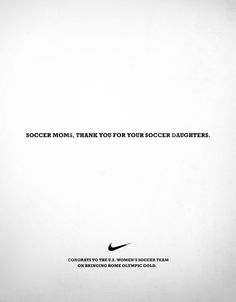
Compare that to print ads. A print ad does not always require an image. The message drives the ad. If an image isn’t necessary to express that message, then there is no image:

Nike ad soccer moms

But a Facebook ad is doomed sans image.

Also unlike print ads, Facebook ads:

  • Live in a social space, where shares, likes and pics of friends pepper each ad
  • Include clickable calls to action
  • Can be commented on
  • Can be tested with great ease, low cost and relatively strong reliability
  • Can be highly targeted

So a Facebook ad isn’t like a print ad.

It isn’t like a Google ad, either.

That’s why we need this beginner’s guide to writing Facebook ads – because the old copywriting rules may not apply in the same way.

Let’s start with a point you may already be very familiar with:

When Writing Facebooks Ads,
Place Key Messages on Your Ad Images

We want to put the important messages where they’ll be seen.

So if all eyeballs are on your image, then it only makes sense to put key messages on said image, like Merchology does:

Facebook ad with copy on image

This is the sort of thing that might excite many a direct-response copywriter. But before you go loading up your Facebook ad image with copy, know this: Facebook won’t allow you to publish / use an image where copy takes up more than 20% of it. In their own words:

Facebook prefers ad images with little or no text, because images with a lot of text may create a lower-quality experience for people on Facebook.

“Text” includes text you’ve overlaid on an image as well as text-based logos, watermarks and even text in your video’s thumbnail images.

Where you place your copy on the image also matters. That’s because, as of the time of this writing, Facebook uses a grid overlay when approving your image. According to Jon Loomer, if your text falls over the gridlines, Facebook may misread your image as text-packed when in fact it meets the 20% rule. Check out Loomer’s example:

20% text rule on FB

So save yourself some frustration and test your images with this rather handy tool before submitting your ad and angering the approval gods.

To make it easier for busy readers to consume that tiny bit o’ text on your image, Contently’s Content Strategist suggests you feature just one product in the image or use a plain, white or blurred image background. The image itself needs to pass Facebook’s guidelines, which include accurately reflecting the product and – to the great sadness of many a weightloss biz – no before-and-after shots.

Now, what copy actually goes on your ad image?

SEMrush recommends focusing on the one message that is most likely to appeal to readers. But that begs the question: Who are my readers? Facebook’s targeting tools make it easy to go as granular as you’d like with your audience (although these smart folks recommend against going too narrow). But for the purposes of this post, let’s break readers or prospects up into TOFU (top of funnel) and BOFU (bottom of funnel).

A TOFU ad is trying to turn a Facebook user into a lead. This might mean setting a goal of a like, download or click.

A BOFU ad is trying to turn a Facebook user into a paying or returning customer. This might mean setting a goal of an account creation or sale.

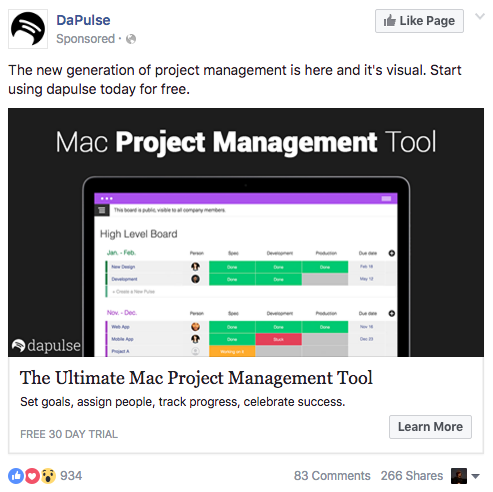
So an on-image message that might appeal to TOFU readers will intro the brand or speak to the product’s value prop. Like this:

Da Pulse TOFU Facebook ad

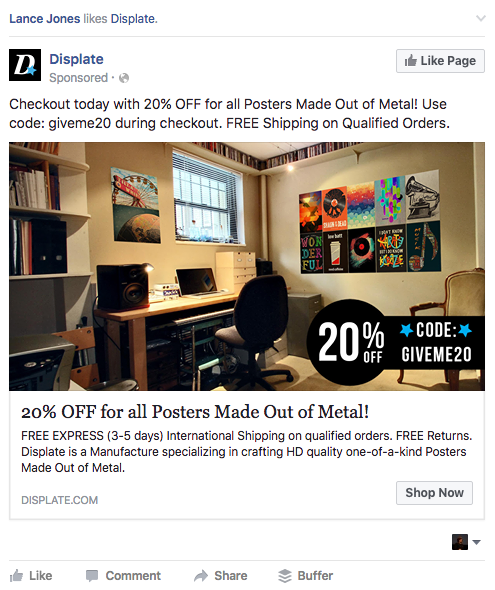
And BOFU on-image copy should prompt the sale – which scarcity, urgency and incentives are great for. Like this:

Displate BOFU FB ad

What you’ll notice, if you compare the two ads above, is that the on-image copy is reflected in the ad’s body copy. This is by design – it’s a better practice you should follow with your ads.

You might also notice that on-image copy is very succinct. After testing 100,000 Facebook ads, Consumer Acquisition found that on-image copy must be “short and snappy.” They also found that copy tends to perform best when it’s in a horizontal or vertical copy bar, with a background color behind it to increase contrast against the image itself.

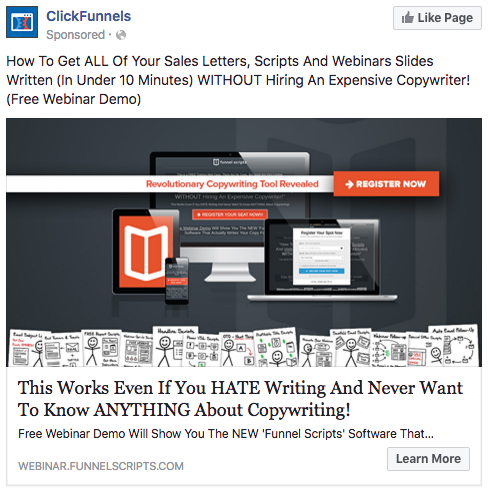
Both TOFU and BOFU can benefit from on-image CTAs, which can invite more clicks (because people love clickin’ those bu’ons). Keep in mind that the goal of the button is to drive clicks, so make sure it looks like a big, juicy, click-worthy button. Like so:

Facebook ad image with register now button

My friend Gavin Helm-Smith (a stellar copywriter at Agora in Australia) has written every kind of Facebook ad you can imagine a thousand times over. Here’s what he says about the copy that should go in an image:

So I always integrate my headline into the image because if Facebook users are gonna stop and look at the image first, the copy will get them to click. The headline in the image is usually the same message as the body headline, but it’s longer.

I don’t worry so much about the 20% rule – it’s gone in Australia – but what will happen is if you have too much text in the image, your reach is throttled, even if you’re bidding high. Facebook doesn’t want complete text ads. But they’re giving the advertiser a little more freedom on how much text they have in there. (This is very new.) Even still, try to stick to the 20% rule when adding your headline copy.

Another advantage of putting the headline in the image is you can go above their character limits for body copy. You can write longer headlines than in the power editor.

In my research, I couldn’t find any tested better practices in copy placement, aside from Jon Loomer’s piece about the FB image grid. That most certainly has a lot to do with the fact that Facebook offers a lot of ad types, each with their own image specs. That said, if you’re in the market for a Facebook ad image template you can write on effectively, try Canva’s ad templates and use this guide by AdEspresso to choose the right template for your ad.

BONUS FROM GAVIN: Create your next ad using slides, and tell a story across each of the slides using on-image copy. This lets you better intrigue and convince your prospect without relying too heavily on the body copy.

The Essentials of Writing Facebook Ad Copy

In a webinar hosted by Bounce Exchange, this is the visual hierarchy presented by a company that tested millions of impressions and spent hundreds of thousands of dollars:
  1. Image
  2. Main headline
  3. Main copy
  4. Secondary copy (top copy)
  5. Call to action

As helpful as that list is, it leaves out one critical component of any great ad: the offer. Unless you’re going for brand impressions alone, your offer is going to make or break your ad.

The ad copy closes 'emWhat are you offering your reader? It has to be good. No, it has to be great. No, they have to think it’s f***ing phenomenal. Yes, that’s a lofty goal. Yes, we should set lofty goals for our copy. That’s what separates a good copywriter from one you never wanna let go of. After all, the image may capture attention – but it’s the copy that closes people.

So make your offer outstanding. Use the “3D” approach I talk about here to see and show your offer from the angles your prospect needs you to show ’em

K, so, we’ve already tackled what and how to write copy for the image.

Now let’s get into the part where it’s just you, the FB ad interface and your keyboard.

This is actually the fun part. (In spite of what the decidedly business-y Facebook ads interface would have you believe.)

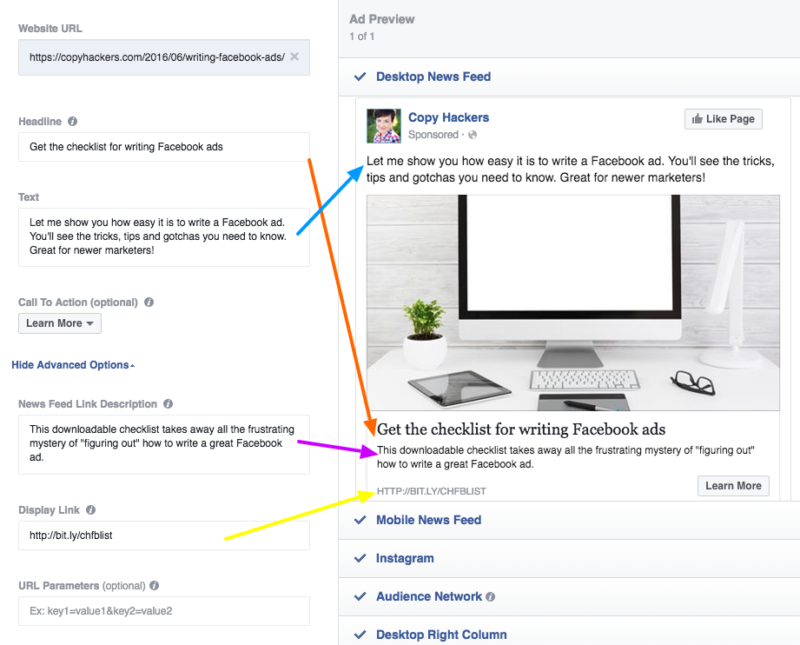
No matter what type of ad you’re writing, every beginner has basically got these fields to work with:

Fields for copy in Facebook ads

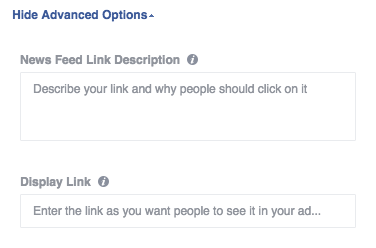
You can click to expand the Advanced options, which is where you’ll find the copy to write for the Newsfeed:

Advanced copy in FB - fields for ads

Each field has a certain character limit or consideration. But these vary and change. So get the most up-to-date guidelines here

Now, where it gets fun is when you actually start filling those fields in and watching the auto-preview change. I challenge any copy geek to find this part boring. The instant gratification is so… instant. And gratifying.

But you can’t actually see your copy preview as an ad until you’ve got an image in place.

So what I like to do is just use a Facebook-provided stock photo as a placeholder. That way I can keep tweaking the copy and seeing how it looks – without worrying about O Great and Mighty Image. This is an early draft of the ad for the checklist I’m giving away with this very post, placeholder in place:

Our FB copy in an ad

At the same time I’m filling out those fields, I’m imagining my headline on the image and asking myself what I should do differently with the headline once it’s on the image so it works extra-hard.

Which brings us to the most obvious part of writing Facebook ads: better practices for filling those text fields with attention-grabbing and -holding copy. First headlines, then “text”, then link descriptions.

How to Write Your FB Ad Headline:
10 quick tips and 1 advanced one

Let me get these 10 quickies out of the way before we get into the good stuff.

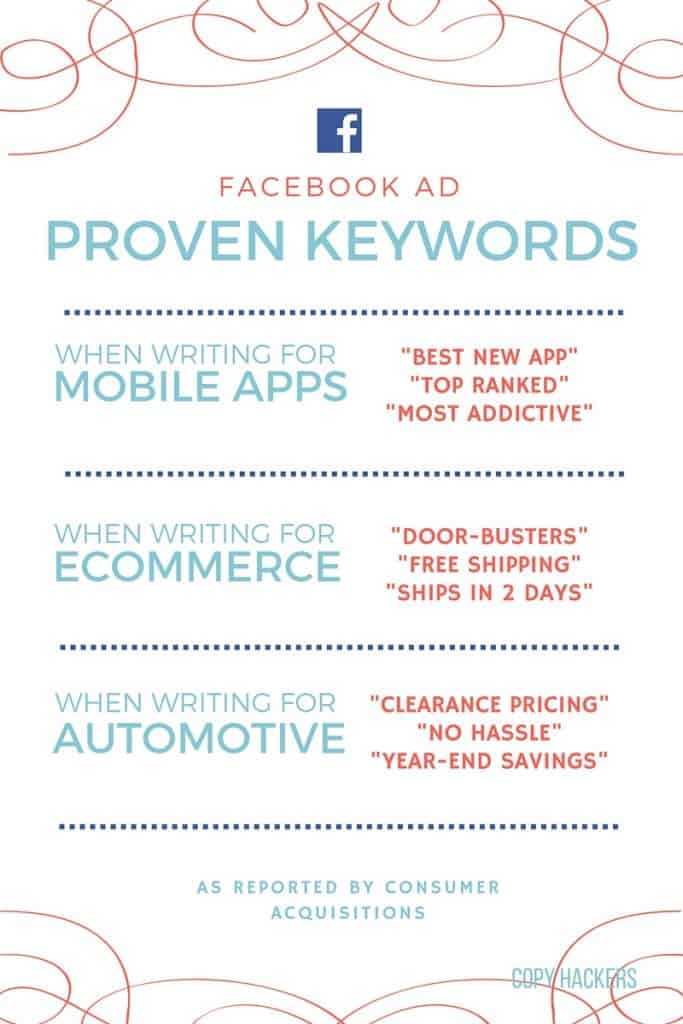
FB keywords that workWhen you’re writing a headline for your Facebook ad:

  • Write for the click. Your ad headline should be a CTA all of its own. Basically, make the first word the imperative form of a verb.
  • Connect “what” with “why.” State what to do – and then say why. What’s the benefit or outcome of acting?
  • Focus on a single, specific thought. People can’t save time and money. They can save time. Or they can save money. Simplify.
  • Use numerals and special characters. We need to draw the eye. So people won’t save a thousand bucks. They can save $1000.
  • Show empathy. The more you’re in their head, the more you’re in their head.
  • Use “new.” Nothing puts an itch in people like the word “new.”
  • Keep it short. As much as this pains me to write, it’s true: AdEspresso found that a max of 5 words is best for FB ad headlines.

In many cases, you may also want to:

  • Ask an immediately relevant question. Just be sure to follow these rules
  • Mention the offer, including any incentives. That could be free shipping for BOFU or a downloadable ebook for TOFU.
  • Make a promise. But back it up, either in the ad or on the landing page. Facebook has rules, y’know.

All of the above 10 points can make for killer starter copy. As can the complete list of headline formulas here >

Now let’s make that copy even better.

This is a beginner’s guide, so I’m not gonna go nuts with advanced copywriting tips. But here’s a sweet-a$$ one that can make for really great copy testing…

Test 5-Foot Benefits vs 5-Mile Benefits

Kim Garst, AdEspresso and others recommend stating a benefit in your ad copy.

Every feature, product or service worth writing an ad about has benefits for the end user. To find the benefit of an offer – the core of an ad – copywriters commonly answer this question:

How will my reader’s life be improved by this offer? 

The answers vary and are easily divided into:

  • 5-foot benefits. These benefits are so close, they’re within reach. You’ll realize them almost as soon as you take the offer.
  • 5-mile benefits. These benefits are life-changingly amazing… and, accordingly, they take a while to realize.

Benefits

Sometimes “save money now” works better than “turn heads at the beach.” Other times, it doesn’t. So test away.

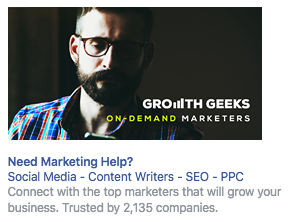
A 5-foot benefit: Connect with an expert5-foot benefits

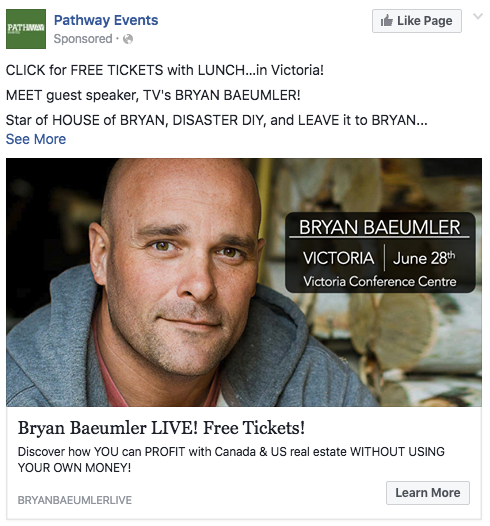
A 5-mile benefit: Profit from real estate
Bryan B FB ad benefits

How to Write Your FB Ad “Text”
(In 90 characters or fewer)

We call text “copy.” Facebook doesn’t. #sigh

The text area ends up right under your name and pic in the ad. For every ad objective, Facebook recommends you use no more than 90 characters of text; the platform will often truncate text for smaller screens, even if you’ve written fewer than 90 characters. So be sure to use the ad preview when writing. For best results, try to stick to 40 characters – that’s the sweet spot Contently’s identified.

One of the most important principles to keep in mind when writing your Facebook ad body copy is this: give your body copy a single goal, and stick to it.

(I spoke about the One Job Principle here, and I later wrote about it here.)

Your ad’s body copy has to move the prospect to click the CTA. That’s its job.

Sometimes doing that job takes a lot of copy:

Lots of Facebook text

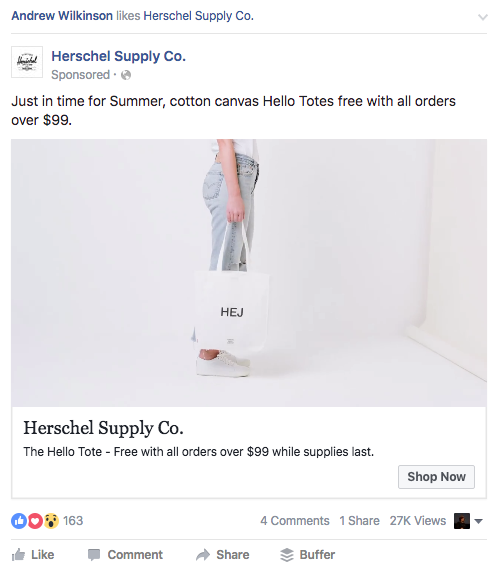
Sometimes it takes almost nothing at all:

Herschel FB ad copy

Writing body copy is the hardest part of writing copy. Period.

Everything about the success of your body copy hinges on a single thing: your hook. To find your hook, you need to know exactly for whom you’re writing the ad… and what they care about. Because the goal of the hook is this: make me care.

Make. Me. Care.

With that in mind, here are some easier ways to find your hook (instead of staring at the screen and wondering how to “make me care”):

  • Pick a fight. Start your text / body copy by saying the opposite of what people believe to be true.
  • Disrupt expectations by changing a cliche. The hook for ad about a hairstyle tutorial: Drastic times call for drastic bangs.
  • Help them imagine, “What if?” What if you had your competitors’ keywords at your fingertips?
  • Cite a previously unknown study. This hook naturally requires some work – but did you know that 98.4% of all work is worth it?
  • Kill something off. Crop-tops are dead.
  • Revive something. Drop shadows are back.
  • Use a known quote, without “quotes.” Say hello to my little friend: Tamagotchi for iPhone 6.
  • Change a known quote, without “quotes.” It is a truth universally acknowledged that a single woman in possession of good fortune treats herself to a Porsche.
  • Make a confession. You’re not gonna like me for this, but…

Should you happen to know I already care about, say, who you are, your name can also act as a hook:

Lewis Howes Facebook ad

Once you’ve found your hook, your job becomes moving your prospect from the hook through the path you’re creating en route to the CTA.

That’s the job of every other word you write in the text field.

So if you’re gonna stick to the 40-char or 90-char rule… you haven’t got much room. Which means your hook has to haul ass toward the CTA. Which may only make sense to me. Nonetheless, there’s really no other way to describe it: move your prospect from A: Headline to B: CTA using a strong hook and persuasive, intentional, succinct “text” copy. Hey, nobody said this’d be easy. It’s the hard, non-formulaic stuff that makes copywriting fun, isn’t it?

But maybe right about now you’re thinking, I’ll just write longer copy. Well I happened to pass the same idea by Gavin Helm-Smith, and here’s what he told me:

If you’re gonna send your prospect to a landing page, short copy is a good default. Short. Sell the click honestly. Then do the heavy lifting on the landing page.

But if you want them to convert on the ad, it can help to go longer. I use the 4 Ps formula to tell a bit of a story. I was working with a client selling photography packages on a discount. Short copy sold them okay, but it was far too focused on the offer, not the benefit. When I introduced a story that tapped into nostalgia, that skyrocketed the ad.

How to Write Your FB Ad’s
News Feed Link Description

We’ve reached that point in the FB ad copywriting experience where we can address this little oddity:

When you write a Facebook ad, the text copy and the headline copy
are split up on the most popular ads: Desktop News Feed ads.

The reason for said oddity surely has plenty to do with Facebook’s ad platform history. I’ve been writing Facebook ads on and off for the last 5 years. If you’ll recall those ancient days of 2011, all Facebook ads happened in the right column. There was no “news feed link description.” …And right-column ads performed abysmally. Gavin Helm-Smith has seen newsfeed ads outperform right-column ads by as much as 9x.

News feed nopers

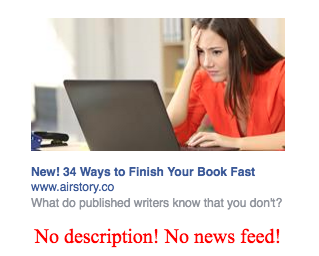
Today, of course, ads appear throughout Facebook news feeds. And when you’re writing ads that are going to appear in a news feed, you need your “News Feed Link description” to work with your headline. That doesn’t mean they have to, like, match each other… But they can actually work together in a very cool way, like so:

News feed Airstory ad

In that example, the news feed link description doesn’t need to appear for the ad to work. But when it does appear – like in a news feed instead of the right column – it plays on the headline.

Writing your news feed link description is a lot like writing the “text” copy. So all the same rules about hooks are at play here, too. The greatness of this extra copy space is, of course, that you’ve now got more room to move your prospect from A to B. Sometimes that simply means repeating and expanding on what your “text” copy expressed, like Betabrand does:

Betabrand news feed ad

As we wrap up this beginner’s guide, it’s worth mentioning: make sure every claim you make in your ad is supported on your landing page.

As Gavin Helm-Smith tells me:

On landing pages, if you make a monetary claim but you don’t support that with proof, you’re in trouble. For example, if you’re writing for “work from home” people, you want to give a specific claim like “Make $700 per month by working from home” and you want your reader to download the book to get the tips for working from home. But Facebook doesn’t want that. Facebook wants you to tell them how on the landing page itself.

The Facebook Ad Copywriting Checklist

I started with the bad news.

Now here’s the good news: I’ve made checklists for you! Use them for your next Facebook ad campaign.

PLUS! There’s even a bonus checklist for optimizing your Facebook ad copy. It’s everything you’ll need to write good Facebook ads and make ’em even better.

Checklist for placing copy on images:

  • Repeat your headline in the image, but expand on it OR use a very short, appealing message
  • Place copy in a horizontal or vertical bar with a high-contrast background
  • Include a juicy, eye-catching CTA
  • Be careful not to let copy take up more than 20% of your image
  • Put copy on an image “about” 1 thing OR use a plain background
  • Use Facebook’s image tester before submitting an image
  • Repeat on-image copy in the ad’s body copy

Checklist for writing Facebook ad headlines:

  • Make the headline a CTA
  • Keep it to 5 words
  • Add a benefit to the headline
  • Test 5-mile vs 5-foot benefits
  • Keep it simple – focus on 1 thing
  • Attract eyeballs with appropriate special characters
  • Be empathetic – any pains you’re solving are real pains
  • If it’s new, say so
  • Ask a question that’ll bring in the answer you want
  • Mention the offer (plus incentives!)
  • Make a promise within reason

Checklist for writing Facebook “text” copy:

  • Open with a strong hook
  • Keep it under 40 characters – max 90
  • Quickly move the prospect from the headline to the CTA

Checklist for news feed link description:

  • Make the description work with your headline
  • Repeat, clarify or expand on the offer expressed in other copy

Checklist for optimizing your Facebook ad copy:

  • Add text to your videos, which autoplay on mute in the newsfeed
  • Use these magic words: You, Free, Because, Instantly
  • Use urgency to nudge the click (which is harder to get than you’d think)
  • Choose “learn more”, “sign up” or “shop now” as your CTA
  • Try short, fragmented sentences that feel like a friend would post
  • Drive to a targeted landing page made just for your ad
  • Make it easier to consume content by varying font sizes in your on-image copy
  • If people know and like your brand, incorporate your brand in on-image copy
  • Keep the same image and headline on your landing page that you used in the ad
  • Take the copy from your landing page and put it in 5 or 6 slides, which FB converts to video (which gets prioritized in the newsfeed)

Big ol’ thanks to Gavin Helm-Smith for all his insights into optimizing Facebook ad copy.

~jo

The post The Beginner’s Guide to Writing Facebook Ads appeared first on Copywriting For Start-ups And Marketers.


from
http://redirect.viglink.com?u=https%3A%2F%2Fcopyhackers.com%2F2016%2F06%2Fwriting-facebook-ads%2F&key=ddaed8f51db7bb1330a6f6de768a69b8

How to Combine Lead Magnets and Ads to Jump-start an Online Training Business

hero's journey - thriving in a changing marketplace

Debbie Hodge has a healthy dose of that crucial trait all successful entrepreneurs seem to have — adaptability.

When she saw that the magazine business was tanking, she realized she needed to find a new venue for her information, so she moved her teaching online.

And when she saw everyone in her space was teaching her topic using how-to tutorials, she decided to take a different approach and focus on storytelling and design.

Business has been good.

It has been so good that she’s now made the ultimate “meta” move: she’s teaching others to do what she herself has learned in recent years.

Debbie’s story is this month’s Hero’s Journey feature. We’re tapping the collective wisdom of our community members to bring you reports from the front lines of the content marketing world. See all the Hero’s Journey posts here.

Read on as Debbie shares her story.

How to zig while others zag

Debbie Hodge: I’ve owned Get It Scrapped — an online business that offers scrapbooking education — since 2007. The primary product offered is an educational membership with classes focused on scrapbook layout design and storytelling. I take a different approach from the rest of my industry, which usually offers how-to, project-based education.

Teach What You Do, which began in 2015, is where I offer a single flagship, premium-priced online class: the eCourse Blueprint, an 8-module, 24-lesson, A-to-Z blueprint for creating and selling an online course. Everything is online, including lessons with video, audio, transcripts, slides, and workbooks. Live “office hours” and “guest expert” webinar sessions supplement that “on-demand” lesson content.

I’ve been creating and selling profitable online courses for nine years. I understand the process, the technology, and I’m always thinking about creative ways to teach in an online classroom.

Adaptability and taking the less-traveled path

Debbie Hodge: The unique angle I’ve taken in the scrapbooking training niche is to focus on scrapbook layout design and storytelling, as opposed to the common models of teaching technique via specific projects and products. That has helped my materials stand out.

I also strategically use lead magnets, list segmentation, and email marketing to sell Get It Scrapped memberships.

It all started after I wrote a book for the scrapbooking industry and worked as a contributing writer, designer, and editor for two scrapbooking magazines.

Magazines were going out of business and I realized I’d never been able to cover the kind of ground I wanted to in articles, which were kept short and simple.

Teaching online was a solution — and a way to make money. My early classes were taught in protected forums and online bulletin boards.

Daring to launch a product to a minuscule list

Debbie Hodge: In October 2015, I was ready to launch the Teach What You Do eCourse Blueprint — but I only had 17 prospects on my email list for the new business. This was a huge contrast to my business at Get It Scrapped, where I had a list of more than 19,000 people and I was using three solid lead magnets to grow my list daily.

I felt anxious to get my product launched and delivered within 3 to 6 months because I knew there were already a few people offering course-building courses — and I could anticipate there would be many more coming.

I’d been working on the content for almost a year, and I feared if I didn’t launch soon, I never would.

One more reason to get the course launched was to have a premium-priced product to complement the lower-priced membership at Get It Scrapped.

I knew that with an engaged list of the right prospects, I would likely convert three percent of my prospects to customers. With that in mind, I began using Facebook ads to promote appropriate lead magnets to build a list of 2,000 people by January, when I planned to offer the class for sale.

The winning combination of lead magnets + ads

Throughout October, November, and December, I used ads to promote six teaching webinars, a free video series, and a free Facebook group.

In late December, I offered early-bird pricing to the most engaged people on my list and sold 30 seats in the class.

With this initial success, I bought even more Facebook ads to promote early January webinars during which I taught and sold the class.

By the second week in January, I had 65 students, revenues of $24,000, and Facebook ad expenses of $4,000. My class was launched.

The successful launch gave me a new confidence in list-building processes and a thrill to be able to prove to myself — and my new students at Teach What You Do — that you can launch a business in three months and grow an engaged list of prospects when you use the right lead magnet content.

For me, the right lead magnet content gets people taking first steps toward creating an online class using processes and tools that I teach them about in live webinars.

Webinars for list-building and engagement

Debbie Hodge: I offer several different webinar sessions that cover topics I see asked about again and again in communities. I promote them to my existing list, with paid ads, and in communities where terms of use allow.

Live teaching webinars are currently great list and engagement builders for Teach What You Do.

These sessions get people started on their own online classes, and they let prospects get a solid sense of my teaching style and knowledge since we’re online together, live, for an hour.

The Rainmaker Digital products Debbie uses

Debbie Hodge: I’m a member of Copyblogger’s Authority and Digital Commerce Institute. I enjoy the community and continued learning. I’ll attend the upcoming live event, Digital Commerce Summit, in Denver this fall.

Also, I’m a Copyblogger Certified Content Marketer and keep that certification current with my Authority membership.

Increasing conversions with small improvements to her sales funnels

Debbie Hodge: The next 90 days at both Teach What You Do and Get It Scrapped are all about improving email communications, including:

  1. A brand-new “welcome” email series for new leads
  2. An improved email series to go with each lead magnet
  3. Better customer on-boarding emails

Connected to this goal of improved email communications is increased conversions. Both businesses need better sales funnels, and improving emails is the first step toward achieving that.

Find Debbie Hodge online …

Thanks to Debbie for appearing in our Hero’s Journey series.

Do you have questions for her? Ask them in the comments.

We’ll be back next month with another story to teach, inspire, and encourage you along your journey.

The post How to Combine Lead Magnets and Ads to Jump-start an Online Training Business appeared first on Copyblogger.


from
http://redirect.viglink.com?u=http%3A%2F%2Ffeeds.copyblogger.com%2F%7E%2F160092378%2F0%2Fcopyblogger%7EHow-to-Combine-Lead-Magnets-and-Ads-to-Jumpstart-an-Online-Training-Business%2F&key=ddaed8f51db7bb1330a6f6de768a69b8

Monday, 20 June 2016

5 Stress-Free Steps for Pricing Your Services

how to price any project

Why does pricing our services provoke such fear and dread?

Even when we’re certain that we provide an exceptional service and charge what we’re worth, we still worry that clients will view our prices as unreasonable.

Of course, we don’t want to underprice our services, either.

Where does this leave us?

Most of the time, it leaves us paralyzed and stuck. So when it comes time to actually give a prospective client a price estimate, we often just take a wild guess.

That’s a huge mistake.

To help you calculate your service prices accurately, I’m going to share a step-by-step method for setting your project rates.

Let’s get started.

Step #1: Perform research and determine your hourly rate

The first step in figuring out your rate is researching the project and asking yourself critical questions (examples below). These questions help you clarify all the details of the project.

You’ll also use the information you gather to determine your hourly rate, and that’s the starting point for the entire process.

At Copyblogger, we highly recommend quoting a project rate, rather than an hourly rate — it protects you and the client.

When you carefully consider your project price, you’ll be able to work comfortably until the project is completed — and you won’t be penalized if you finish faster than anticipated.

And because freelance services are notoriously variable in cost, your client will appreciate knowing their fixed cost going into a new project.

Why, then, do you need to determine your hourly rate if you’re going to quote a project rate?

Your hourly rate is the first variable in your project price. Your client doesn’t need to know this rate — it’s for your own calculations only.

During this step, consider:

  • The project scope. Make sure you have a clear understanding of the client’s expectations and your role in helping him meet his goals for the project.
  • Whether or not this project will lead to ongoing work. Is the client already talking about additional projects he’ll need help with, or is this a one-time assignment?
  • The client’s budget for the project. Carol Tice, a freelance writer and founder of Freelance Writers Den, recommends inquiring about the budget for a new project. Clients won’t always have an answer, but when they do, it gives you a great piece of data to work with. Carol also adds that asking about the prospective client’s budget helps you weed out low-paying clients who don’t value your services!

After you’ve researched the project, your role as the service provider, and the budget, determine an hourly rate. This is the first component you’ll use to calculate your project base rate.

Step #2: Estimate how many hours the project will take

Break down the project into parts, and then estimate how many hours each part will take to complete.

Add up the hours for each part to get the total number of hours for the entire project. This is the second component you’ll use to calculate your project base rate.

Step #3: Multiply your hourly rate by the number of hours, then add padding

Calculate your project base rate by multiplying your hourly rate (from Step #1) by the total number of hours the project will take to complete (from Step #2).

Base rate = (Hourly rate) x (Hours the project will take to complete)

Then add some padding. We recommend adding a markup of 25-50 percent to your project base rate to cover additional expenses, overhead, and that affliction most service providers suffer from, which we call “Acute This-will-be-easy-itis.”

In other words, pad your total time just in case you’re underestimating it (which is extremely common).

Padding will cover aspects of the project like:

  • Client interaction and ongoing project questions. To provide great service, you’ll want to be available to answer client questions and provide status updates — that time can add up.
  • Revisions and additional changes. Are revisions included in your project fee? If so, include them in your markup number if that time isn’t already reflected in Step #2.
  • Other unexpected additions. Ideally, the project will unfold as expected. But if it doesn’t, padding allows you to be flexible (within reason). It enables you to be a helpful service provider who goes the extra mile to meet your client’s needs — because you know your own needs are covered.

Once you’ve added your markup, you have your final project price.

Project price = (Base rate) + (Markup)

Step #4: Communicate the price clearly to the client

Now you can clearly communicate the project price to your client and how you will proceed if the work scope expands beyond the original expectations set for the project.

Actively manage your client’s expectations and avoid miscommunications during this stage of the process.

Step #5: Track your hours and adjust future pricing accordingly

Here’s a critical last step of the pricing process that many service providers overlook: If you want to get better at pricing your services, you must track your hours when working on a project to determine if your original estimate was accurate.

Carol advises:

“Track your time, and find out how long it really takes you to do a project. Most people underbid when they’re getting started, so careful time tracking makes it all about the data. That’s useful.”

If you closely monitor your time and discover you consistently underestimate or overestimate the amount of time you spend on your client projects, you can adjust your future price quotes accordingly.

My favorite time-tracking tools are Harvest and FreshBooks.

Price your services with confidence and clarity

Pricing your services doesn’t have to be a nerve-racking process. When you use a smart method like this, creating price quotes can even be (dare I say it?) fun.

Check out the first two articles in this series on pricing your services:

And remember:

Communicate price quotes to clients with confidence and don’t apologize for your prices.

What’s your method for assessing a project and calculating your fee?

Share in the comments below.


Our Certified Content Marketer training program shows writers how to position and promote their writing businesses

If you’re interested in becoming a Certified Content Marketer, our Certified Content Marketer training program will reopen to new students sometime soon.

You can add your email to our waiting list below to be the first to hear about it.

Find out when our Certified Content Marketer training program reopens:

The post 5 Stress-Free Steps for Pricing Your Services appeared first on Copyblogger.


from
http://redirect.viglink.com?u=http%3A%2F%2Ffeeds.copyblogger.com%2F%7E%2F159857490%2F0%2Fcopyblogger%7EStressFree-Steps-for-Pricing-Your-Services%2F&key=ddaed8f51db7bb1330a6f6de768a69b8

Friday, 17 June 2016

Rainmaker Rewind: Microsoft Just Bought LinkedIn. Here’s Everything You Need to Know

Rainmaker FM rewind

This week on Rainmaker Rewind, Sean Jackson, Jabez LeBret, and Mica Gadhia have a conversation about the recent acquisition of LinkedIn by Microsoft for $26.2 billion.

In this up-to-the-minute episode, you’ll hear The Missing Link team share their thoughts about this announcement and what it means for you.

And as always, don’t miss out on other great episodes that were featured on Rainmaker FM.

  1. The Missing Link. The Missing Link team explores Microsoft’s acquisition of LinkedIn and how it affects each of us: Microsoft Just Bought LinkedIn. Here’s Everything You Need to Know …
  2. The Digital Entrepreneur. Pamela Wilson joins Jerod Morris to discuss what she’s learned through her extensive experience creating and running successful membership communities: Practical Advice on Turning the Challenges of Building Membership Communities Into Opportunities
  3. Confessions of a Pink-haired Marketer. Sonia Simone answers the age-old question: Is it okay to swear in our content marketing? Should You Swear on Your Blog?
  4. Hack the Entrepreneur Jon Nastor interviews leader, speaker, “Marxist-capitalist,” and smart entrepreneur Simon Biltcliffe: Money is the Outcome of Success (Not the Cause)
  5. The Showrunner. Jerod Morris and Jon Nastor discuss a few simple ways to capture inspiration before it escapes: How to Never (Ever) Forget an Important Idea Again
  6. The Writer Files. Kelton Reid rounds out the second part of last week’s interview with Cynthia D’Aprix Sweeney: How Bestselling Debut Novelist Cynthia D’Aprix Sweeney Writes: Part Two
  7. Youpreneur. Tune in to this episode to hear Chris Ducker’s batching strategy and his tips on how to be more productive: How ‘Batching’ Your Tasks Can Put Your Productivity on Steroids
  8. Copyblogger FM. Sonia Simone explains the importance of treating your freelance gig as a business … if you really want to make a good living: How to Make a (Really Good) Living as a Freelance Writer
  9. Hack the Entrepreneur. Jon Nastor interviews SEO specialist, marketing consultant, connector, and digital entrepreneur Brandon Lewin: Why You Need to Do Work That Matters
  10. Unemployable. In case you missed it, Brian Clark finished out Season One with a fascinating interview with Henry Rollins: Henry Rollins on Entrepreneurial Art

And, one more thing …

If you want to get Rainmaker Rewind sent straight to your favorite podcast player, subscribe right here on Rainmaker FM.

The post Rainmaker Rewind: Microsoft Just Bought LinkedIn. Here’s Everything You Need to Know appeared first on Copyblogger.


from
http://redirect.viglink.com?u=http%3A%2F%2Ffeeds.copyblogger.com%2F%7E%2F159319460%2F0%2Fcopyblogger%7ERainmaker-Rewind-Microsoft-Just-Bought-LinkedIn-Heres-Everything-You-Need-to-Know%2F&key=ddaed8f51db7bb1330a6f6de768a69b8

Thursday, 16 June 2016

The Content Graveyard (and Why So Many Articles Fail)

keep your ideas alive

On May 22, 1919, a New York hotel owner named Raymond Orteig announced a prize.

The Orteig Prize, as it came to be known, was the whopping sum of $25,000 (about $340,000 in 2015). It was to be given to the first allied aviators who flew nonstop from New York to Paris or vice versa. 

Six aviators died in the pursuit of that prize.

Then an American air mail pilot named Charles Lindbergh took up the challenge. On May 20, 1927, he took off from Roosevelt Field in New York and landed in Paris 33.5 hours later. Many before him had tried to fly the route in stages. Lindbergh’s feat was that he did it alone and without stopping. 

I’m going to explain why it’s not a good idea to follow the Lindbergh method when you write articles.

The 4 main writing stages

As writers, we see the vast expanse of an article in front of us, and we assume it’s possible to write the article from start to finish. But one of the biggest reasons why we struggle with writing is that we don’t break down the article-writing process into stages.

So, what stages do you need to go through to write an article?

Consider these four stages:

  1. Outline your content
  2. Craft a fascinating introduction
  3. Communicate your core message
  4. Edit and proofread

Let’s explore each one.

1. Outline your content

Animators first create rough sketches and storyboards. Chefs assemble recipes and ingredients. Athletic stars perform warm-up routines before they get to the stadium. 

Many writers simply sit down to write an article and the process gets messy. Without a clear structure, it’s easy to spin your wheels endlessly while attempting to write.

But the outline is just the starting point.

2. Craft a fascinating introduction

The introduction to your article draws the reader into your content, so it’s vitally important, but crafting your introduction can also be the most frustrating part of the writing process.

A successful introduction causes the reader to wind up in the middle of the article without quite realizing how she got there.

It’s smart to plan your introduction in advance. Are you going to highlight a problem or tell a story? How will you hook your reader?

3. Communicate your core message

An article consists of several parts.

First, pique curiosity about your topic and answer:

  • What
  • Why
  • Where
  • When
  • How

If you’re writing about “the core elements of storytelling,” you have to guide the reader through your lesson, propose objections, show examples, add a summary, and take the reader to the next step. 

4. Edit and proofread

You’re not quite done.

Before you post or submit your article, you still must:

  • Fact-check
  • Delete excessive text that doesn’t support your main point
  • Polish your sentences for greater clarity
  • Correct grammar, spelling, and punctuation errors
  • Proofread

Do you cut corners on these stages?

Many writers try to perform all of these four stages in one session.

When I started writing articles back in 1999, I’d follow the nonstop Lindbergh method and fail in epic-style. So many of my articles remained unfinished that I dubbed a folder on my computer the “article graveyard.”

To become a better writer, I had to change my ways.

Here’s how I write my articles now

  1. At the beginning of the week, I outline a series of articles at a café — never at the office.
  2. Several days later, I write out how I intend to start each of those articles.
  3. Then, I’ll take on one piece at a time, working through the core message of each article.
  4. Finally, when I’m finished writing, I’ll edit the articles or get a colleague to review them.

When you have a deadline, doesn’t this system sound tedious?

Deadline stress mostly occurs when we put off the act of writing an article until the very last minute. But if you plan ahead and leave time for these stages, you won’t be constrained by a time limit.

When you systematically go about constructing your article in stages, you stand a much better chance of getting to the other side because it gives your brain time to process your ideas. 

A tired, deadline-driven brain doesn’t work well at all.

You don’t need to write your article the way Charles Lindbergh managed his flight.

Lindbergh paid a high price on his solo flight across the Atlantic Ocean. On the way to the other side, he went through sleep deprivation and delirium. He talked about seeing mirages. He even claimed that apparitions spoke to him and helped him on his trip. 

This doesn’t have to be your fate. There’s no reason to put yourself through that kind of misery.

Ditch the nonstop journey to conquer the content graveyard

A nonstop journey is a sure-fire method for beginning articles that ultimately end up in the content graveyard.

Instead, plan a multi-stage journey over the duration of several days or even a week.

That’s how you’ll win your own Orteig Prize time and time again — and live to tell the tale.

The post The Content Graveyard (and Why So Many Articles Fail) appeared first on Copyblogger.


from
http://redirect.viglink.com?u=http%3A%2F%2Ffeeds.copyblogger.com%2F%7E%2F159081268%2F0%2Fcopyblogger%7EThe-Content-Graveyard-and-Why-So-Many-Articles-Fail%2F&key=ddaed8f51db7bb1330a6f6de768a69b8

Wednesday, 15 June 2016

Copywriting Roulette, or Toward a Theory of Copywriters as Therapists

“Is this gonna work?” Publish. “Nope.”

“Is this gonna work?” Publish. “Nope.”

“Maybe this will.”

And so it continues.

Copy Roulette: the marketing game where startups rely almost entirely on swipe files, plug-and-play templates and step-by-step page structures to grow their businesses. You know you’ve played it before. You see a course packed with “proven templates,” and you buy it for those alone. Then, of course, you use the templates and – surprise! – they don’t work because a) they aren’t right for your audience and product, b) they’ve been used repeatedly by everyone else that downloaded them or c) both.

Copy Roulette is not good for business.

To play it, you:

  • Default to shortcuts instead of doing the research,
  • Favor “proven” over putting in the work, and then
  • Cross your fingers and hope your borrowed templates create the ideal result.

What’s particularly sad about playing that losing game is this: it still took you time, energy and even money to play. You were promised a shortcut. What you got is wasted time. Which means you’re starting from scratch again.

If only you’d spent those resources on the right approach…

Brian Balfour, one of the top “growth hackers” in the world lists 10 reasons why companies fail at growth. You’ll notice that 6 of the 10 speak to a desire to find shortcuts:
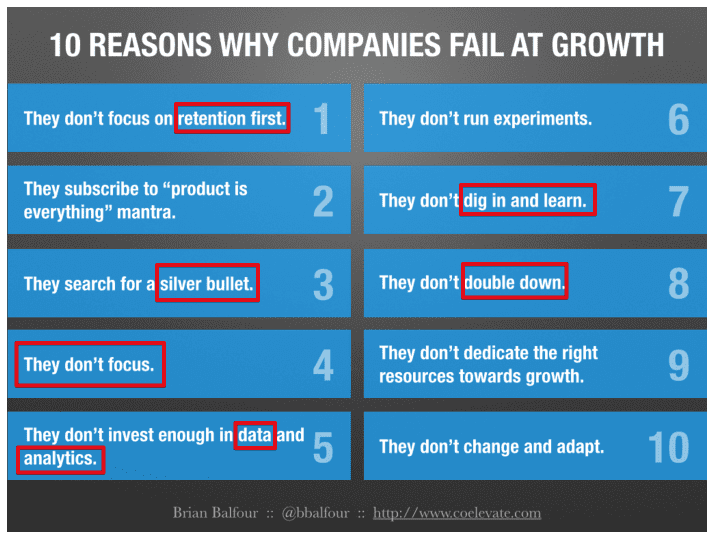
10 reasons growth fails

Copy fails for the same reasons when all you do is swipe, copy-paste and hope for the best.

This is Copy Roulette:

  • Chasing after silver bullets with the latest headline template
  • Not digging in and learning what part of your body copy is failing to convert
  • Not doubling down on the time-tested swipes that also work for your product/market
  • Skipping the data and analytics when examining your traffic sources, heatmaps and recorded visitor sessions
  • Not focusing on what copy to improve or what messaging to lead with

Just stop. …Or did you think you just need to find “better” headlines and copy somewhere else?


what harm are templates + shortcuts doing to your startup? asks @responsecopy on @copyhackers
Click To Tweet


Using a Wilson Blade 104 and standing on a court
does not turn you into Serena Williams

So let’s say you’re in the exact same position every startup on the planet is in: you’re dissatisfied with your conversion rate and MRR.

Those are not problems that can be solved by swiping the right headline or borrowing Groove’s marketing plan.

In most cases, those problems are symptoms of a deeper issue: something is broken with your offer, your messaging and/or your product-market fit.

You already know that. I know you do. I’ve consulted with dozens of startup marketing teams across the US and Europe, and I’ve seen the same issues time and again. I’ve also seen the same quick-fixes: somebody else’s email copy, landing page copy, A/B test or marketing strategy.

(Side note: I’m not saying you should ditch all of your copywriting templates, structures or entire swipe file library. Keep them. Reference them. But know that they’re superficial – they’re bandages on scratches.)

True growth that’s sustainable, predictable and exponential can only be achieved when you’re writing copy with a strategy that’s tested and provenIt’s this:

Knowing your customers better than they think they know themselves.
And better than your competitors do.
And then
using their own words to get them to take action.

Now that I’ve fed you some tough love, let me give you something you can reliably use. It’s a proven, tested way to truly understand people.

It’s called… therapy.

Before you roll your eyes, give me just two more minutes to get you on board. It’ll be worth it. Let’s start with this – have a quick read about Alliance Theory:
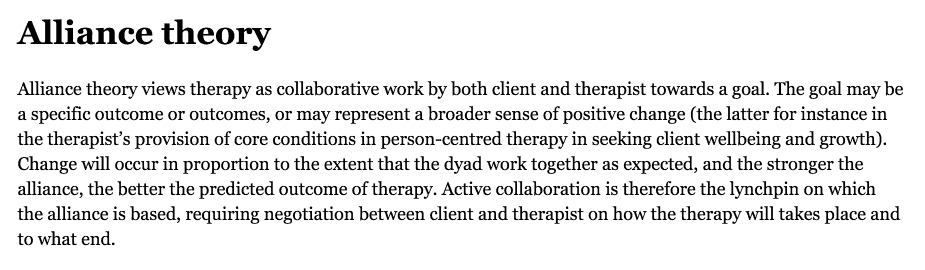
Alliance theory and copywriting is (almost) the same

From “The Beginner’s Guide to Counseling & Psychotherapy” by Stephen Palmer

You – as a founder, marketer and copywriter – should form an alliance with your potential customer and work together towards a sale. (Or, as my friend Ryan Schwartz puts it: “You’re coaching the sale”.)

That’s an interesting idea, isn’t it? Forming an alliance WITH your prospect. It’s so interesting, you should tweet it:


Copywriting technique: form an alliance with your prospect, by @heysamwoods on @copyhackers
Click To Tweet


I’m going to teach you exactly how to do that in this article by sharing the 5 ways to get more leads, fan and sales by channeling your inner therapist. (And by not just blindly copying what someone else did. No matter how “epically successful” they tell you their campaign was.)

5 Strategies to Get More Leads, Fans and Sales
By Channeling Your Inner Therapist

Here’s the skinny on what your therapist can teach you:

  1. Get close to your reader
  2. Tap into the right cognitive biases
  3. Become the obvious “yes”
  4. Convince powerfully
  5. Trigger emotions that drive behavior

What do you do with each of those?

Let’s start with the first…

Strategy #1 – Get Close to Your Reader

There’ve been beaucoup de studies done on the importance of the therapeutic relationship.

To save you years of reading (you’re welcome), I’ll just give it to you straight: that relationship is a mighty big deal.

So, imagine if just like a therapist you believed your most important objective was to build, nurture and strengthen your relationship with your customer EVERY time you interacted with him. Imagine if you believed it with such conviction that you put it on the top of your list every day.

What might happen?

Let me give you the CliffsNotes: You’d start converting like a mofo.

Here’s how you can learn from the “therapeutic relationship” and directly transfer those skills to the various phases where your copywriting will move the needle (acquisition, conversion, and so on).
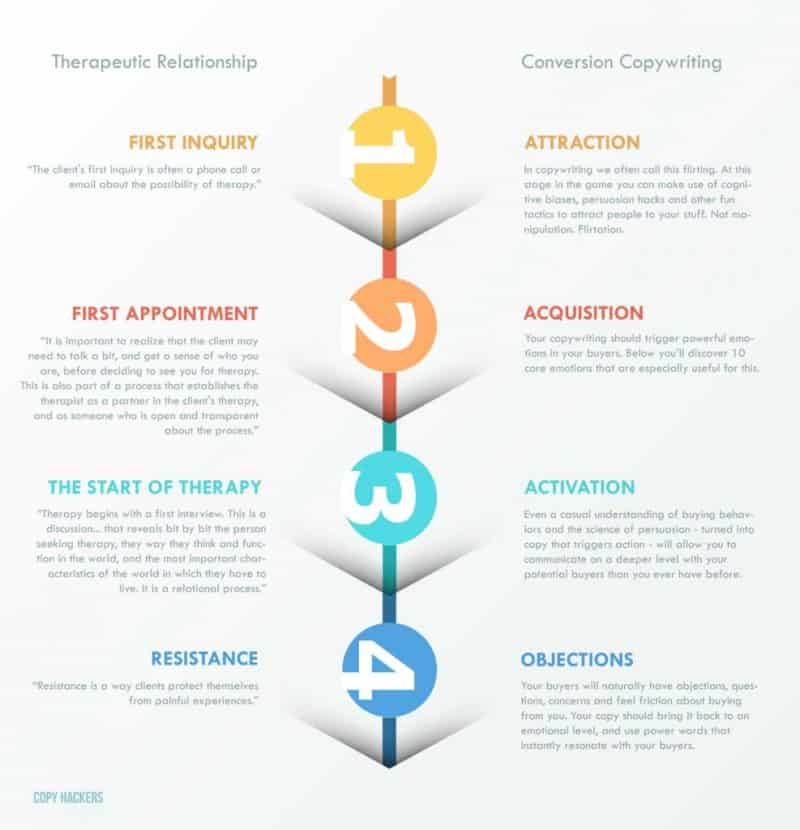
therapy vs copy on Copy Hackers by Sam Woods


Sources on cognitive therapy here, more techniques here and here.

This isn’t YAT, or yet another table. This is a strategy. A “strategy” therapists have been using with their clients since the beginning of couches and clipboards. And one that could actually help you get double or triple the results you want.

Because if you don’t start putting your relationship with your potential clients and customers on the pedestal it deserves, 1) your copy is going to suck, and 2) your company is going to end up in the company graveyard rapidement.

Strategy #2 – Use the Right Cognitive Biases to Drive Conversions

Cognitive biases are errors in judgement and decision-making, common to all humans. Why do they happen? Because of our cognitive limitations. This is often referred to as Bounded rationality, “the principle that organisms have limited resources, such as time, information, and cognitive capacity, with which to find solutions to the problems they face.”

It works like this:

You’re at a restaurant, looking at a menu and trying to decide between fish or steak.

You don’t have all the available information on how fresh the fish is (or isn’t), or if the steak is going to be juicy. That’s limited information.

You’re hungry, starving even, and haven’t hydrated enough today. Or maybe you’ve had one too many drinks before dinner. Either way, your cognitive abilities (to think, reason) are limited.

Next, the people you’re having dinner with are ready to order and they’re impatient. The waiter? Oh yeah, she’s waiting for you to decide. You have limited time to make your decision.

All this works against you making the best decision – any decision, really.

This is true for you, me and everyone else.

Your website visitors, email subscribers, trial users, customers – everyone – have brains that simply make predictable mistakes and use heuristics (shortcuts) to grasp reality and make decisions.

This means that, if you play your cards right, you can harness the behaviors these biases cause.

BUT.

If you just rush off in search of a list of all the cognitive biases there are, crank out random experiments and write half-baked copy…

You’re on a fool’s errand. Sorry. But it’s true.

Here’s what you absolutely, positively, cannot miss:

  1. Your potential customers aren’t robots walking around, waiting for someone to tap into their wiring and remote-control their behavior.
  2. They’re human beings, with desires, emotions, beliefs and experiences that influence what they say and do.
  3. So, when your potential customers find themselves in various situations, their brains will only serve up the information that’s recent, frequent and relevant (see the research and article, published in Encyclopedia of Human Behavior).

This means there are only SOME biases that work well for conversion copywriting.


not all cognitive biases will help you persuade, by @heysamwoods on @copyhackers
Click To Tweet


But too many (maybe even you) are seduced by the thrill of knowing a bunch of biases. C-levels love hearing about ’em, so marketers love talking about ’em. I submit the following as evidence:
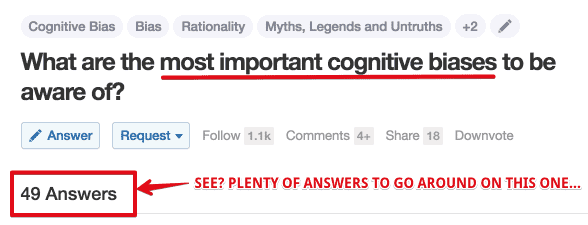
What are the most important cognitive biases to be aware of? On Quora

That’s way too many answers for what’s supposed to be “the” Most Important Cognitive Biases, no? (Here are even more.)

Everyone has an opinion on which cognitive biases are the most important.

But you and I are not interested in how many there are, or necessarily what they’re called. That’s the stuff of party tricks. It’s not helpful when it’s time to write better copy. Far more powerful is knowing this:

When and where to use a bias for maximum impact on conversion.

If you understand your customers well enough, you can reliably stick to a handful of biases, strategically deployed and used throughout your landing pages, forms, emails and so on.

If you were a therapist, you’d be thinking about what your client needs to move forward in their treatment.

As a copywriter, you should be thinking about what copy will move your potential clients and customers forward in your nurture and sales process. That thinking will make it crystal clear what words to use. So now, rather than trying your hand at yet another game of Copy Roulette, let me share with you the 5 most effective cognitive biases to consider when writing copy and designing pages or experiences. Not only will I share with you the biases – but I’ll also share with you the points in the average SaaS funnel at which they historically have worked best AND exactly when you should use them.

Cognitive Bias #1: The IKEA Effect
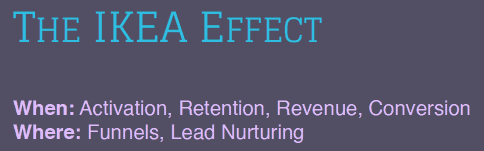
Cognitive bias: The IKEA effect

What it is: People have a tendency to place a disproportionately high value on products/services that they’re part of creating, often regardless of outcome (like IKEA furniture).

How you use it: When you make people “work” towards buying and using your product or service, they’ll value it more. They’ll also be more invested and stick around longer. In the sales process, you can use techniques like collaborative discoveries and closes. When they work towards something, they’re more likely to follow-through and make a purchase (or convert).


what ikea has to do with persuasive copywriting, by @heysamwoods on @copyhackers
Click To Tweet


Take a look at Algolia’s homepage, for example:
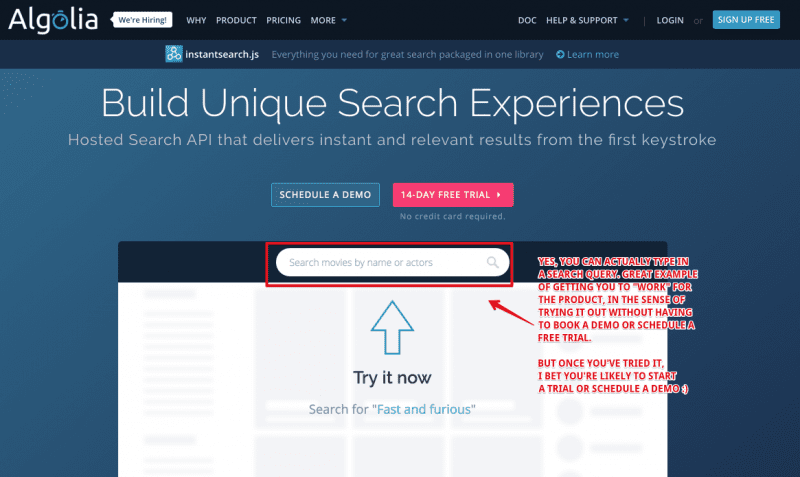
Home page copy on Algolia, using the IKEA effect

Home page copy on Algolia, using the IKEA effect

On the homepage, you can type in a search query (the arrow and “try it now”, plus search suggestion is strategically placed to move your eyes back up) and see how it works.

Once you’ve tried it, it’s a small micro-commitment that could very well encourage you to take the next step, either start a free trial (small ask) or schedule a demo (medium ask).

But the point is this: From the very first moment, you’re tasked with getting involved and even trying the product, prior to a real demo or trial.

What you should do: Consider what smaller steps your potential customers can take, before they have to sign-up for a free trial or get on your list. You could use surveys and quizzes, contests or even demos that aren’t hiding behind an opt-in wall.


how to use The IKEA Effect, on @copyhackers
Click To Tweet


Cognitive Bias #2: The Ambiguity Effect
Cognitive bias: the ambiguity effect

What it is: Tendency to avoid options or actions that are missing information. This makes the outcome and probability seem “unknown.”

How you use it: Make outcomes and next steps crystal clear at key conversion points. If people don’t understand your product/service or action, they will not choose it.

Here’s a great example of a poor homepage (obscured to protect the guilty) falling prey to to this bias:
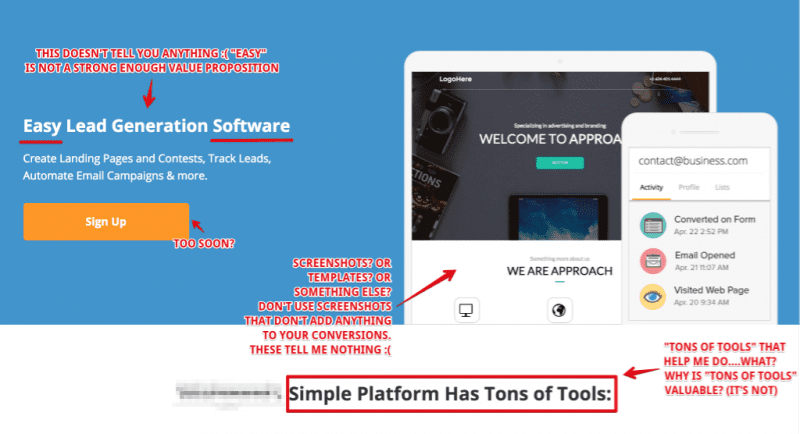
Ambiguity effect in your copy

Ambiguity effect in home page copy

Their lead generation software might be amazing. But “easy lead generation software” tells me nothing. The word “easy”, much like “made simple”, is over-used and useless in this context. Having obscured what software this is, it doesn’t stand out at all, right? Nothing memorable. No clear value proposition. Just “tons of tools” and a nondescript screenshot.

And what am I signing up for?

The CTA lacks context + micro-copy that could help the visitor understand just what’s going on.

It’s all just very ambiguous.


is “ambiguity effect” making your copy perform poorly? asks @heysamwoods on @copyhackers
Click To Tweet


What you should do: Don’t let your amazing product or service suffer from poor copy. When you think like a therapist, you’ll realize that speaking in ambiguities lead nowhere. Same goes for copy and conversions. Use tools like UserTesting to get a sense of how complete strangers perceive your copy and messaging.

With that taken care of, you can harness the next bias pretty easily.

Cognitive Bias #3: The Attention Bias
Cognitive bias: the attention bias

What it is: The tendency of our perception to be affected by our recurring thoughts.

How you use it: The more often a lead sees your message, Unique Selling Proposition, ads, etc., the more likely she is to respond, take action and purchase. Make sure your messaging is consistent, that you have plenty of CTAs (that look the same with the same copy) and use retargeting.

This example, from Price Intelligently, is fun:
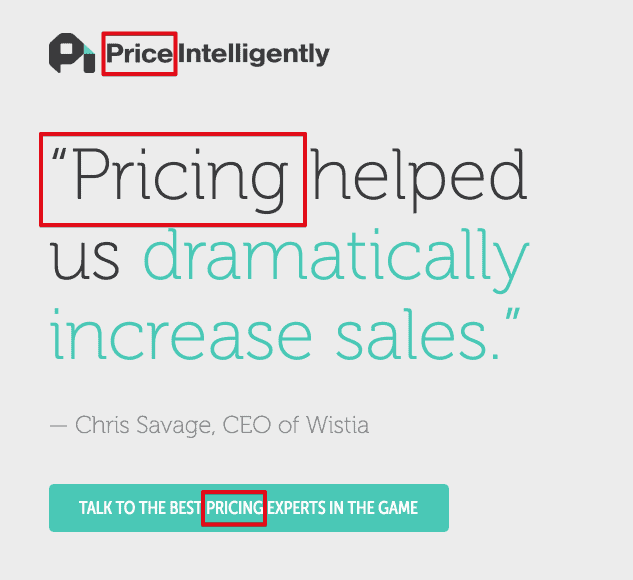
Good example of the attention bias in copywriting

Good example of attention bias in copywriting

See the repetition of “pricing” in various forms?

This is just on their homepage, and hero section alone.

Notice the coupling of “pricing” with customer testimonials talking about outcome and benefit. When you scroll, you see:
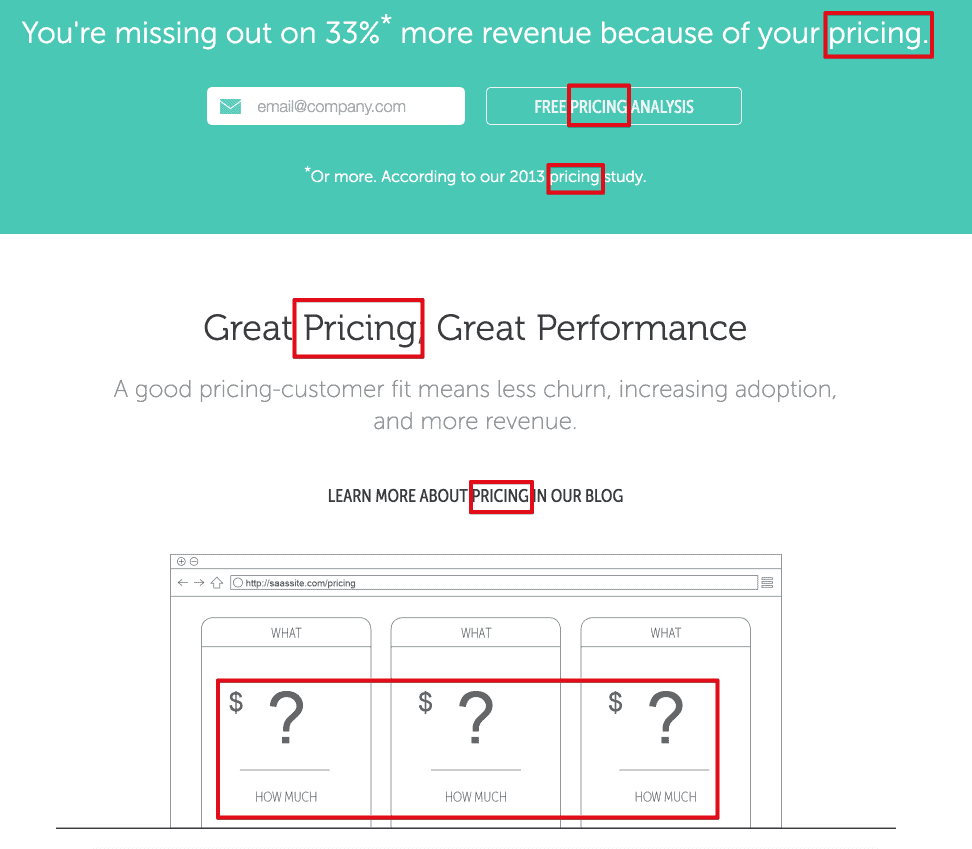
Even more copywriting that plays on your attention bias

Think they’re trying to tell us something? The copy has also subtly moved on to highlighting potential issues you may have with poor pricing (“missing out on 33% more revenue”) and what you get by pricing your product accurately (“less churn, increased adoption, more revenue”).

And the hits just keep on coming:
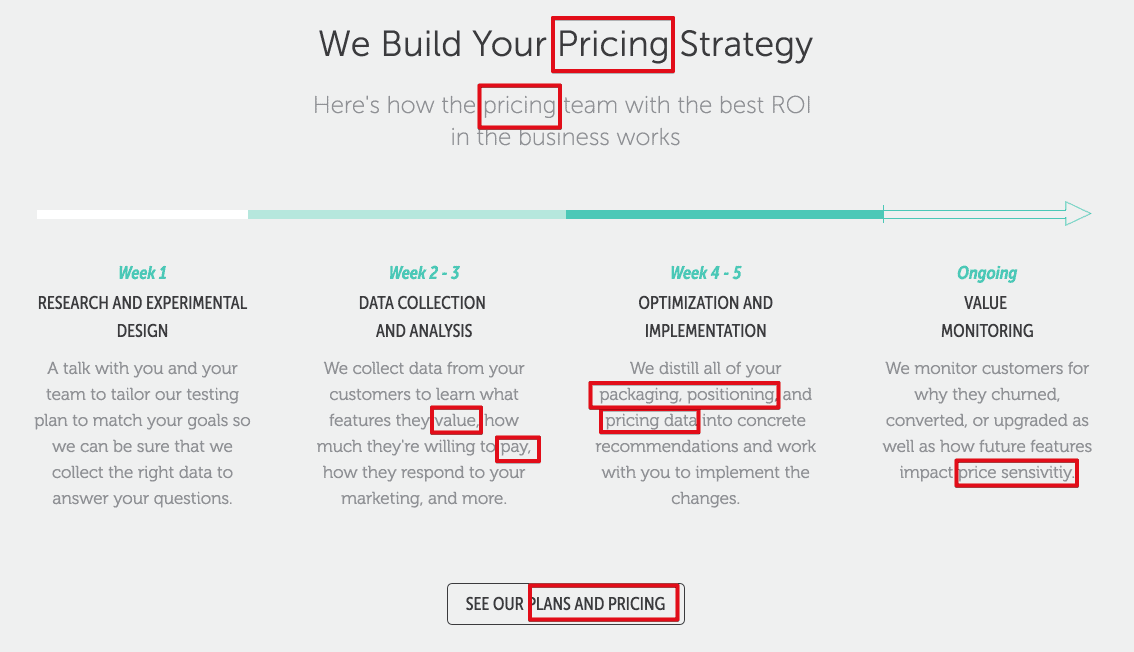
They're really making use of their copywriting to push your attention bias button

Pricing continues to be aligned with business needs, like “strategy”, “team”, “value”, “packaging”, “positioning” and so on. (And I didn’t even mention the smart use of the teal/green [money] color.)

On the homepage alone, your brain’s attention bias is practically on drugs, as you’ll walk away remembering one thing about them: these guys know pricing.

What you should do: What word can your product or service own? Whatever it is, you should follow the lead of Price Intelligently and use it as often as it makes sense on your home page and elsewhere.

BONUS: Combine it with our next bias.


amazing persuasive technique by @heysamwoods on @copyhackers: align “pricing” with “value”
Click To Tweet


Cognitive Bias #4: The Anchoring Effect
Cognitive bias: Anchoring effect

What it is: The habit of relying on “anchors,” on one trait or piece of information, when making decisions (usually the first piece of information that we acquire on that subject).

How you use it: Usually, the first price someone sees will affect not only their purchase decision but also what they’re willing to spend. You can extend this beyond purchase by anchoring the value in something tangible and then giving it away for less. This can also be used for positioning your products/services.


anchoring explained! @heysamwoods gives examples on @copyhackers
Click To Tweet


Time Warner Cable finds a way to anchor internet package prices by showing you the most expensive option first. This makes the others look cheaper:
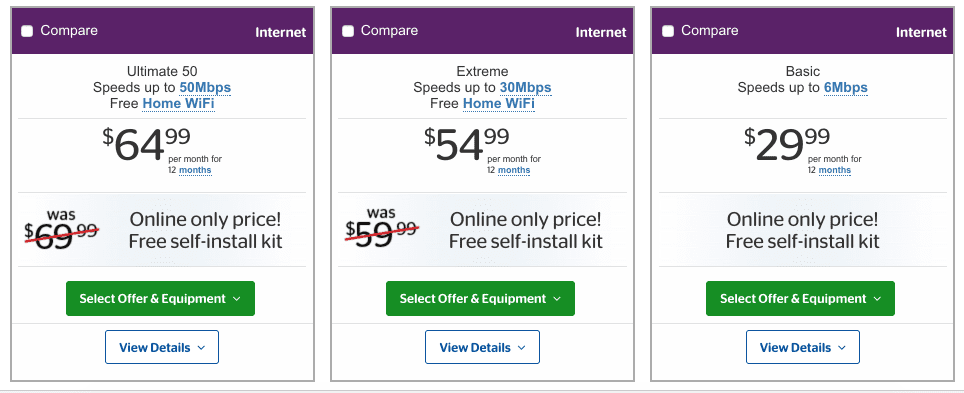
Example of the anchoring effect for pricing and copywriting

Even if their other packages offer slower speeds, you’re still primed by price and are more likely to make a decision based on price vs. features.

What you should do: On your pricing tables or product packages, experiment with leading with a higher price first. You can also do this in your sales copy, by simply anchoring the value in a higher price point than what you’re then offering it for.

Cognitive Bias #5: Functional Status Quo
Cognitive bias: Functional Status Quo

What it is: If your product challenges traditional use of a product or service, you’ll have a much tougher time marketing it.

How you use it: Don’t try to change what people are already doing. It’s more profitable to insert your products/services in the normal behavior of people. Small behavioral adjustments could happen overtime, but you’ll run out of money before you turn a profit. Your marketing needs to be in their current streams of behavior and psychology to yield results.

You can look at Vend to see how they use copy to communicate how their solution, in a complex environment like Point-of-Sale systems, solves their potential customers’ problem.
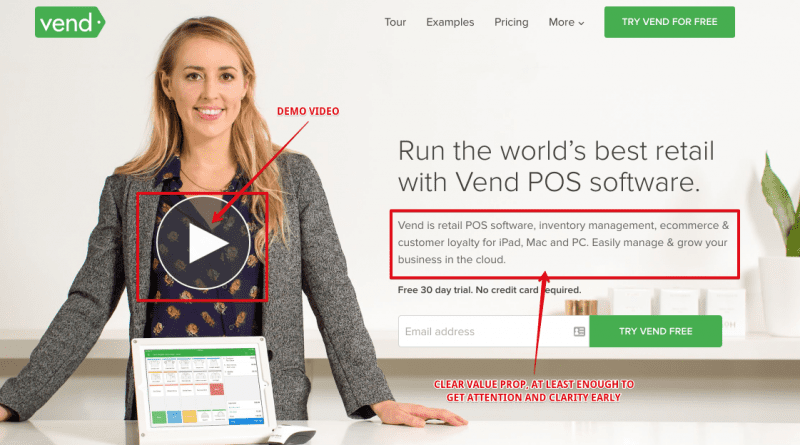
Vend using functional status quo

Vend using functional status quo

A demo is almost a must for companies who’re entering into “old” markets. And the use of screenshots that not only show how the app functions, but tells you where you’ll use Vend is a smart move.
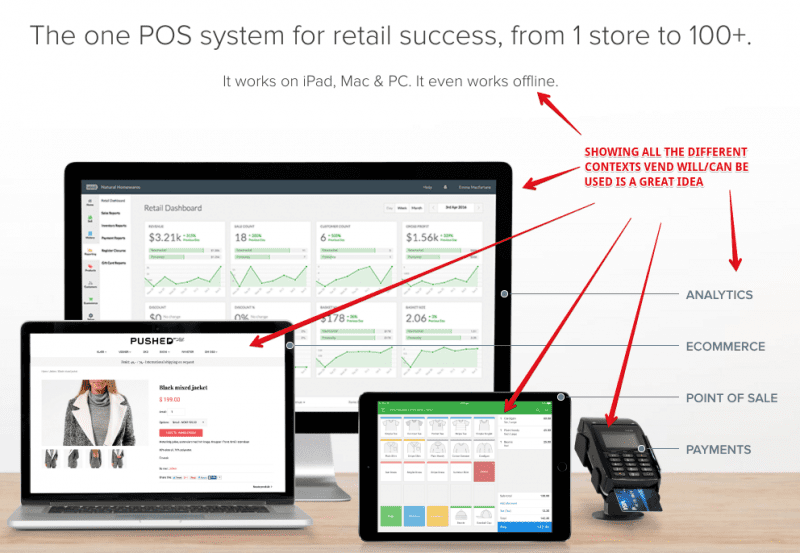
Vend continues with harnessing functional status quo in their layout and copywriting

Vend continues with harnessing functional status quo in their layout and copywriting

What you should do: If your product requires even a medium sized change in behavior, you can mitigate the friction by taking a cue from cognitive behavioral therapy (CBT):

“CBT works by changing people’s attitudes and their behavior by focusing on the thoughts, images, beliefs and attitudes that are held (a person’s cognitive processes) and how these processes relate to the way a person behaves”

And what better way to affect thoughts, images and beliefs but through copywriting? You’ll learn how to do this in a minute. For now, you can also see more biases “out in the wild”, like in this example of GrowthHackers, shared via KISSMetrics:
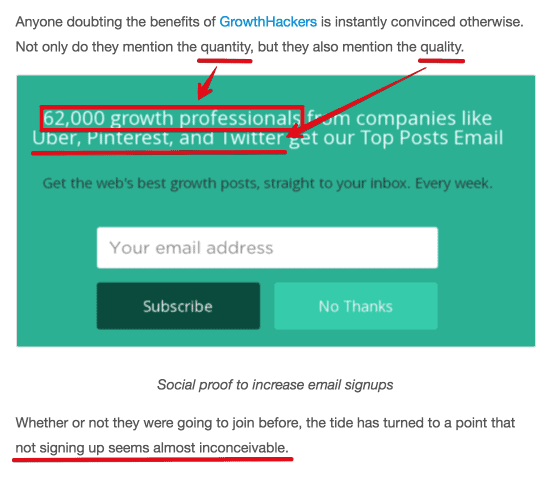
Using Cognitive Biases for increasing email signups

As seen on KISSmetrics: Using cognitive biases for to boost signups

Catch a few more ideas on how to increase email signups with cognitive biases over on KISSMetrics.

For you to connect the dots and infuse your copy with the power of biases, you need to understand how persuasion works. Sadly, only knowing who Cialdini is and what his 6 principles are is not enough. It’s a great starting point, sure. But if you’re in marketing or copywriting, then you’re in the business of understanding how people tick. Hence this whole post. 🙂

Let’s get back to our five strategies for getting more leads, fans and sales.


anchoring effect, ikea effect + 3 other killer biases to know. nice work @heysamwoods on…
Click To Tweet


Strategy #3 – Become the Obvious “Yes” for Your Audience

This might shock you, but it has to be said:

Mr. Cialdini, we get it. Those 6 principles. They’re all good and cool but…

There’s a lot more to the “science of persuasion” than Cialdini.

Take a look at How To Use 10 Psychological Theories To Persuade People, for example. And here’s a research paper that talks about subliminal advertising, “Persuasion in the Marketplace: How Theories of Persuasion Apply to Marketing and Advertising”:

“What makes consumers so fearful of subliminal advertising is the notion that they may not be able to defend against an unwanted persuasion attempt.

However, stimuli need not be outside of conscious awareness to persuade: Supraliminal primes may also influence attitudes and behavior without consumers’ awareness if they are not aware of the influence of the prime on their attitudes and behaviors.”

And where can subliminal messaging be found in the first place?

In advertising and copywriting. Look at this:

Subliminal messaging, anyone?

The magazine name is SFX – but wow, doesn’t that look like “SEX”?

Or how about this slightly disturbing example:
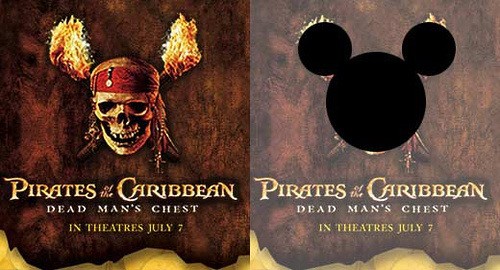
Even more subliminal messaging!

I guess they’re trying to persuade us to go to Disney World. Or murder Mickey. I’m not sure which. But one of the two.

Subliminal messaging is powerful, especially because it affects you without your full realization. But before you sink your teeth in the juicy, sizzling steak of subliminal messaging and persuasion, ask yourself:

How would a therapist think about this? #wwtd

It would be like something you’d find in this  paper, “Persuasive communication: The case of marketing” (by Marie-Odile Taillard):

“Two of the goals of human communication are: to be understood and to be believed.

In persuasive communication, both of these acts are fulfilled.

[…]

Marketing communication offers a rich domain of investigation for this endeavor: we show that pragmatics can only benefit from an analysis of persuasive communication in an “optimized” context such as marketing.

We try to affect our audience’s beliefs, desires and actions.

Persuasion is the communicative act that carries out both these goals – an audience that has been persuaded has understood an utterance, and believed its message.”

That means, for your copywriting to be persuasive it has to fundamentally be:

  1. Understood
  2. Believed

And with copywriting, you’re also affecting your audience’s beliefs, desires and actions.

You can memorize Cialdini’s 6 principles and recite them on your deathbed if you’d like, but…

Unless your copywriting bridges the gap between
theories and becomes actual communication,
you’re persuading
nobody

So, how can YOUR copywriting bridge that gap?

Use this Persuasion Framework worksheet I put together, inspired by “The One Sentence Persuasion Course” by Blair Warren.
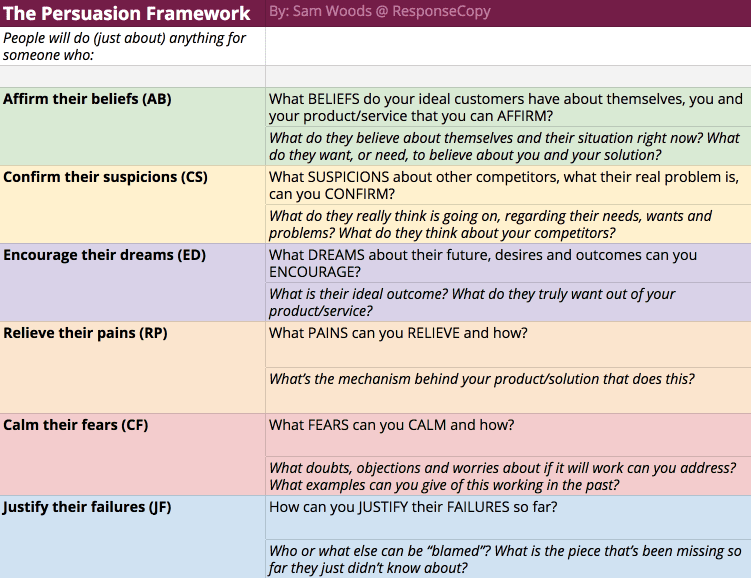
The Persuasion Framework, by Samuel J. Woods of ResponseCopy

Your answers to those questions will form the basis for your copywriting, on any page, in any email and for any persuasive messaging.

What you should do: Once you’ve filled out that above worksheet, you can actually think of stacking your messaging on, say, a home page with:

  • First, lead with Affirming Beliefs and Confirming Suspicions.
  • Next, Justify Failures and Encourage Dreams
  • Finish with Calming Fears and tie-in your CTA with Relieving Pains

Actually, you can stack that flow in several different ways but that’s enough to get you started.

Strategy #4 – Write Powerful & Effective Messaging

Robert Gifford is a professor of Psychology and Environmental Studies at the University of Victoria.

Here’s what he says makes people receptive to your messages:

  1. Urgency – This is critical for inciting action.
  2. Certainty – Communicate maximum certainty (with integrity) in your solution and its capabilities.
  3. Customization – Tailor messages for different groups, representing various interests and stakes. (Or levels of awareness and intent)
  4. Positivity – The message frame should be positive. Calling for sacrifices rarely, if ever, works.
  5. Control – Make it clear that people’s action and efforts are the deciding factor.

The goal is to craft messages that are “sticky”. Sticky messages get planted in the minds of your readers and simply won’t go away. They’re remembered.

Let’s look at how you can up the “stickiness” factor with this now rather popular framework.

Messages That Stick (Chip & Dan Heath)

Two brothers, Chip and Dan Heath, learned that ideas that “stick” all share the following six principles:
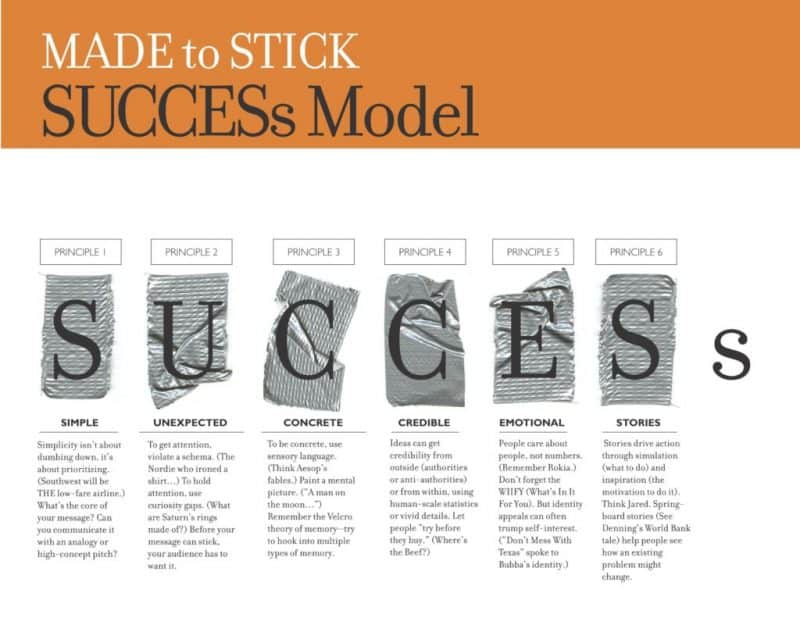
Made to Stick framework

  1. Simple: Your message has to be simple. You must come up with a profound compact phrase that would summarize your whole premise.
  2. Unexpected: In order to capture someone’s attention, you need to break a pattern. You need to understand and play with two essential emotions – surprise and interest.
  3. Concrete: People won’t remember vague stuff. What helps people understand new concepts is concrete language.
  4. Credible: You need somebody who people trust to confirm your case. The trustworthiness of your source makes all the difference.
  5. Emotional: Feelings inspire people to act.
  6. Stories: A credible idea makes people believe. An emotional idea makes people care. Put both of them together into an idea as stories have the amazing dual power to stimulate and to inspire.

Are you following the rules of sticky copy, or SUCCES? Test yourself by taking a look at your most recent email campaign, landing page or sales page. Is the message both simple and unexpected? Is it emotional and credible? Does it tell a story in a concrete way?

Do your messages show that you understand your audience? Is what you’re saying and promising believable? Have you crafted your messages in such a way that your audience will be receptive to them? Are they sticky? (That is, after your audience clicks away, does anything stay with them? And make them want to go back to it?)

Copy Hackers recently opened up enrollment for the second cohort of The Copywriter Mastermind. I was in TCM1 and now I’m in TCM2.

One of the new students in the cohort said that one of the reasons he decided to apply to the course was because of two little lines in one of the many emails Joanna sent. Here’s that copy:

“…Neither do your bosses or clients, who drop 5 or 6 figures driving traffic to your words.

Think about that for a second. All that money is driving to your words…”

That was sticky as hell. And the realization that the money was driving to this potential student’s words got him to keep going back to the sales letter, submit a lengthy application, and then ultimately hand over a substantial sum of money to Copy Hackers. (Editorial note: Thanks! 🙂 )

You can do the same in your copy if you think less like a “copywriter” and more like a therapist. That is, if you use the strategies now at your disposal to create compelling messages that stick.

If you’re not quite there yet, or you just pulled out some of your most recent copy and it makes you want to cringe a little bit by how much you might be missing the boat, there’s a BIG piece to the puzzle that we’re going to address now.

Emotions.

This is likely to be your favorite part. Sorry it took so long to get here – but you didn’t want a shortcut anyway, did you?

Strategy #5 – Trigger Emotions That Drive Behavior

What if I told you that “95 percent of our purchase decision making takes place in the subconscious mind”?

If you’re stuck in the “Copy Roulette” mindset, you might spend precious hours on hunting down “tricks” on how to get in touch with that subconscious mind.

Tsk, tsk. What a shame.

To think and write like a therapist, understand behavioral models – like this one, a fascinating “Behavior Model for Persuasive Design” by Stanford’s BJ Fogg:

“Behavior is a product of three factors: motivation, ability, and triggers, each of which has subcomponents.

The FBM asserts that for a person to perform a target behavior, he or she must

(1) be sufficiently motivated,

(2) have the ability to perform the behavior, and

(3) be triggered to perform the behavior.

These three factors must occur at the same moment, else the behavior will not happen.”

Your copy can realistically only address 2 of the 3 factors: Motivation and Triggers.

Motivation, however, cannot be magically conjured up, but only “channeled”.

Copywriting master the late Eugene Schwartz put it this way:

“The power, the force, the overwhelming urge to own that makes advertising work, comes from the market itself, and not from the copy.

Copy cannot create desire for a product.

It can only take the hopes, dreams, fears and desires that already exist in the hearts of millions of people, and focus those already existing desires onto a particular product.

This is the copywriter’s task: not to create this mass desire — but to channel and direct it.”

Your copy has to focus and channel pre-existing motivation.

(Good news: your potential buyers are buyers because they have that pre-existing motivation and desire).

So, it’s about triggering the behavior – but how?

Make use of emotional triggers, primarily. Why? Because according to neuroscience, our decisions are emotional, not logical. And functional MRI neuro-imagery has shown that, when evaluating purchases, you primarily use emotions and later you rationalize your choice…

…And positive emotions toward a product or brand have greater influence on your loyalty than trust does. (Amazing, right?!)

Now, the exact emotions that will have the greatest impact on behavior depend on your customer, product and market. No emotion swipes, no feeling shortcuts.

As an example, what if you got this letter in the mail one day:
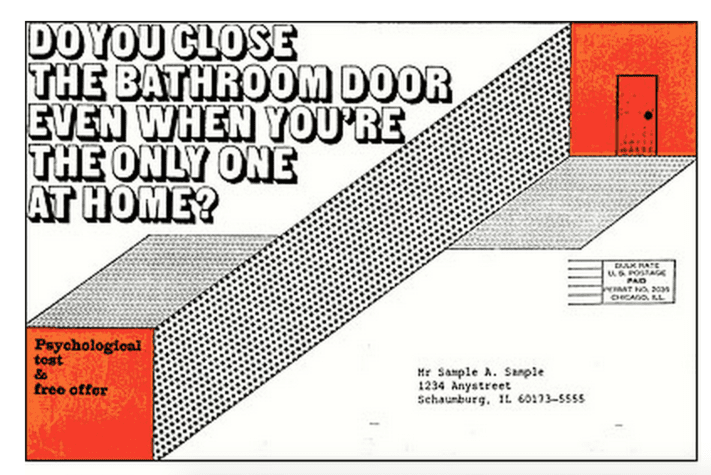
Emotional triggers with a Bill Jayme letter

Who could resist such a headline?

“Psychological test & free offer” only adds to the intrigue.

This mailer was created by copywriter Bill Jayme, who also popularized the now-sales-letter-staple, “Dear Reader”.

Biggest takeaway for you? Having empathy for your readers increases your chances of making a sale.

(Therapy will teach you that. Swipe files won’t.)

You’ll find plenty of different ways to use and categorize emotions, but here’s a model that works really well for copywriting purposes: Plutchik’s Wheel of Emotion.
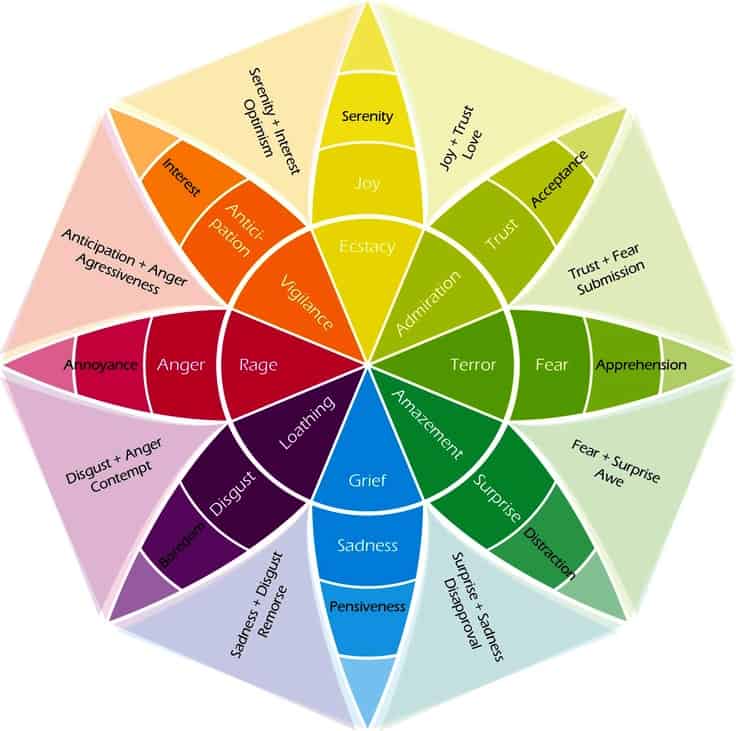
Plutchick's Wheel of Emotion

Plutchick’s Wheel of Emotion, not to be confused with an emotional rollercoaster

In that wheel, you can see a change in intensity and degree of feeling as you move closer to the middle. You want your copy to “move” people and bring them on an emotional journey – a story, of sorts.

But, you don’t need to worry about triggering uncontrollable, raging emotions.

Even some of the most common emotions we feel daily can be prompted and used for persuasion.

In fact, with emotions involved, we end up persuading ourselves. And that kind of persuasion is more powerful than anything else.

So, how do you elicit the right emotions that will help you get a click or purchase?

Yup, you guessed it: Words. Phrases. Sentences.

Copy! 

Firebox uses emotion-inducing product descriptions:

Emotional copywriting - isn't this cute?

And this additional description sets the tone with all the feels:
Copywriting with all the "feels", right?

See what they’re doing? The “merciless chills of winter”, “clutch onto a smelly hot water bottle that’ll be cold in less than an hour” and the “toasty solution has popped up”, which you can “snuggle and squeeze”, keeping you “cosy”.

You can practically taste, smell, feel and see this product. And feel yourself using it.

We’ll continue with this in just a minute, but pay attention to this:

All emotions are not equally persuasive

Research by Jonah Berger shows that high arousal emotions stimulate us into action.

(You know, when you can feel it in your gut or chest, maybe even a flash of heat on your forehead).

Conversely, low arousal emotions discourage action. We can’t have that.

Let’s look at 10 emotions you can tap into to get your users to act.

10 Emotions You Can Trigger For Maximum Persuasion

  1. Desire: When you write copy that presents products and services that helps fulfill various desires, you’ve struck gold.
  2. Trust: Copy that stimulates trust, such as “no hidden fees” or “total and 100% transactional transparency”, speak to this trigger. Make sure the trust-triggering messages are placed next to CTAs and in bold or italics so they’re easily visible.
  3. Belonging: Copy that makes people feel that they’re part of a select group can be very effective. Most people enjoy a sense of belonging – and the more exclusive, the better.
  4. Instant Gratification: People want quick solutions and they mostly want it all yesterday. Use instant gratification triggers such as ‘in two hours or less’ or ‘within 24 hours’ and so on in your copy.
  5. Leadership: For the right person, like early-adopters, messages about being the first to try something new can be highly effective. Spark their feelings related to leadership with cleverly worded copy such as ‘be the first to try our new program’ or ‘be the first to own this car’ work to trigger leadership-related emotions.
  6. Love: The need for love is constant and people seldom find long-term solutions to fulfill this need. Can your product or service help them experience love, from family, friends or even from co-workers?
  7. Greed: Consider a message that says, ‘Here’s how you can make millions with no investment’. Does that not appeal to the greed in you? Exactly. No need to be crude, of course.
  8. Hope: Hope is what drives the human spirit to look for solutions and push forward even when things look bleak. When you offer solutions that will help improve lives, health, relationships or careers, use hope as the emotional trigger in your headlines, cross-heads and body copy.
  9. Fear: When fear grips a person, rationality is pushed aside, making the person susceptible to quick decisions. When fear is the trigger, people are already ready to take action. All you need to achieve with your copy is to suggest which action to take.
  10. Guilt: Look at nonprofit organizations. They trigger guilt with copy and pictures of starving kids and barren landscapes to get you to donate. Certain consumers feel hugely gratified when they respond to guilt-triggering messages.

Boom! 10 emotions I can use in my copy for max persuading power – thx @heysamwoods
Click To Tweet


That should be enough of a start to help you immediately up the ante in your writing.

Could a swipe file teach you this? Nope. If you stare long enough, you might guess what’s happening. But copy based on guessing doesn’t convert. And conversion copywriters don’t guess.

With all that said, what do you actually do with WORDS?

You’re Now Ready To Tackle The Nuts and Bolts of Copywriting: Words

If you start and stop with the endless lists of tactics, simply swapping words around and playing “Copy Roulette”…

  • You’ll never rise above the paltry 2% conversion rates
  • Your SaaS onboarding sequence will just be an “info pump ‘n dump” scheme that fails to engage your users
  • Your home page will remain a jumbled mess of a street vendor, throwing cheap trinkets at people to see what they might like
  • And those lofty, pumped up revenue goals will deflate, petering out with a pathetic “pfffffft…”

Nope. Not gonna have it. You deserve better.

So, when you take a moment and think about this like a therapist might, which is to…

  • Use language and words that resonate and trigger actions and reactions
  • Feel like they’re understood and understand you
  • Get to know, like and trust you
  • And finally, compel them to take action

You’ll get better at turning up the emotional volume of your words, like:

Happy > Overjoyed

Satisfied > Thrilled

Prohibited > Outlawed

There’s usually several degrees, from low- to high-intensity, that you can explore with your copy.

Let’s explore a couple tactics you can use for amplifying emotion in your copy.


holy crap – this copywriting post by @heysamwoods keeps getting better and better
Click To Tweet


Tactic #1: Find the Right Emotional Words For Your Customers

Shanelle Mullin over at ConversionXL has a list of 8 steps you can take to start identifying the emotions your potential customers will respond to:

  • Conduct qualitative research to better understand your audience. What’s their emotional range? What are they feeling when they arrive on your site? 
  • Select a font that helps encourage the emotion you’re looking to create or maintain.
  • Choose the two or three colors that will create or maintain your emotion of choice. Use them consistently in your branding.
  • Evaluate your current images. What emotions are they evoking? The answer is never “none”.
  • Be aware of facial expressions, size, color, body language, etc. in your images.
  • When possible, make an emotional appeal and present an emotional benefit.
  • Repeat trigger words throughout your copy to inspire and maintain the right emotion(s).
  • Craft a story with a protagonist and a beginning, a middle and an end.

You can, of course, do some of this by finding words, language and messaging ideas from places like Amazon and TripAdvisor.

And if you need to brush up on where stellar messages come from, get this guide for free.

But now that you have done that, and you’ve picked out images and visuals that evoke the emotions your customers are seeking…

How can you actually turn this into copy?

Tactic #2: Apply The Wheel of Words

This wheel of words (combined with Plutchik’s Wheel of Emotion above) may come in handy next time you need to amplify your words:
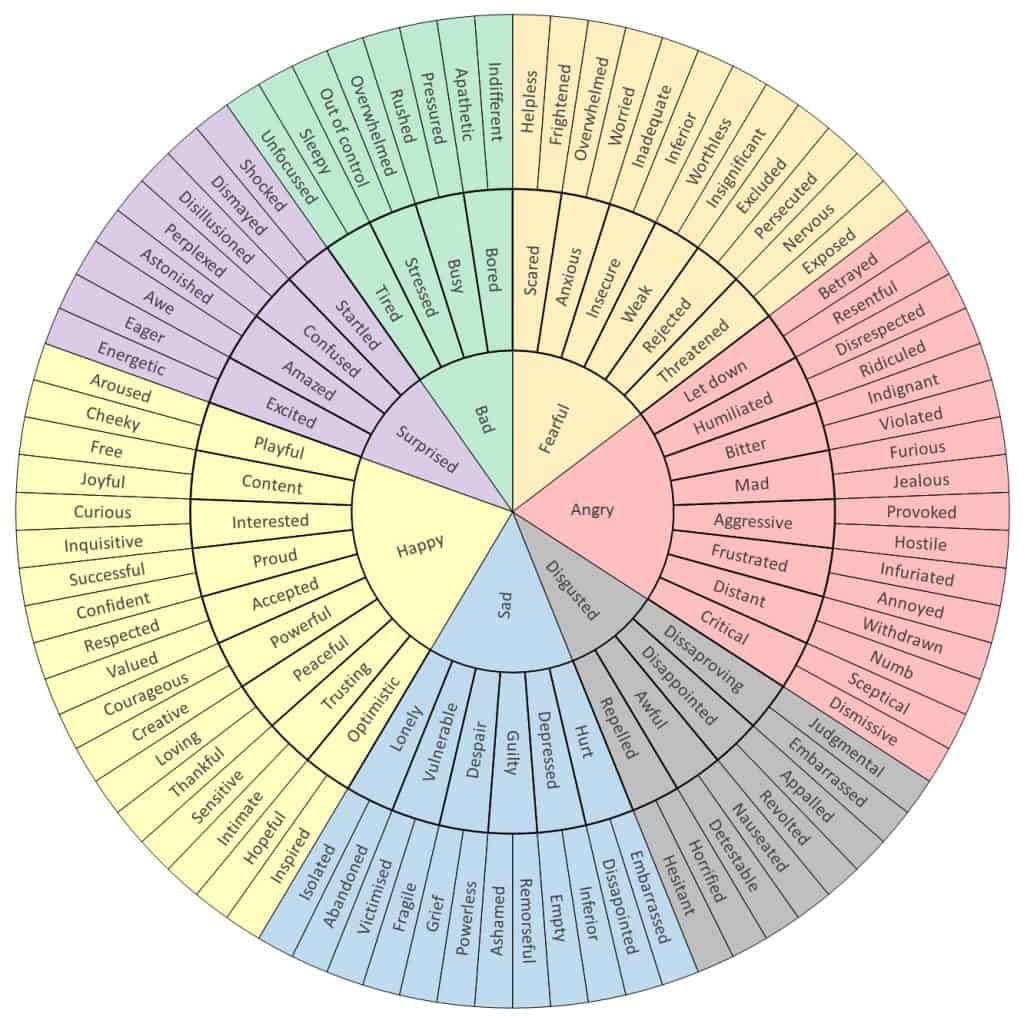
Wheel of Emotional Words

With all these wheels, you’ll be able to drive more conversions. Har har.

Let’s say you’re selling a weight-loss program and your research gave you insight into words used by your customers:

  • Before buying your weight-loss program, they felt “depressed” over their weight, “guilty” that they couldn’t stop eating junk food, and “ashamed” of themselves.
    • Look at the “sad” and even “disgusted” slice of the wheel.
  • When using your weight-loss program, they feel “amazed”, “excited” and even “astonished” that it worked so well.
    • Look at the “surprised” slice of the wheel.
  • They want to feel “proud” and “confident” of achieving their desired weight-loss goals.
    • Look at the “happy” slice of the wheel.

See how many more options you have with words you can use?


major a-ha moment! thanks @heysamwoods for the wheel of words. more like wheel of awesome.
Click To Tweet


You can then spin up a lot more ads or headlines that capture attention with words like:

“Are you plagued by disapproving comments and judgmental looks from even strangers, when you just can’t say no to that full pint of ice cream?”

Or:

“Would you rather be startled over the fat that’s melting away every day, than nauseated after every meal?”

Can you see how using words of varying degrees of intensity can help you trigger stronger emotions with your potential customers?

Isn’t that kinduv amazing. That copy just wrote itself.

The whole point, of course, is not just to sprinkle random “emotion” words around. That’s the “Copy Roulette” mentality you and I have already talked about.

Instead, sift and plant your words strategically, like a therapist would in a session, to draw out responses, nods and silent yesses from your potential customers.

So, how can you amplify these words and make use of them?

Tactic #3: Use This Easy 3-Step Process to Write Copy that Makes People Feel

Each time you sit down to write a page, consider this 3-step process, from Bushra Azhar (of Persuasion Revolution), with a giant list of about 380 words.
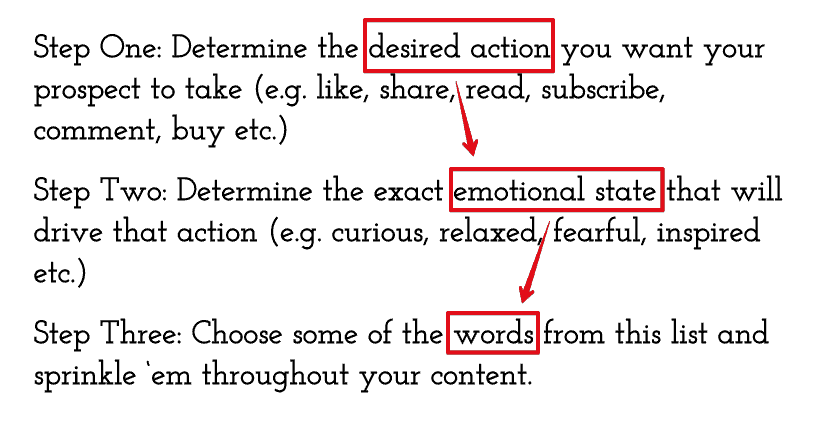
3-Step exercise for using emotional words

With this simple 3-step process in mind, use this exercise:

  1. Desired Action: Start a Free Trial of your SaaS
  2. Emotional State(s) to Drive Action: Excited, Urgency (that your software can and will solve their problem and meet their needs)
  3. Words to Use: Instant relief, eliminate hours, slash wasteful spending, control chaos

So, you might start with:

FleetBuddy helps you easily manage your fleet operations.

Start your free trial now!

Pretty standard. And pretty boring.

But given your exercise above, you could turn that into this:

Control the chaos of fleet management with FleetBuddy.

Finally, get instant relief from the stress of servicing your fleet when you sign up today for a free trial. You’ll collaborate more effectively with your team, eliminate hours of sifting through piles of printed spreadsheets and slash wasteful spending on fuel.

Start Your Free 14 Day Trial

If you’re someone who’s flailing around with spreadsheets and trying to manage a fleet of vehicles, you’re most likely very excited about this, and feeling a sense of urgency to try it out.

The first option was okay but a bit bland. The second, after we put it through our exercise, is bursting with emotion-inducing language, priming your reader for conversion. <<– that’s how great copy happens

Tactic #4: Use These Power Words

If you still need some recommendations to jolt your creativity, consider using these proven, high-converting terms:
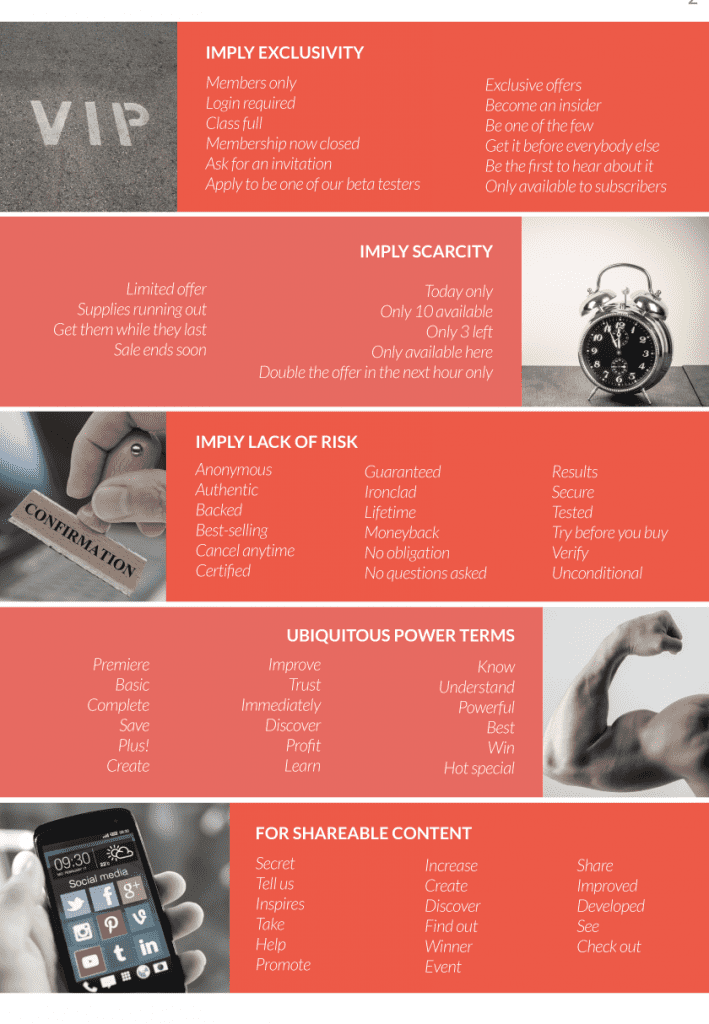
So many words that convert

And our friends over at CoSchedule compiled a massive collection of “500+ Powerful Words To Use For Writing Emotional Headlines” if you want some more.

Pretty strong words, no?

A word of warning: Don’t let these examples collect dust on your hard drive! I’m only handing you these swipe files now because you’re ready for it; you know they need to fit into a strategy.

Finally, use this last tactic to X-ray copy that you see others using, and learn why they wrote their copy that way.

Tactic #5: Reverse-Engineer Copy

This is one step beyond just piling up swipe files, and truly thinking like a therapist: You understand where someone is now, and work your way back to how they got there.

Let’s look at the YouNeedABudget.com (YNAB) home page and how they use a particular vocabulary throughout:
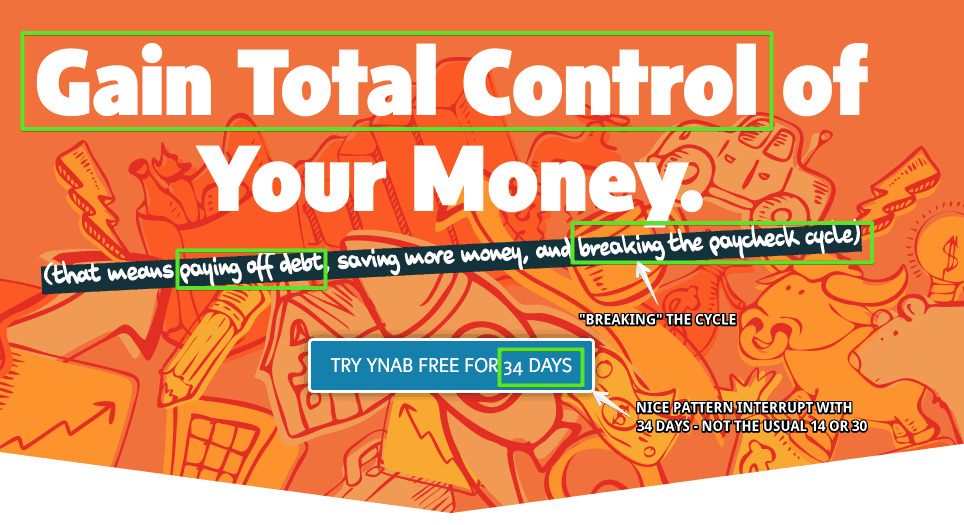
YouNeedABudget.com home page copywriting

You’ll notice a few things right away, like “Gain”, “Total Control” and “breaking” the cycle of living paycheck to paycheck.

(As a side-note, you can appreciate the “34 days” pattern interrupt, too).

The page continues with:
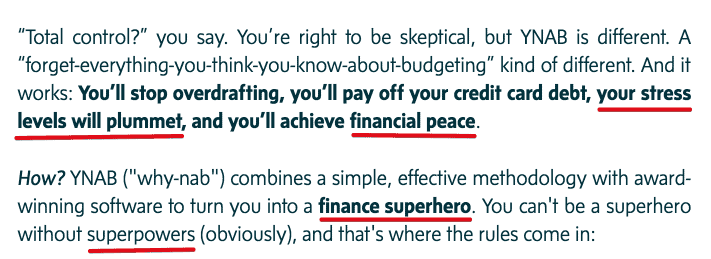
More copywriting goodness from YNAB

See the underlines? It’s not just “less stress” but “your stress levels will plummet and you’ll feel “financial peace.

Moving on to:

And even MORE copywriting goodness from YNAB

Are you seeing this? It’s really cool when you put on your “Copy Therapy X-Ray Glasses” and see the word matrix:

Your money has a “job” > It’ll do the work of saving and spending for you.

And it’s “dialed in” > You’re spending money wisely and with precision, preventing accidents.

When you “embrace” your expenses, you “smooth out” cash flow > No more fighting with your money (what a relief!), you’ll make up and become best friends.

Say “goodbye financial roller coaster” > No fear pounding in your chest, making it hard to breathe; everything will be just fine.

You’ll “roll with the punches” and get back on “track” > No one likes taking a financial beating but if something comes up, you can duck and dodge and get things straightened out again.

Finally, “age your money”, no more “paycheck cycle” with a “plan” > See? Your money is now a source of wisdom, relief and strength. No more confusion or stress. It’s taken care of.

That’s the power of identifying and using emotional power words and phrases in copywriting.

Dear Friend, It’s Time For Us To End Our Session
(Chances are, it’s been at least 60 minutes.)

As you sit up straight again, take a moment to breathe in. And out.

Can you see how the “Copy Roulette” mentality has sabotaged your home pages, ads, emails, landing pages… everything?

All those times you’ve opened a blank document, your mind filled to the brim with possibilities of what to write…… only to stare into the white abyss, cursing the unforgiving blinking cursor, which is slapping you in the face with each flicker.

But it’s not your fault.

You’ve been given the right tactics and the right ideas but were withheld the strategies that tied it all together. It’s so easy to get pulled into the “horder itch” and snag every listicle and “swipe file” in sight.

And while you must study successful copywriting and have a swipe file library, don’t allow that to become a crippling crutch that trips you up each time you sit down to write copy.

Think like a therapist. You’re “coaching the outcome”, the click, the visitor becoming a lead, and that lead opening their wallet to buy.

The bottom line: writing excellent copy is hard as hell. You can’t outsource it to some swipefile by cutting and pasting something that worked for someone else, some other business, and think it’ll magically work for you too.

You have to listen to YOUR audience. Build a relationship with them by making them feel understood. Reflect back to them what they’re already feeling through emotional language. And then make sure your offer is so aligned with what they want that they can’t help but say, “Hell yes!”

~Sam

The post Copywriting Roulette, or Toward a Theory of Copywriters as Therapists appeared first on .


from
http://redirect.viglink.com?u=https%3A%2F%2Fcopyhackers.com%2F2016%2F06%2Ftheory-of-copywriters%2F&key=ddaed8f51db7bb1330a6f6de768a69b8