Tuesday, 23 May 2017

3 Tips on High-Conversion Copy from a Sales Page Specialist

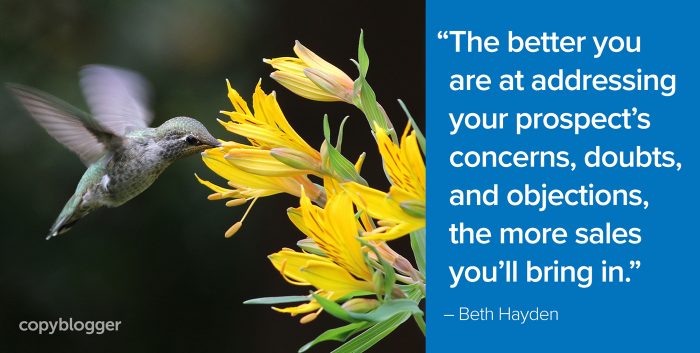
"The better you are at addressing your prospect’s concerns, doubts, and objections, the more sales you’ll bring in." – Beth Hayden

I know what some of you are thinking.

You’re asking:

“Do I really need a sales page anymore? Can’t I sell using social media/webinars/live events/blog posts/podcast episodes?”

I don’t know the details of your exact situation, but I will say this:

If you need to spell out the benefits of your product or service in order to make more sales (which you do), a sales page will drive more positive results for your business.

Unfortunately, writing sales pages has gotten a bit of a bad rap. Some people get wildly anxious when they sit down to write one. Or worse, they fill their sales pages with rambling copy that doesn’t persuade anyone to buy.

These days, I’ve developed a specialty as a sales page copywriter — so I wanted to give you three quick tips for improving your own sales pages.

But first, I want to tell you how I fell in love with writing them.

Why I love writing sales pages — and how you can learn to love them, too

About a year ago, I took Derek Halpern’s Sales Page That Converts course, which was a game-changer for me. I studied the course closely, and used that advice to craft sales pages for my next six clients.

As it turns out, I’ve got a knack for it. One page I wrote for a client resulted in a $70,000 launch. That one felt good, I gotta admit.

I’ve learned to love writing sales pages by doing it … a lot. I understand what my goals are and what I need to accomplish in each section. I know what questions to ask my clients. And I understand the writing process.

These days, sales pages are like giant puzzles that I get to put together.

You can learn to love writing sales pages, too — you just need practice.

I understand the struggles of facing a blank screen when you’re writing, so here are my three best pieces of advice to jump-start the process for you.

Tip #1: Thoroughly explain your offer

The most important thing any persuasive copy needs to do is give your prospects the information they need to make a decision.

That means you’ve got to clearly explain the features and benefits of a product or service, and why your product or service is different from your competition.

For example, if you’re selling hot air balloon rides, you’ll need to describe the features by explaining how long the ride will last, whether it’s appropriate for kids, the safety measures you employ, and what riders can expect on the big day.

Then you could show one of the benefits of your service by describing it as a potential gift for a loved one. If your prospect gave the ride as a once-in-a-lifetime gift to a spouse, you could describe the joy and gratitude on her face as they lift off into the air on a crisp autumn morning.

Or you could talk about how excited the prospect’s kids would be if they got to go for a balloon ride and how his kids would think he is the world’s greatest dad. You could mention that one of your balloons would be a wonderfully memorable place for a proposal!

You’ve also got to explain why your balloon rides are better (or different) from your competitor’s. Do you cater to people who have a fear of heights? Do you do Disney-themed rides that are perfect for kids? Do you provide longer balloon rides than anyone else in your area?

Whatever your product or service, don’t be afraid to spill all the beans and share all the juicy details of what the prospect gets, why it’s awesome, and why you’re the right choice.

Tip #2: Answer all of your prospects’ questions

One of the most important parts of a sales page is the “Frequently Asked Questions” section. This is the place where you get to address all of the nagging little questions on your prospects’ minds.

When many prospects ask questions about your product, what they really want to know is:

“Is this going to work for me?”

For example, let’s say you’re selling an online program that teaches people how to start their own online hot air balloon ride company.

When your prospect lands on your sales page, she’s going to have some concerns. Almost all potential customers do.

  • If she’s a newbie entrepreneur, she’s worried she doesn’t have enough experience, and she’ll be completely lost in your program.
  • If she has lots of experience with ballooning, she’s concerned there won’t be enough useful material in the program for her.
  • If she’s from some far-flung corner of the world, she’s worried that the information in your program won’t apply to her, because the ballooning regulations may be different in her neck of the woods.

Your job is to address all of these concerns in your “Frequently Asked Questions” section.

Brainstorm every question you’ve ever been asked about your product or service, and then narrow down your list to the 10 most common questions. Next, write down your (honest) answers to those queries in your sales page’s FAQ.

You’re particularly looking for questions that stop people from buying. The better you are at addressing your prospect’s concerns, doubts, and objections, the more sales you’ll bring in.

Tip #3: Don’t be afraid of writing a long page

If you do everything I described in tips #1 and #2, you’ll need to use more than a couple of lines of copy. It’s just a fact.

Don’t fear the long-form sales page! If you need eight pages of copy to give your prospects everything they need to make a decision, so be it.

I promise — you’re not going to content marketing hell for writing a long sales page. (Actually, Copyblogger has always advised that you make your copy as long as it needs to be.)

That doesn’t mean you’ll fill your sales page with pointless fluff just to meet some imaginary word count requirement. Every word needs to count, and every phrase needs to pull your prospect closer to your desired action.

Longer copy sells because it provides all of the right information.

Your sales page can be one of your best business assets

When you write a high-conversion sales page, you create an “online salesperson” that can bring in sales for your business — month after month and year after year.

As you keep practicing, you’ll notice that one day, writing sales pages won’t be scary. Pretty soon, you might actually be crazy enough to enjoy writing them.


Writers: Ready to position yourself for greater success?

Beth Hayden is one of Copyblogger’s Certified Content Marketers. Our Certification training is a powerful tool that helps you learn new writing strategies and position your business for greater success. We’ll be re-opening the program shortly — add your email address below to learn when we reopen to new students.

Find out when our Certified Content Marketer training program reopens:

The post 3 Tips on High-Conversion Copy from a Sales Page Specialist appeared first on Copyblogger.


from
http://feeds.copyblogger.com/~/330921760/0/copyblogger~Tips-on-HighConversion-Copy-from-a-Sales-Page-Specialist/


Monday, 22 May 2017

Pet Peeves from the Copyblogger Editorial Team, and What they Reveal

"No one can nurse a good peeve quite like a group of writers." – Sonia Simone

We’ve written quite a bit lately about identifying core values in your content.

Creating content around a positive value like integrity, fairness, humility, or faith will attract an audience that shares those values — and that fosters a powerful sense of unity.

But our friend negativity bias tells us that the flip side of that will probably be more compelling. In other words, talking about the things that bug you will build an even faster bond with your audience.

For today’s post, I asked our editorial team to let us know their peeves — the things that irritate, bother, and annoy them.

I’m going to try to tease those out and figure out the values behind them — and see what that might say about who we are as a company and a community.

So let’s get peevy.

Stefanie Flaxman’s peeve

Stefanie is our editor-in-chief, and as you’d expect, she has a healthy list of grammar and usage peeves.

But an editor is much more than a proofreader. It’s one thing to misplace a comma — it’s another to come at a post in a fundamentally flawed way. Here’s Stefanie’s peeve:

Hype/extremes/absolutes: Writing voices that are heavy on absolutes tend to simultaneously lack substance and speak to the reader as if they know what’s best for them … which isn’t a combination that builds credibility.

For example, earnestly referring to any flesh-and-blood human being as a “guru” is typically too vague or a sign of hype. If the person is an expert, top scholar, or highly respected professional, use those labels instead — they’re more specific.

What it reveals

Putting this post together reminded me that an Allergy to Hype has always been at the core of Copyblogger’s message. Since Brian founded the blog in 2008, Copyblogger has always stood in contrast to the hype-slingers who substitute flash for value. We believe that substance matters.

Robert Bruce’s peeve

Ten-dollar words: This is an old one, but a good one, and for good reason. Most writers have moderate-to-severe mental problems. I am, obviously, no psychologist, but the attempt to unnecessarily project one’s “intelligence” through the use of big words — when plain words can do the job — seems to be clear evidence of this.

What it reveals

Besides the obvious fact that Robert wins a lifetime “get off my lawn” achievement award, I think this shows how passionate we are about Quality. Quality of information, quality of business practices, quality of writing.

Loryn Thompson’s peeve

You’ve only seen Loryn on the blog once (so far), but she’s crucial to our editorial success. She’s the data analyst who looks at the numbers behind what we’re writing, and helps us to get our message out more effectively.

Here’s Loryn’s peeve:

Using “over” with numbers (instead of “more than”) : As Rainmaker Digital’s data analyst, this one comes up for me a lot. Every time I catch myself writing “over 5%…” in a report, I go back and change it to “more than.” 
 
Now, the Associated Press said in 2014 that both “over” and “more than” are acceptable to use with numeric comparisons — as in, “There were over two hundred people at the event.” But you know what? It still bugs the crap out of me. 

In my mind, “over” mixes the abstract world with the physical realm. For example, if you were to say, “We flew over 6,000 miles …” you could be saying that you flew more than 6,000 miles. Or, you might mean that you were literally above the earth for 6,000 miles.

What it reveals

I picked this one precisely because the team doesn’t agree on it. Some of us are “more than” folks (me, Loryn) and some aren’t. Stefanie tries to remain agnostic.

While it can be fun to give in to that eye twitch when someone makes a style choice we don’t like, I think it’s smart to keep some perspective. There are usually good arguments to be made for different usage choices, so I’ll go with Diversity as a value for this one.

My take is that it’s more important to be thoughtful about your choices than it is to be didactic. Although alot is never going to be a word and you can’t make it one.

Twitch, twitch.

Jerod Morris’s peeve

Jerod’s a person with a strong moral compass, and I was interested to see his peeves. Here’s the one I chose from his:

Misspellings of names: It’s especially bad when the name is a common one that’s misspelled in an obvious way. But any name misspelling shows a lack of basic respect for the subject you’re writing about. It’s not really grammar, but it still makes me cringe. Find out for sure.

What it reveals

Misspelling a name in content is a classic example in failure of what Jerod calls Primility (the intersection between pride and humility). It’s both sloppy (lack of pride) and disrespectful (lack of humility). I think it’s fair to say that Primility is a core value for Jerod, and that’s probably one of the reasons he’s been such a great asset to our company.

We are, make no mistake, proud of the work we do at Copyblogger. We love producing the blog, and we try hard to make it excellent. But we know that humility’s important, too. We’re under no illusion that this blog is perfect, and we try to challenge each other to always make it more relevant, more useful, and more interesting.

Sonia Simone’s peeve

You may feel like you already know more than you need to about my peeves. For today, I revisited a favorite:

Boring content: This one just makes me sad … seeing site after site after site that utterly fails to stand out in any way.

When I see a site with a genuine, passionate voice — even if there are a few usage errors — I may cringe a little, but mostly I cheer. I’d much rather see a site with plenty of G.A.S. than a grammatically perfect one that has no soul.

What it reveals

Individuality is absolutely a core value at Copyblogger. We’ve never endorsed the paint-by-numbers approach to marketing and online business … partly because that would be very boring, and mostly because it just doesn’t work.

And then there’s the Oxford comma

If you aren’t familiar with the Oxford comma (also known as the serial comma), it’s that final comma in a collection of items in a sentence.

Here’s a visually amusing example of the same sentence with and without one.

I like the Oxford comma because it’s always clear. Jerod gets downright fierce about his support. That renegade Loryn, though, has come to prefer dropping it.

“I used to be a staunch Oxford Comma advocate, but now I prefer the way short lists flow without it.” – That Renegade Loryn

Either is correct, but do be consistent. (Although the late Bill Walsh, noted Washington Post usage stickler, advises that if a serial comma is important for clarity, go ahead and put one in there, even if it’s not your usual style.)

A note about peeves and unity

I mentioned when we started that talking about the negatives will build a connection with your audience more quickly — and it will. But keep in mind that a steady diet of negativity will give almost anyone indigestion.

Don’t shy away from talking about the good stuff, too. An honest values system includes both positive and negative points of view.

How about you?

What sets your teeth on edge when you see it in a blog post or hear it in a podcast? What do you think that says about you and your values?

Let us know in the comments!

The post Pet Peeves from the Copyblogger Editorial Team, and What they Reveal appeared first on Copyblogger.


from
http://feeds.copyblogger.com/~/329697330/0/copyblogger~Pet-Peeves-from-the-Copyblogger-Editorial-Team-and-What-they-Reveal/

Thursday, 18 May 2017

What Not to Do (in Content Marketing)

What Not to Do (in Content Marketing)

Some weeks are all sunshine and lollipops. This week is not that week.

Actually, all week we’ve been warning you of various colorful ways online professionals can shoot themselves in the foot. On Monday, I talked about a bunch of ways (around 30, I think) that people mess things up for themselves when they’re conducting their professional lives on the web. Some of them are silly, and some of them are serious. (I hope you’ll add your own advice in the comments!)

On Tuesday, Robert Bruce alerted us to the dangers of the writhing, pushing, sweating bodies of hype. Goodness gracious me. He does have an important point to make, beyond all the heavy breathing, and it’s an entertaining read.

And on Wednesday, Stefanie Flaxman shared an embarrassing email marketing fail (not ours, thank goodness) — and the lessons to be learned from it.

Over on the Copyblogger FM podcast, I dug into the deliciously awful disaster of the Fyre Festival that Wasn’t … and talked about what it means to accept responsibility for messes.

How about you — got any interesting disasters to share? (Your own or someone else’s?) Mistakes are how we learn and grow, so let us know in the comments!

— Sonia Simone
Chief Content Officer, Rainmaker Digital

Catch up on this week’s content


Goofus thinks ‘U’ is a word. Gallant shakes his head. The Goofus and Gallant Guide to Success on the Web

by Sonia Simone


are you a writer, or a flimflam artist?Why Sex Doesn’t Sell

by Robert Bruce


reveal the details that compel your prospect to take action immediatelyA Quick Copywriting Lesson Taken Directly from an Email Marketing Fail

by Stefanie Flaxman


A Different Way to Think About Your Online CompetitionA Different Way to Think About Your Online Competition

by Sean Jackson & Jessica Frick


Plagiarism, Self-Deception, Bad Sandwiches, and Other Interesting DisastersPlagiarism, Self-Deception, Bad Sandwiches, and Other Interesting Disasters

by Sonia Simone


How Bestselling Fantasy & Sci-Fi Author Catherynne M. Valente Writes: Part OneHow Bestselling Fantasy & Sci-Fi Author Catherynne M. Valente Writes: Part One

by Kelton Reid


Showrunner 101 (Back to Basics)Showrunner 101 (Back to Basics)

by Jerod Morris & Jon Nastor


The post What Not to Do (in Content Marketing) appeared first on Copyblogger.


from
http://feeds.copyblogger.com/~/325092776/0/copyblogger~What-Not-to-Do-in-Content-Marketing/

Wednesday, 17 May 2017

A Quick Copywriting Lesson Taken Directly from an Email Marketing Fail

"Reveal the details that compel your prospect to take action immediately." – Stefanie Flaxman

Ten years ago, a tattoo shop I went to subscribed my email address to their email newsletter.

They didn’t send updates very often, so I never unsubscribed. However, new owners recently acquired the business — and apparently their email newsletter list — because lately I’ve been getting not very good emails more frequently.

I should have unsubscribed after receiving the first few, but I kept forgetting. I’d just scroll through an email quickly and delete it.

And I’m glad that was my routine, because today I have a copywriting lesson to share that I took directly from a mistake they made in an email they sent last week.

What was the email marketing mistake?

The first three paragraphs of the email contained too many comma splices and exclamation marks for my taste, but those goofs didn’t bother me too much.

As I continued to scroll down, a photo caught my eye and I wanted to read more about the tattoos in the image.

But when I looked at the caption below the photo, it said:

“Create a great offer by adding words like ‘free,’ ‘personalized,’ ‘complimentary,’ or ‘customized.’ A sense of urgency often helps readers take an action, so think about inserting phrases like ‘for a limited time only’ or ‘only 7 remaining!’”

The person who wrote the email didn’t fill out that section of their template and forgot to delete the placeholder text. Although that’s a forgivable mistake that any busy person could easily make, it communicates a bit of carelessness.

If someone else proofread the email, they would have caught the error before it was transmitted to everyone on their list.

Even though I’m not interested in getting any new tattoos in the near future, I’m a potential customer to the shop and they didn’t take steps to demonstrate that their business pays attention to details. I was also disappointed that there wasn’t a caption with descriptions about the tattoos.

All businesses need to establish trust with prospects, and that’s especially true when you use needles and ink to permanently mark your customers.

What’s special about your offer?

So, now that I’ve reminded you to double-check all the information you send to your email list, let’s discuss the copywriting lesson that was accidentally sent to me:

What else can you add to make a reader say “yes?”

When you’re ready to make an offer, the first part suggests including words like:

  • Free
  • Personalized
  • Complimentary
  • Customized

If you craft your own content and copy, you may take information you’re quite familiar with for granted. See if you’ve forgotten to communicate any powerful benefits as you review your writing.

The second part suggests creating a sense of urgency with phrases like:

  • For a limited time only
  • Only 7 remaining!

Ultimately, you want to reveal the details that compel your prospect to take action immediately.

Talk to one person intimately, as if you’re sharing the secrets of a great deal they need to act on right away. Explain why it wouldn’t make sense to wait.

Some speculation, just for fun …

I’ve been thinking about possible reasons why the tattoo shop left that portion of the email template blank.

In addition to the likely possibility that it was an absentminded error, I’m speculating that they did not intend to make any direct call to action in this email, so they ignored the “create a great offer with a sense of urgency” suggestion.

My assumption is that they mainly want to provide interesting and useful content to their audience in order to build relationships with people who will eventually become customers.

Unfortunately, they didn’t persuade me to continue a relationship with them. I’ve now unsubscribed.

The post A Quick Copywriting Lesson Taken Directly from an Email Marketing Fail appeared first on Copyblogger.


from
http://feeds.copyblogger.com/~/323964885/0/copyblogger~A-Quick-Copywriting-Lesson-Taken-Directly-from-an-Email-Marketing-Fail/

Tuesday, 16 May 2017

Why Sex Doesn’t Sell

"Are you a writer, or a flimflam artist?" – Robert Bruce

In his essay, “It’s Necessary for the Scene,” American playwright David Mamet explains why no play or movie he writes or directs include explicit sex scenes.

Mamet is no prude. He cut his teeth in the theatre, working in and around that last great institution of vagabonds and players, excess and fornication.

No, what he’s getting at here is something more important than a hopeless moral stance. It is a display of wisdom and restraint that can instruct both copywriters and content marketers.

“When we see the scene of simulated sex, we can think only one of two things:

  1. Lord, they’re really having sex … or
  2. No, I can tell, they aren’t really.

Either of the above responses takes us right out of the film.”

Sex doesn’t sell the story; it takes us completely out of the story.

Good copy and great content come from the humility of listening … listening to the conversation your audience is having and entering that conversation with an honest, clear, useful, and helpful story.

What “takes us right out” of that marketing story? Half-truth. Hype. Hard sell. These are the “sex scenes” of copywriting, content, and marketing, online or off.

Like so many impotent Hollywood producers who’ve derailed otherwise great films with unnecessary plot lines and scenes, dropping a little “sex” into your copy to punch it up will only cripple your efforts to tell the story.

And that’s important … telling the story. Yes, “sexy” copy will get you sales — maybe even a lot of them — but it will not get you the kind of audience who will stick with your story, and potentially buy from you for years to come.

Be patient and substantial enough to build (or market) something truly great, and then tell the story of that greatness honestly, directly, and clearly.

Sex doesn’t truly sell, because it’s ultimately just a cheap distraction, an attempt to veil the emptiness of your product or service.

Start marketing at the start, and you’ll find that the writhing, pushing, sweating bodies of hype are merely diversions that your business can’t afford, and that your audience won’t buy.

Image source: Pietro De Grandi via Unsplash.

The post Why Sex Doesn’t Sell appeared first on Copyblogger.


from
http://feeds.copyblogger.com/~/322771339/0/copyblogger~Why-Sex-Doesnt-Sell/

Monday, 15 May 2017

The Goofus and Gallant Guide to Success on the Web

"Goofus thinks 'U' is a word. Gallant shakes his head." – Sonia Simone

Back when I was a very nerdy little kid, every month I would anxiously await my copy of Highlights magazine, and read it cover to cover. I’m charmed to discover that Highlights is still publishing, and that they still feature the regular comic strip “Goofus and Gallant.”

Gallant was a kid who always did the right, noble, and virtuous thing. Goofus, on the other hand, could be counted on to be selfish, unpleasant, and rude.

For now we’ll just gloss over the uncritical definitions of absolute good and bad, along with the thorny question of just what’s going on at home with Goofus that he has so much trouble with social norms.

Let’s assume that Goofus isn’t Goofus because he’s intrinsically evil, but because he doesn’t get it. Perhaps he’s being raised by quasi-tame wolverines who lack the ability to teach him the refinements.

We see a lot of Goofus on the web.

So in the interest of spelling out a few unwritten (or widely written, but ignored) rules of the web, let’s look at how Goofus and Gallant conduct themselves.

Goofus promotes freebies and sponsored products without telling his audience. Gallant always discloses when he gets something for free, or when he’s being paid for a post.

Goofus deletes his updates when he’s caught being a Goofus. Gallant knows that the internet never forgets.

Goofus thinks deadlines are suggestions for approximately what month you can expect to see his stuff. Gallant manages his deadlines and turns content in promptly.

Goofus asks random questions on Facebook and Twitter. Gallant uses Google first.

Goofus sends three or four emails a day to his list, hammering them to Buy His Stuff. Gallant knows that smart content marketing is about keeping messages relevant and overdelivering on content quality.

Goofus believes every word he writes was dictated directly from the Almighty. Gallant respects editorial standards, and studies his edits to see what he might improve next time.

Goofus tweets when he’s drunk. Gallant knows that’s a better time for face-to-face embarrassment with close friends.

Goofus thinks that exclamation points are like bacon. More bacon is always better. Gallant knows that exclamation points are like salt. Just a little. Maybe none.

Goofus looks past your shoulder when he’s talking to you at conferences, in case someone more important walks in. Gallant knows that when he’s talking to you, you’re the most important person.

Goofus thinks he’s entitled to other people’s time and attention. Gallant knows he has to earn it, and that it won’t always be easy to do.

Goofus posts racist stuff on social media. Gallant calls him out on it.

Goofus is constantly trying a new trick to get his site to rank in search engines. Gallant knows that creating smart, strategic content is a much better use of his time.

Goofus mansplains. Gallant manlistens.

Goofus publishes content the day he writes it, warts and all. Gallant proofreads, and lets his content sit for at least a day before it goes live.

Goofus talks smack about other people in his community. Gallant knows gossip will always get back to the person who’s being trashed.

Goofus is obsessed with traffic. Gallant is obsessed with conversion.

Goofus takes potshots at people who try something new. Gallant puts his energy into making his own projects great.

Goofus thinks “U” is a word. Gallant shakes his head.

Goofus posts memes about eating popcorn when he sees fights brewing online. Gallant knows that those fights happen between real people with real feelings, and he tries to stay out of flame wars.

Goofus shares fake news. Gallant checks his sources.

Goofus fervently believes every conversation on the web needs his input. Gallant speaks up when he has something useful to say.

Goofus gets bored. Gallant gets busy.

Goofus wants to know what he can get out of it. Gallant wants to know what he can contribute to it.

Goofus loses his temper when he’s called out for a mistake. Gallant manages his own fragility and learns from feedback.

Goofus spams Facebook groups. Gallant manages well-run Facebook ads.

Goofus stuffs his content with keywords. Gallant writes for human readers first, then makes small tweaks for search engines.

Goofus posts blog comments because he thinks they build backlinks. Gallant posts blog comments because he knows they cultivate relationships.

Goofus chooses a writer for his project based on the lowest possible price. Gallant chooses a writer for his project based on the highest possible awesome.

Goofus has an online money-getting system. It doesn’t work. Gallant has a digital business. Some days it isn’t easy, but it does actually make money.

How about you?

I don’t know anyone as pure and perfect as Gallant. I don’t suppose I would like him much if I did. We’re all a mix — we have our Gallant moments and our Goofus ones.

How about you … what’s your favorite cringe-worthy Goofus behavior that you see around the web? What would you propose as a more Gallant alternative?

Ever have any Goofus moments of your own?

Let us know in the comments. :)

The post The Goofus and Gallant Guide to Success on the Web appeared first on Copyblogger.


from
http://feeds.copyblogger.com/~/321521177/0/copyblogger~The-Goofus-and-Gallant-Guide-to-Success-on-the-Web/

Thursday, 11 May 2017

Tough Love Week on Copyblogger

Tough Love Week on Copyblogger

I got an email from my team last week saying, “Seth Godin just wrote a post about an interesting new program he’s doing. Should we try to get him on the podcast?”

The answer to that question is always Hell, yes. It’s always great to talk with Seth, and he shared a little bit about his interesting new seminar, and a lot about his thoughts on communicating to create meaningful change. I got a lot of value out of the conversation, and I think you will, too. His seminar is also well worth checking out, but you have to do that by Friday.

This week on the blog was all about seizing responsibility and making your professional life better.

My conversation with Seth sparked some thoughts that I explored in Monday’s post — about how we can quit putting up with not-so-great clients and attract more of the wonderful ones instead.

On Tuesday, Robert Bruce told us to shut up. In a nice way. A mostly nice way.

And on Wednesday, Stefanie reminded us that the world does not actually revolve around us, no matter how it may seem. She gave some solid advice for how to get over an obstacle that keeps a lot of web-based writers from reaching their goals.

The Showrunner published their 100th episode this week! They celebrated by answering your questions about podcasting. Never let it be said that Jonny and Jerod do not know how to party.

Enjoy all the straight talk … and let us know what you do with it!

— Sonia Simone
Chief Content Officer, Rainmaker Digital

Catch up on this week’s content


it isn’t just ability that makes a writer successful — it’s also wise positioning5 Elements that Build a Roster of Terrific Clients

by Sonia Simone


shut up and listenHow to Become a Great Copywriter

by Robert Bruce


In order to work, pre-internet writers had to follow a publication’s editorial standardsMaster This Writing Practice to Find More Loyal Readers

by Stefanie Flaxman


How to Recruit the Best Talent for Your Online BusinessHow to Recruit the Best Talent for Your Online Business

by Sean Jackson & Jessica Frick


Seth Godin and How to Create ChangeSeth Godin and How to Create Change

by Sonia Simone


How Senior BuzzFeed Writer and Author of ‘Startup’ Doree Shafrir Writes: Part TwoHow Senior BuzzFeed Writer and Author of ‘Startup’ Doree Shafrir Writes: Part Two

by Kelton Reid


We Answer Your Questions (and Celebrate 100 Episodes)We Answer Your Questions (and Celebrate 100 Episodes)

by Jerod Morris & Jon Nastor


The post Tough Love Week on Copyblogger appeared first on Copyblogger.


from
http://feeds.copyblogger.com/~/316911069/0/copyblogger~Tough-Love-Week-on-Copyblogger/