Like you, I consume a whole lot of reports every day – company data, public data.
Many are acceptable, some are very good and all the rest leave me extremely frustrated with both the ink and the think.
People make so many obvious mistakes. Sometimes repeatedly.
Just yesterday I was quietly seething because none of visuals included in the report contained any context to understand if the performance I was looking at was good or bad.
Rookie mistake.
The graph could be going up, down, all around and I as a consumer had the job of figuring if something was good, bad or worth ignoring.
The heartbreaking part is that most executives will take a look, realize the difficulty in interpretation in 15 – 20 seconds, and go back to shooting from the gut. Even if the report has hidden gold.
In a move that might not surprise you, I sat down with the person for 90 minutes going visual by visual, table by table, directing changes that would ensure everything had context.
A report usually has a hard time explaining why something is going awry or going really well. (That is why you have job security as an Analyst!)
A report can usually be very good at clearly highlighting what is going well or badly.
Your #1 job is to make sure your reports don't fail at this straightforward responsibility.
So today a simple collection of tips that you can use to up-level your reports – to allow them to speak with a clear, and influential, voice.
For many of you a reminder of what you might have let slip, for others a set of new things to implement as you aim for your next promotion.
#1.Context, Context, Context!
One of the biggest reporting mistake is not making clear if the performance is good, bad, or otherwise. It’s missing context.
Your challenge is that senior leaders will always only ask for data. It is your job as the Analyst to understand the needs and wants enough to complement data asked for with context.
I recommend five strategies to provide context in your reports:
1. Use Pre-Set Targets. 2. Use Industry Benchmarks. 3. Use Averages. 4. Use Like-Type Time Periods. 5. Use Segments.
They are roughly in priority order, from the most valuable (hardest to do) to the little less valuable (easiest to do). You can choose multiple ones sometimes.
An additional benefit of providing context: You are packaging a little bit of your brilliant brain in your reports – that is invaluable
A metric is a number. Usually good for tactical and diagnostic purposes. Moves small things.
A KPI is a metric that helps you understand how you are doing against your objectives!
Big difference.
If your reports are not being admired, or you suspect no on is even looking at them, a big contributor is the fact that that all it contains are metrics (with lower value insights).
As much as possible your reports should only contain KPIs – especially as they go up the chain of command.
You, your agency, your IT team, your search marketing co-worker, your email optimization co-worker, all the folks who make tactical decisions need to see metrics. Include them. Make sure the tactical optimizations happen.
But, even there, make sure you include the one or two (max) KPIs that provide a direct line of sight to business bottom-line for all those metrics. (Yes. Context again!)
To up-level your reports, ruthlessly kill metrics, dimensions, time periods, segments, pages, visuals, data that's only there to show how clever you are, etc.
No one receiving your data is going to love it as much as you do. So why send them so much of it?
Why not try to send them just enough that they'll immediately understand the glorious glory and that they really need you… And, they come chasing for you!
Imagine that.
Our CMO Dashboard is one table with six KPIs. Three inputs KPIs (to identify who to blame). Three output KPIs (to identify success/failure clearly). For a super-large company.
It was not easy to do it, but it is possible and I hope you see it as a template.
We obsessivly apply the Konmari method by consisntely tidying up our reports, and keep only those elements that speak to the heart and discard items that no long spark joy.
: )
#4. Include recommended actions.
For analysis being shared with executives (via email, presentation, slack), I recommend my Insights-Actions-Business Impact (IABI) model of storytelling with data.
The Actions bit is about being clear in terms of what you want the recipient to do based on the analysis being sent. This is invaluable (because none seeing the data after you will understand it as much as you do).
With reports, this is hard to do. When you automate data production, it places huge limits in your ability to include your brain (Actions) with it.
Still, here's how you can up-level even your reports with a focus on Actions:
Where possible, recommend stopping things. For example, where campaigns fall 3x below-average conversion rate, have your report automatically populate that list separately under a column "Recommend Stopping."
Where possible, recommend amplifying activity. For example, pages with low bounce rate but above average traffic (recommend them as landing pages for relevant campaigns). The referrers with the lowest checkout abandonment rate, recommend figuring out how to get more traffic from there.
You catch my drift.
By building alerts into your reports, you can solve for the Actions, and when you do that your smarts are packed into your reports.
Executives hate acronyms. We, Analysts, love nothing more than converting things into acronyms, so much more efficient! How can you not love CPIL! Everyone knows CPIL.
No.
It is a small thing, but in the footer or someplace accessible, spell out your abbreviations.
Better yet, include a cover page explaining them in English.
Here's of ours KPIs:
% Budget Passed PFC
Is it clear to you what it means? Of course not. It would be hard for most people inside our company to know what that means.
Here's what it says on the cover page:
Did the channel budget meet the minimums required for success?
English. Plain English.
(For some of you far away from our team, perhaps that is still too cryptic. I ask for your trust that people inside our company – with very little knowledge of analytics – would understand the above.)
A rapid fire…
Please for the sake of all the holy water in the world insure all numbers in a table are at the same altitude. Don't mix 3.5 mil with 964 k. It makes me so mad.
Please don't switch the scale on axis if two graphs are there for me to compare!
Please use sensible time periods. A daily graph for three months is almost always useless.
Please don't hideous colors in your stacked bar charts.
Please don't include pie charts.
Please, please, please, use consistent fonts and font sizes.
And, a hundred pleases, ensure every cell in a table has the same alignment!!
If you are a part of our team, you know I have thousand more of these. But, I'll stop now.
Little mistakes steal your credibility. You are star, you don't deserve that.
#6. Literally up-level your reports.
Are your reports going to the right people?
It is not uncommon to see reports end up with everyone but the person with the responsibility to drive change.
When was the last time you checked how many people get each report (and if they are still an employee of your company), how many opened it, and when was the last time someone asked you – the report creator – a non-obvious question?
Six months?
Look, if report recipients are not asking you non-obvious questions, assuming you did the 11 things above, then no one is digesting your reports. A big cause of that, assuming they are good reports, is that they are not ending up with the right person.
Do the audit.
And, find the highest possible person who can make a decision on the data, and make sure they are getting the report.
If they are very senior (say 4 levels above you), then consider including a cover page with a summary of the two critical KPIs (contextualized). That will increase the chances they'll turn to page two.
#7: Sort by interestingness.
A lot time ago when I was but a young lad, I'd worked with my peers on a feature in GA that ended up being called weighted-sort.
The source was an observation that so very often, across time periods, the top ten rows of anything only changed a little bit. Top ten referrers. Top ten unhappy customers. Top ten best performing promotions. Top ten anything.
When the top ten don't change all that much (head < > tail issue), how can a report with top ten be useful?
Of course things below the top ten or top twenty were changing a lot. It is just that showing 20 or 50 rows is basically asking people to go on a fishing expedition!
I remember saying we should have an option to sort tables by interestingness.
Weighted-sort became one of the ways in which we surfaced what was hidden below the surface AND showed promise of being important for the business.
Often what's worth paying attention to hidden in your data. Explore options to sort by interestingness to surface those valuable insights.
#8. Be brave.
No one likes to get bad data.
No one likes to get new data that shows old problems.
No one likes to share reports that challenge the CMO's orthodoxy.
You will feel the pressure to change things. To not include a metric. Or include a different metric. Or to eliminate some context. Or to outright BS. Or, happens all the time, compromise your integrity.
Try to be brave. Try to fight for the data. Try to fight for your company's customers to show how your company is disappointing them. Try to fight for the truth.
You'll up-level the impact your reports have.
You won't always win.
Sometimes there is such power asymmetry between you and the person asking you to compromise your integrity that you have no other choice. I've had to. :(
But try.
Sometimes you'll win. And, even when you lose you'll sleep a little better.
Bottom line.
You are a star.
You work so hard at a very hard job.
The data you produce, the ambition you have for that data to have an impact is admirable.
I hope you'll use the tips above to live your best analytics life.
“Copywriting is using words to persuade people to take some kind of action, such as clicking on an ad or purchasing a product. For this reason, it’s one of the most important aspects of marketing. It’s also why professional copywriters are the highest-paid writers on the planet.”
Which means, online, copy is your scalable salesperson. Copy:
Addresses a specific audience,
Offers a unique benefit or promise,
Gives strong proof,
Calls the reader to take action and
Is tested and tweaked over time to improve results.
Getting them to WANT to engage with you….not spamming them with offers. Generously giving something valuable to the person….not just “greedily asking” for stuff. Getting them to WANT to buy from you….not out of pressure, but because they enjoy your content and help.1
Copywriting is the act or occupation of writing text for the purpose of advertising or other forms of marketing. The product, called copy or sales copy, is written content that aims to increase brand awareness and ultimately persuade a person or group to take a particular action.
What Copywriting Means: Quotes from Copywriters
Now that you know copywriting is the art and science of using your words to get a person to take action, here are quotes from copywriters to help you truly understand what copywriting is and why it matters so much.
It’s a conversation.
“Copy is a direct conversation with the consumer.” – Shirley Polykoff
It’s salesmanship.
“To properly understand advertising or to learn even its rudiments one must start with the right conception. Advertising is salesmanship.” – Claude Hopkins
“Anything you write is, at its core, selling something. Maybe that something is a product or service. Maybe it’s you.” – Kira Hug
It’s not “creative.”
“When I write an advertisement, I don’t want you to tell me that you find it ‘creative.’ I want you to find it so interesting that you buy the product.” – David Ogilvy
It changes your reader.
“Decide the effect you want to produce in your reader.” – Robert Collier
It makes you nervous NOT to act.
“The best advertising should make you nervous about what you’re not buying” – Mary Wells Lawrence
How Pro Copywriters Write Copy
Don’t write. Assemble.
“Copy is not written. Copy is assembled.” – Eugene Schwartz
Make the product interesting.
“You must make the product interesting, not just make the ad different. And that’s what too many of the copywriters in the U.S. today don’t yet understand.” – Rosser Reeves
Outperform the current control.
“Probably the biggest thing or biggest ‘aha’ moment I had with the process of copywriting was when I realized that copywriting was more than just being creative. …I didn’t start becoming successful, in my own eyes, until I said, ‘No, my clients are not hiring me to be creative; they’re hiring me to deliver a control.’” – Carline Anglade-Cole
Know your prospect.
“Your job is not to write copy. Your job is to know your visitors, customers and prospects so well, you understand the situation they’re in right now, where they’d like to be, and exactly how your solution can and will get them to their ideal self.” – Joanna Wiebe
Sell value, not discounts.
“A big reason so many businesses compete on price is because they can’t prove what value they offer, so they’re stuck with the one selling point that’s a breeze to communicate: cheapness.” – Mish Slade
“We have become so accustomed to hearing everyone claim that his product is the best in the world, or the cheapest, that we take all such statements with a grain of salt.” – Robert Collier
Create a mood in your reader.
“In writing good advertising it is necessary to put a mood into words and to transfer that mood to the reader.” – Helen Woodward
Use easy words.
“Make your copy straightforward to read, understand and use. Use easy words; those that are used for everyday speech. Use phrases that are not too imprecise and very understandable. Do not be too stuffy; remove pompous words and substitute them with plain words. Minimize complicated gimmicks and constructions. If you can’t give the data directly and briefly, you must consider writing the copy again.” – Jay Abraham
“Make it simple. Make it memorable. Make it inviting to look at. Make it fun to read.” – Leo Burnett
Don’t write copy for search engines.
“Do you ever want to sacrifice tone and feel for what you know the search engines are looking for on a page? That answer is no.” – Heather Lloyd-Martin
If a control is working, don’t try to “fix” it.
“I’ve learned that any fool can write a bad ad, but that it takes a real genius to keep his hands off a good one.” – Leo Burnett
To Write Copy, First Understand People
All prospects are people first (not roles).
“A business man is no different from any other kind.” – Robert Collier
“A copywriter should have an understanding of people, an insight into them, a sympathy toward them.” – George Gribbin
Bring a single desire to life at scale.
“Tap a single overwhelming desire existing in the hearts of thousands of people who are actively seeking to satisfy it at this very moment.” – Eugene Schwartz
Sell outcomes.
“Here’s the only thing you’re selling, no matter what business you’re in and what you ship: you’re selling your prospects a better version of themselves.” – Joanna Wiebe
Tap into the imagination.
“The mind thinks in pictures, you know. One good illustration is worth a thousand words. But one clear picture built up in the reader’s mind by your words is worth a thousand drawings, for the reader colors that picture with his own imagination, which is more potent than all the brushes of all the world’s artists.” – Robert Collier
“The greatest thing you have working for you is not the photo you take or the picture you paint; it’s the imagination of the consumer. They have no budget, they have no time limit, and if you can get into that space, your ad can run all day.” – Fictional character Don Draper (Mad Men)
Find the emotion.
“It has long been my belief that a lot of money can be made by making offers to people who are at an emotional turning point in their lives.” – Gary Halbert
Use your audience’s words.
“There is your audience. There is the language. There are the words that they use.” – Eugene Schwartz
Write to one person.
“Good advertising is written from one person to another. When it is aimed at millions it rarely moves anyone.” – Fairfax M. Cone
Be interesting enough to be read.
“Nobody reads ads. People read what interests them. Sometimes it’s an ad.” – Howard Gossage
3 CRO-killing trends to avoid in your SaaS web copy
What was REALLY going on in the NNG study that suggested people don’t read online
5 factors for winning SaaS website copy
Yes, sometimes short copy is better than long copy
3 actions to improve your web copy performance
“It’s too long.”
Web copywriters get this feedback all the time.
But I suspect SaaS copywriters hear it most.
Because in the world of SaaS websites, short copy reigns supreme.
For example:
And:
Oh and this:
If you search long enough, you’ll find the rare SaaS website that uses somewhat longer copy, such as rightmessage.com.
And Basecamp’s often-changing, always-experimenting homepage uses quite a bit of copy too – at least compared to most SaaS websites.
But these examples are certainly outliers.
If you don’t believe me, search for SaaS website templates. You won’t see many templates with as much copy as Basecamp’s homepage. You’ll see templates like this:
But why?
Why, in the world of SaaS websites, do so many founders and marketers demand such short copy?
As I mulled this question over, new ones arose:
Does shorter copy just work better on SaaS websites? If so, why?
Are SaaS companies recklessly conforming to the common practice of super short copy without good reason?
How does copy length affect conversion rates on SaaS websites?
To find out, I talked to some of the best copywriters in SaaS:
Joanna Wiebe, whose agency works with the likes of Shopify Plus and Egnyte
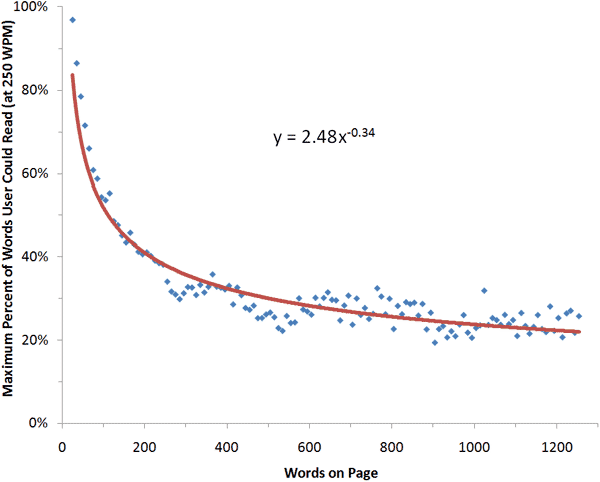
This fancy graph from Nielson shows that the more copy you have on your page, the less your visitors will read, relative to length. Have 1000 words on your page? Few will read the whole thing. Have 1 word on your page? 100% of visitors will read it. Et voila:
And this: “79 percent of our test users always scanned any new page they came across; only 16 percent read word-by-word.”
Now before we discount the 16% of visitors who read EVERY word in Neilsen’s study and, in doing so, conclude that people don’t read online so we should all keep our copy short…
…let’s take off our Usability Glasses for a moment and put on our CRO Hats.
Here’s what those usability studies fail to take into account:
How engaging is the copy? You can get an 8-year-old to read 1,000 pages in 3 days if you’re JK Rowling.
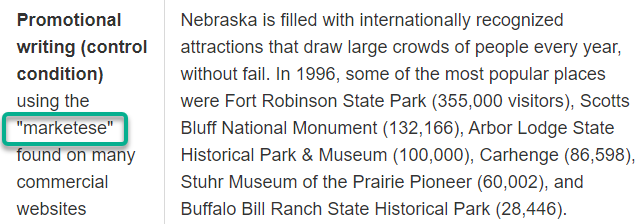
How relevant is the copy to the reader? Here’s a sentence that Nielson asked their test participants to read:
“Nebraska is filled with internationally recognized attractions that draw large crowds of people every year, without fail.”
Total snoozefest.
I’ll read all day about my own problems and desires. But you’d have to pay me to read about how many tourists visited the Buffalo Bill Ranch State Historical Park in 1996. (It was 28,446.) UNLESS you wrote it to be specific and all about me, like:
“You’ll have the time of your life creeping the spooky halls of Buffalo Bill’s very own mansion, right here in Nebraska.”
SHOCKING NEW STUDY REVEALS THATPEOPLE DON’T WANT TO READ BULLSHIT!
Remember, the point is conversions and sales. Which means this:
You need to care way more about people who are likely to buy from you than you do about an average person in an average situation.
You don’t want to cater to your average prospects.
You want to cater to your best prospects.
As Eduardo Esparza, founder of the SaaS growth optimization agency Market8, tells me:
“Buyers are readers.”
So if 16% of your visitors read every word of your homepage — it sounds like you have yourself some potential buyers.
Takeaways: Yes, people are more likely to skim web copy than to read all of it. But, the original UX research that claims “people don’t read online” is misleading.
First, 16% of participants in a key study read every word.
Second, the copy that participants read was described by NNG as “Marketese,” which means that this research doesn’t apply to great copy written for a specific audience.
Third, if 16% of people read every word of painfully boring “marketese,” imagine how many would read every word of copy that actually engages them. Guess: more than 16%.
Bad Reason 2: Everyone’s copying the design-first approach
When I set out to understand why SaaS websites use such short copy, my leading hypothesis was reckless conformity — the clueless following the clueless.
ConversionXL Founder Peep Laja, who’s been optimizing SaaS websites for over a decade, confirms my suspicion that this plays a role:
“In SaaS, it’s a massive everyone-copies-everyone approach. ‘Since others have short copy, we need short too!’”
This gets compounded by a related problem:
SaaS websites are often designed before they’re written.
(So much for form follows function, eh?)
Here’s Peep again:
“Most SaaS sites are design-first. Meaning the DESIGNER designed the site to look good, and they left little room for copy. They probably used Lorem Ipsum in the design phase. So whoever wrote the copy just filled in the blanks.
The right way to do this is copy-first. First decide on the messaging, then use design to best deliver this message.
My personal experience — doing CRO for SaaS sites for some 10 years — is that copy is actually the biggest driver of conversions for them. Almost all SaaS sites look good, so design will not get them to buy. It’s table stakes. SaaS sites are fairly simple, so usability is usually not an issue. So it’s mostly copy.”
“We’ve verified that your landing pagecopy is twice as important to conversion rates as your design.”
Takeaways:
If you want to optimize your website for conversions, you need to write your copy first. Then build your design around the copy.
If you start with design, you’re putting arbitrary constraints on your persuasive argument.
Bad Reason 3: Copy by committee
As you just read, SaaS marketers start with the assumption that they should follow what famous brands do and keep their web copy super short.
Copyhackers founder Joanna Wiebe breaks down what often happens from there:
“The marketer starts with short copy.They share it with the boardroom. And a dozen other voices try to agree on what messages they ‘like’. So they whittle that short copy down to even shorter copy.
Finally the designers get their hands on the copy and squeeze it into a design that was built on the short-is-best assumption.”
Copy by committee + Design-first approach = Super short copy
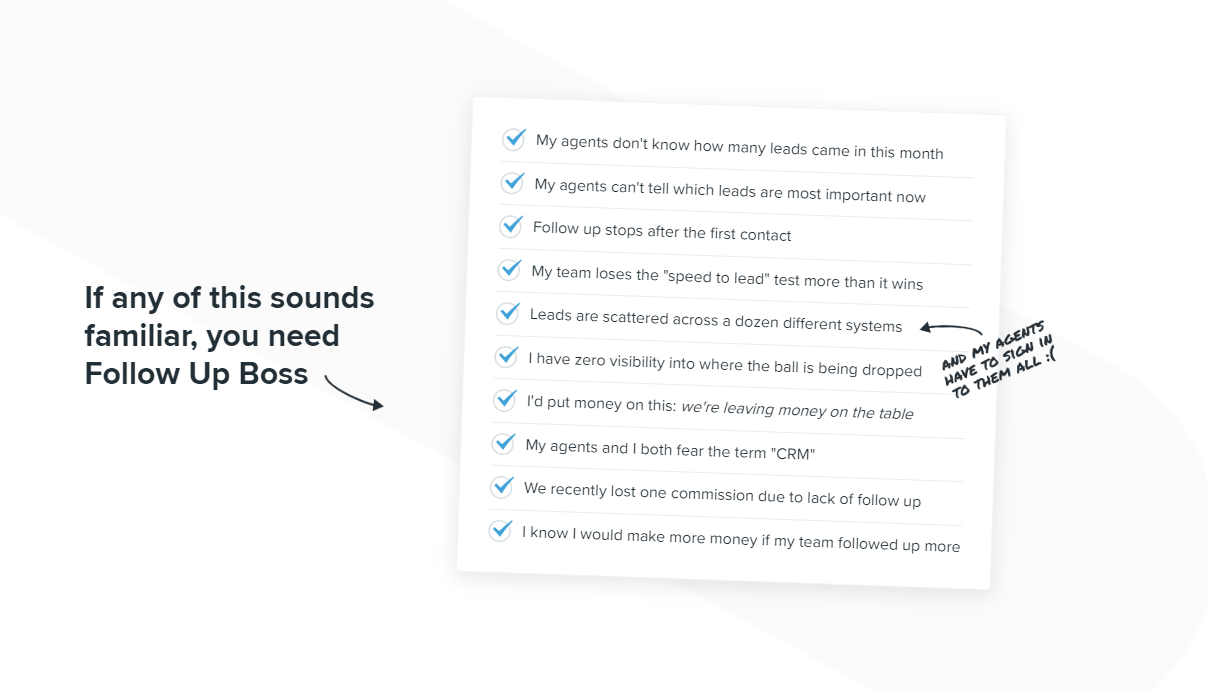
Take this example of powerful agitation copy that the Copyhackers Agency wrote for Follow Up Boss (featured in the Copyhackers course 10x Web Copy):
Do you see many SaaS homepages taking up this much space with agitation copy?
Do you envision a boardroom with no understanding of direct-response copy principles signing off on copy like this?
Me neither. At least not without some convincing. So well done, team at Follow Up Boss!
Takeaway:
Great copy can be scary. It’s emotional. It’s specific. And it makes people who don’t understand copy and conversion optimization nervous. So the more uninformed voices weighing in, the fewer messages will pass their arbitrary requirements.
And now for some good news. Well, kinduv.
Why copy length is a red herring
When I first set out to see if short copy worked better on SaaS websites, I searched for every case study that tested short copy against long copy that I could find.
Here’s what I realized:
There are no case studies that test short copy against long copy.
In fact, length can never be the only variable at play.
Any time you add or remove copy, you’re changing the overall message of your page.
Did the longer version win?
Looks like you found some important messages that help your visitors take the next step.
Did the shorter version win?
Looks like the longer version has some counterproductive messages that only got in the way.
Either way, it comes back to the message. Not the length of the copy.
In a moment, you’ll see why some messaging strategies call for longer copy than others.
But first, I need to add a big fat caveat to the whole “copy length doesn’t cause conversions” idea…
“If copy length doesn’t cause conversions, I can write as long as I want, right?”
Not so fast.
First, I don’t advocate wordiness. Nor do I encourage you to muddle your copy’s power by cramming in every idea you wish to express.
What I do suggest is that we SaaS marketers and copywriters stop focusing so much on copy length in our review process. And instead focus on figuring out the exact messages our ideal visitors need to hear in order to take the next step.
Second, copy length may not influence conversions directly, but readability sure can.
So now that I’ve complained about misleading UX research…
And now that I’ve said copy should come before design…
…I get to come crawling back to the UX researchers and designers of the world to beg their forgiveness.
Because readability matters.
Even if you have great copy, a wall of text is still a wall of text.
And poor readability causes all sorts of problems that hurt conversions.
Namely these two:
Friction: “This page looks like work. I’m outta here.”
Credibility: “This doesn’t look like a trustworthy business.”
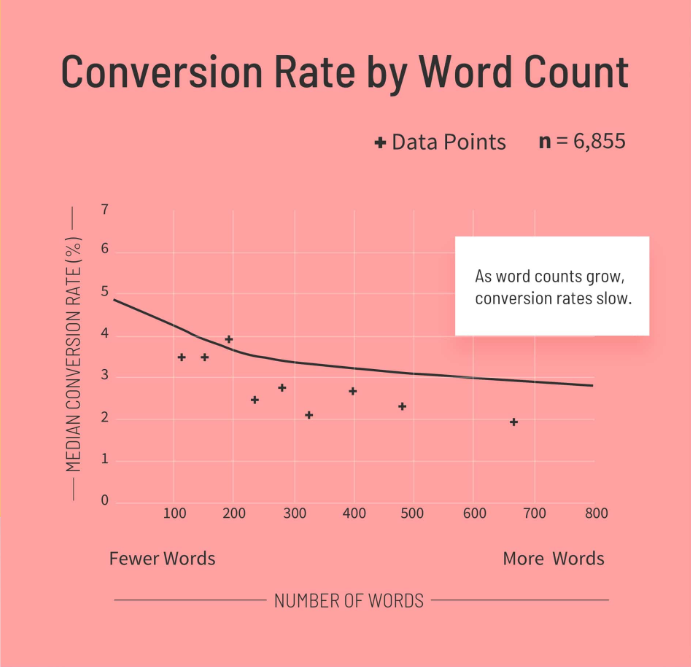
Translation: On average, SaaS landing pages with more copy had lower conversion rates than SaaS landing pages with less copy.
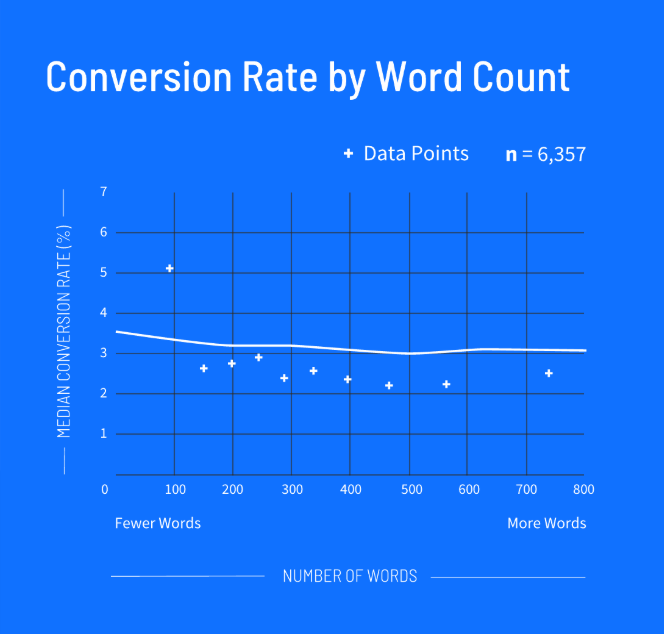
Compare that to the business services industry, where Unbounce found no clear relationship between copy length and conversion rate.
SaaS:
Business services:
This study is for Unbounce landing pages, so we don’t know exactly how this applies to websites.
But it’s not unfathomable to think the results might be similar.
“Wait — but Andrew you just said that copy length doesn’t cause conversions. Why would there be any correlation?”
Because some situations call for a messaging strategy that requires lots of copy. And other situations call for a strategy that requires less copy.
In either case, it’s the overall messaging — not the length of the copy — that truly drives conversion rate.
If that seems a tad confusing now, don’t worry. This should clear things up…
When you focus on these 5 factors, your “copy length” question will answer itself
What follows are 5 factors that you need to consider in your messaging strategy.
When your copy accounts for all 5 of these factors, the natural consequence is that your copy will be about as long as it needs to be.
Because these factors largely determine how much copy your ideal messaging strategy will require.
Factor 1: Visitor awareness and the structure of your customer journey
In the copywriting bible that is Breakthrough Advertising, Eugene Schwartz introduced stages of awareness to the world. It’s a continuum of 5 stages that describe how much a given prospect knows about how your product will improve their life, which Copyblogger has summarized nicely:
Most Aware: Your prospect knows your product, and only needs to know “the deal.”
Product-Aware: Your prospect knows what you sell, but isn’t sure it’s right for them.
Solution-Aware: Your prospect knows the result they want, but not that your product provides it.
Problem-Aware: Your prospect senses they have a problem, but doesn’t know there’s a solution.
Completely Unaware: No knowledge of anything except, perhaps, their own identity or opinion.
On the less aware end of the spectrum, the prospect doesn’t even understand that they have a problem, much less that your product could solve it. It’s you staring blankly at the TV during life insurance commercials — you don’t have life insurance, haven’t thought about getting it, would be better off with it, but haven’t yet felt the need for it…
On the more aware end of the spectrum, the prospect already knows all about your product and why it’s likely to be a very good fit for them.
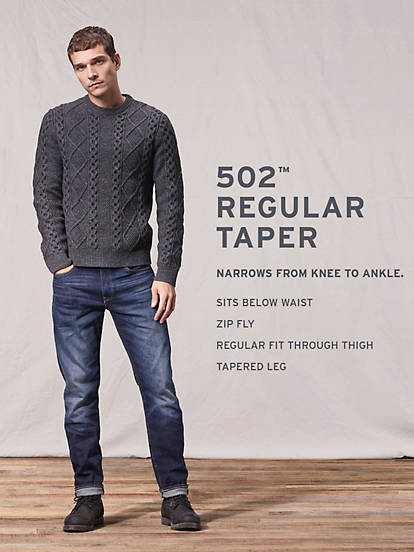
For example, I like to order the exact same pair of jeans from Levi’s whenever mine wear out. I’m “most aware.”
Because my awareness of that specific pair of Levi’s is so high — I already know they’re exactly what I want — Levi’s doesn’t have to tell me much to get me to buy. A discount and a checkout button could be plenty to get the sale. Sending me to a long-form sales page would be hilariously counterproductive.
On the other hand, imagine you want me to sign up for a course that teaches a skill I’ve never even heard of.
Before I’m ready to buy, you’ll need to build my awareness. And you may have to do it in multiple steps — not all on one page. You’ll need to get me to…
Realize that I have a problem
Understand that there are solutions to that problem
See that your solution will deliver the outcome I want
Decide that your solution is the best choice for me
Get me to take action
In this situation, this hypothetical company has a whole lot more work to do than Levi’s.
How does this apply to SaaS websites?
I turned to QuickSprout CEO Lars Lofgren. He knows a thing or two about building a website. And he’s tested a lot of SaaS websites over the years. (And as Senior Director of Growth & Product at Ramit Sethi’s I Will Teach You To Be Rich, he’s tested a lot of long-form sales pages too.)
In his experience, short-form copy tends to work better for most SaaS companies — particularly B2B websites with longer sales cycles:
“The reason long-form copy rarely works for SaaS websites is structural.
Long-form sales pages are so long and keep all the copy in one place because the copy needs to take someone through the entire journey at once. The copy needs to do all the work.
For SaaS companies, the web copy is rarely responsible for doing all the selling. The sales funnels are typically longer, and the journey happens over multiple steps and multiple places.”
He adds, “The role of the website is to get the buyer to the next step, usually a free trial or a demo. And that’s it.”
“In my experience, the SaaS purchase decision is sort of an odd one… so much of the conversion happens away from the site. And it’s pretty rare to get a lead who is super unaware and needs tons of copy to educate them on their problem.”
Factor 2: Market sophistication
Remember when the word “cloud” referred to a puffy cluster of sky marshmallows?
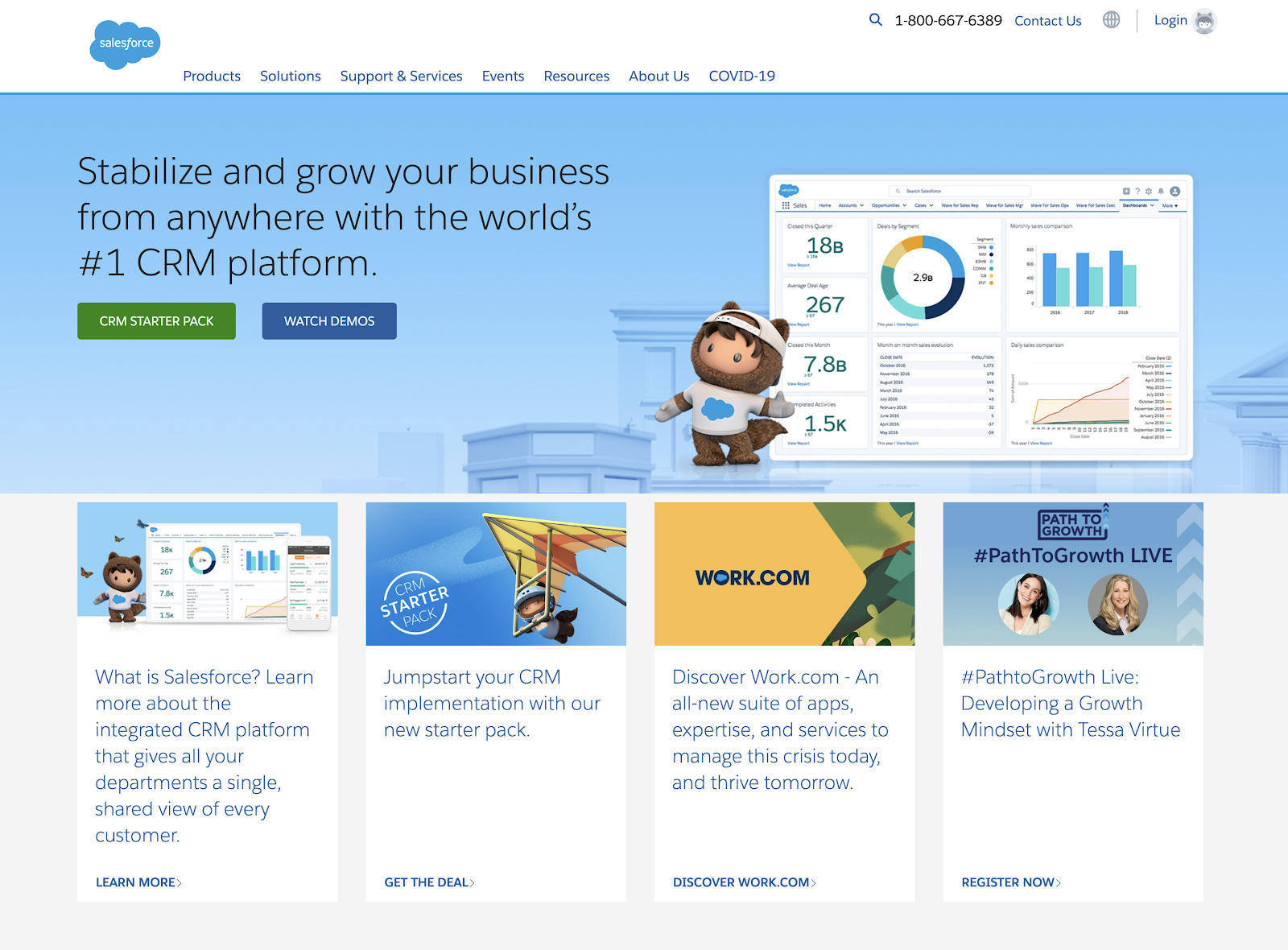
Then Salesforce arrived in the late 90s and the concept of cloud computing crept into the mainstream.
Check out this artifact I found using Wayback Machine:
Does anyone else hear dialup modem tones?
Sometime between then and now, “cloud” became a buzzword.
Eventually, customers expected their CRM to be cloud-based. And the term largely disappeared from marketing messages.
As a market matures, it goes through states of sophistication — another crucial concept from Breakthrough Advertising. And since I spent $130 on this book, let’s grab the definition straight from the source.
Your market’s state of sophistication is the answer to this question:
“How many similar products have they been told about before?”
For example…
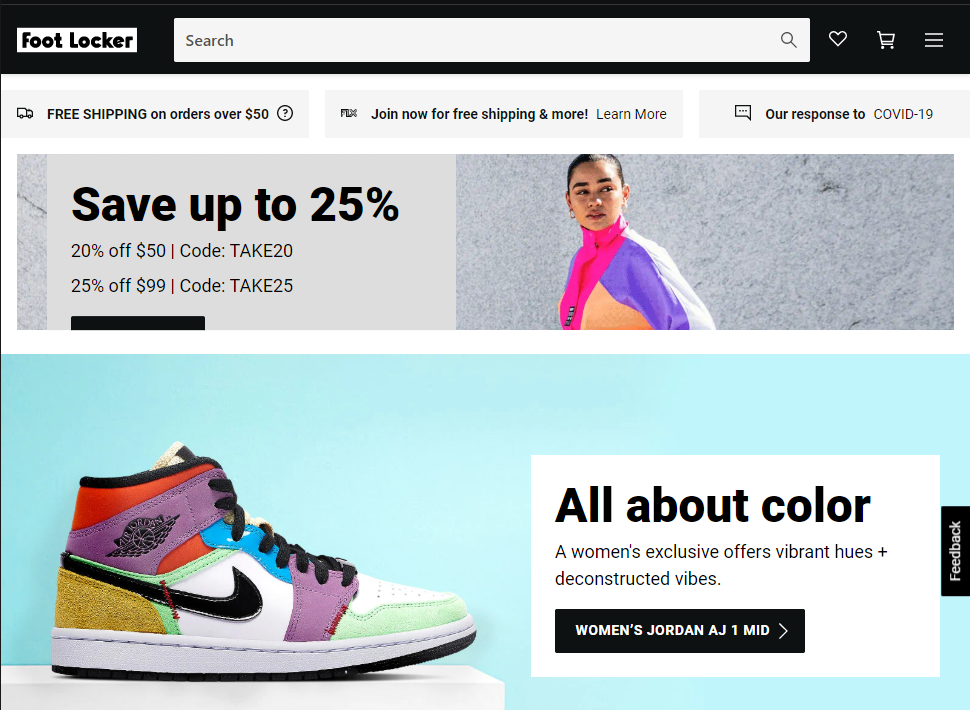
If you own a regular ol’ shoe store, you’re selling to a sophisticated market. Your entire audience already knows about the benefits of wearing shoes. Footlocker’s homepage can skip straight past the question “why buy shoes?” and go straight into “why buy our shoes”. Or “why buy our shoes today.”
In other words, in a sophisticated market…
…you don’t have to sell your product category. Just your product.
In 2000, Salesforce still had to explain the advantages of replacing physical CRM software with a cloud-based CRM. Now that the market’s mature, they don’t.
How does this apply to SaaS websites?
In a case study from 2012, the heatmap software Crazy Egg tested their homepage against a new page that was about 20x the length of the control.
The longer page won by 64%.
Some time later, Crazy Egg hired Joanna Wiebe to see if she could beat the new control.
Joanna attributes much of this to the maturation of the heatmap market.
In the beginning, visitors didn’t really know what heat mapping tools were or why they should want them.
To boost conversions during the early stage of sophistication, Crazy Egg needed more messaging that explained the what and why of heatmap tools.
As the market matured, people became familiar with heatmap tools, and much of that messaging became unnecessary. It only got in the way.
As your market becomes more familiar with products like yours, you may find that some of your copy becomes so obvious that it’s unnecessary. The same way that Salesforce doesn’t have to explain what a cloud is anymore.
Factor 3: Intent, motivation and your visitors’ context
Joanna Wiebe noticed something interesting back in her days as a copywriter for a famous tax and accounting software:
Selling the product during tax season was easy.
With so much legal and financial pressure, prospects were so motivated to solve their problems every April that the copy, well, didn’t matter so much. At least not as much as it mattered the rest of the year. She referred to selling in this context as The Hot Coal Effect: you could put hot coals between a prospect and the “buy now” button, and they’d walk over them just to click the button.
It’s the same reason meth dealers don’t need good customer service to sell their product. (At least that’s what I learned from Breaking Bad.)
Or why people will wait in long lines to eat at famous restaurants that are known for being rude.
Sure you’ll lose some self-respect, but have you tried the chicken noodle?
The more motivated your prospects are, the less work you need to do to convince them to convert.
So when you know your audience is highly motivated, you should focus on paving a clear path to conversion. And ruthlessly cut any messages that get in the way.
When your prospects land on your website clutching a credit card and hunting for the BUY NOW button, your copy’s main job is to pave a smooth path and stay out of the way.
The point is, you can’t determine the right messaging strategy without deep empathy for the context in which your ideal visitors find your website.
What’s their intent?
Are they in a rush?
Are they reading your copy on their phone?
The context matters.
How does this apply to SaaS websites?
Here’s Joel Klettke again:
“Often, leads have a very specific use case or feature set in mind. They’re moving fast to find a SaaS that does what they need: ‘Does it do this? Does it do that? Can it accommodate my use cases? Okay, what does it cost?’”
In other words, many visitors don’t need a long, desire-building story — they need to check items off their checklist.
Joel continues, “in my experience, they’re often comparing. They know the ‘big players’ and need to quickly differentiate them and make the call.”
And sometimes, Joel adds, “many SaaS products are researched by someone who’s just trying to get a quick quote or whip through a demo so they can pass that info to a C-level decision maker.”
Joel’s insight might help explain the Unbounce report finding we discussed earlier:
That shorter copy correlates with higher conversion rates in SaaS.
Factor 4: Risk, price and complexity
Consider these two situations:
You’ve been invited to a free webinar by a brand you know and trust. All you have to do is submit your email address to attend.
You’re a CMO and you’re considering a 6-figure marketing automation purchase.
In the first situation, your risk is low. The worst thing you envision happening is that you waste 20 minutes on a webinar.
In the second situation, a bad purchase could cost you your job. You know, the thing you use to put food on your family’s table.
In the second situation, you would have more questions, anxieties, hesitations and objections that need to be addressed before you buy. Often there’s a team of salespeople to help with purchases that big.
But your web copy still needs to address the complexity and risk that your visitors perceive.
Look at the difference between Intercom’s free webinar page and their pricing page:
The pricing page simply has more risk and complexity to address than the webinar page.
“Our testing suggests a direct relationship between the cost/complexity of an offer and the amount of information that is required to achieve a conversion.”
How does this apply to SaaS websites?
Many SaaS websites have very low-risk offers such as demos and free trials. Which may help explain why many SaaS websites get away with shorter copy. Your challenge is to figure out which questions, anxieties and objections you need to address to get your ideal visitors to overcome their resistance.
More on that when we get to the 3 actions you can take to nail your messaging strategy.
Factor 5: Targeting multiple segments and personas
This idea comes from Joanna again:
“Long copy is tricky. It’s easy to get wrong.”
In other words, the more you say, the more likely it is you’ll say the wrong thing. (That’s also some good dating advice I always ignored.)
Think about it.
Most websites are designed to please multiple segments. And the list of messages you can say to all segments is small. The messages, generic. Say much more and you risk alienating an important part of your audience.
How does this apply to SaaS websites?
If you look at the Airtable homepage through this lens, the super short copy makes sense. Their audiences are all over the place.
Because Airtable can be many different things to many different people:
To me it’s a CRM. To the head of operations at a 1000-person company it’s a project management tool. The list of personas and use cases goes on.
If Airtable gets much more specific in their copy, they risk scaring away huge segments.
When you have multiple personas who need drastically different messages, you may have to sacrifice specificity, which usually means shorter copy. And unfortunately, worse copy. However, you may have opportunities for more specific and powerful messaging on pages that are designed for specific personas or use cases.
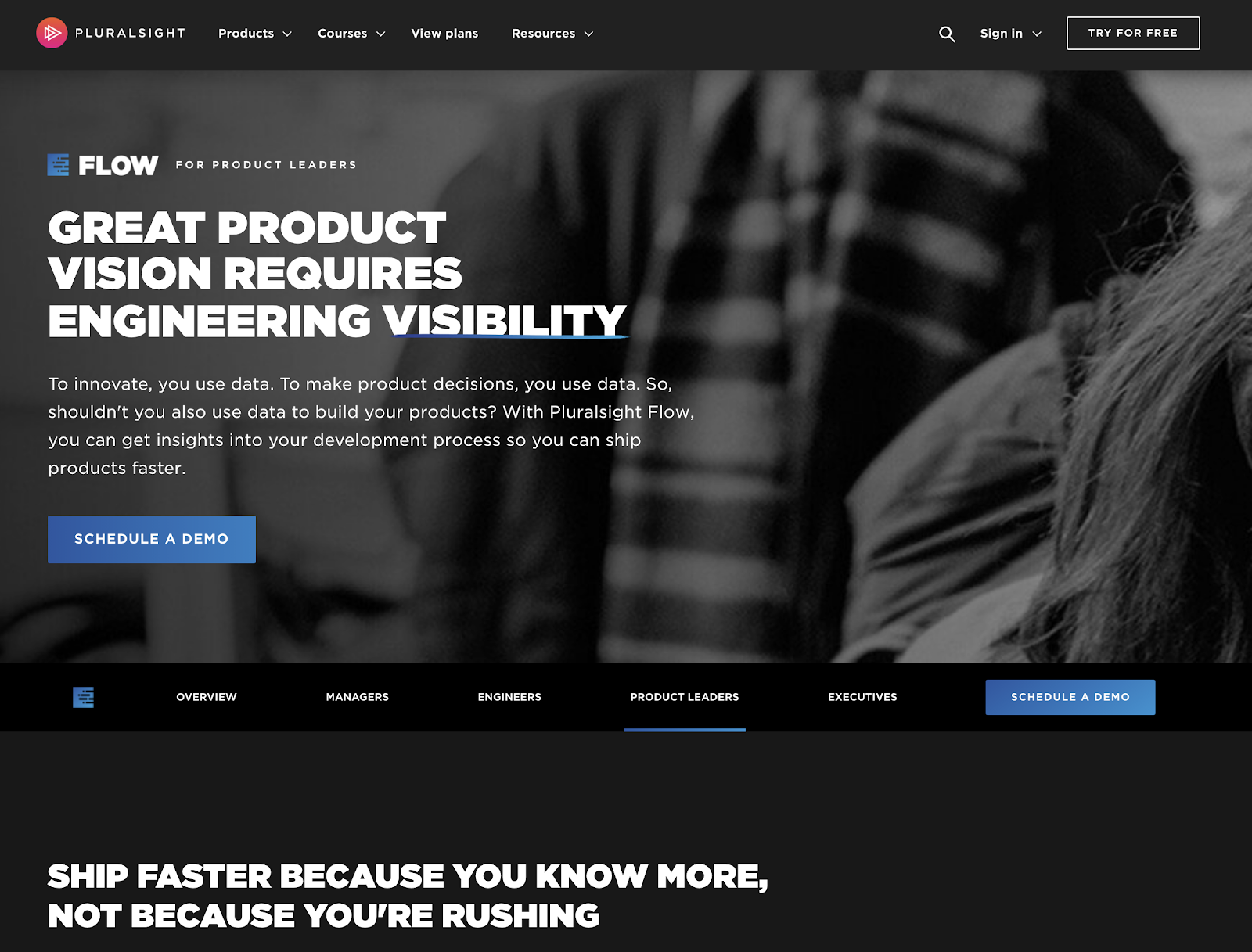
Flow by Pluralsight has good examples of persona-segmented pages across their website, like this one for Product Leaders, where the copy is specific to what a product manager needs to know about how Flow will improve his/her life:
And remember, not all visitors are equally valuable. It may be net positive for you to double down on certain messages for certain visitors, even if it risks alienating some of your less valuable traffic.
Putting the 5 factors together:
A tale of two SaaS websites
This hypothetical scenario from SaaS Copywriter and CRO Josh Garofalo illustrates how these 5 factors influence your messaging strategy:
“Company 1 is the incumbent in the general email marketing software market.
The decision-maker, buyer, and end-user is the same person. They’ve evaluated, bought, and used other email marketing solutions in the past. The buyer’s goal is to save money. And the offer is to sign up for the new, unlimited, forever-free plan designed to increase market share.
Company 2 is an AI solution that autonomously evaluates, chooses, and purchases software for enterprise companies. Nothing like this exists. Most people don’t yet think of manually evaluating and buying software as a problem that can be solved.
It’s not hard to imagine a long list of questions, objections, and hesitations that will need to be addressed.
And the kicker?
A meaningful demo requires phone calls, coordination between departments, and plugging into their software stack to simulate real software purchases.
And if they buy? Thousands of dollars per month.
Company 1 can get away with short copy. Customers are aware of who they are and what they do. The ask is as frictionless as it gets — have the thing you want for free, forever.
Company 2 will require longer copy. They are first to market and the technology is complex. They need buy-in from different parties with different goals. The ask requires cross-departmental cooperation. The price tag is staggering.”
Enough theory! Here are 3 actions you can take to optimize your messaging strategy for conversions
Action 1: Interview your best customers to find out why they switched
One of the keys to Conversion Copywriting is a hyper-focus on your prospects. You’re not writing copy for yourself. Or your boss. You’re creating it for your ideal visitors.
Without a doubt, the strongest qualitative method to uncover the messages your prospects need to hear is to run customer interviews.
But not just any customer interviews. You can’t just talk to your customers and expect golden insights to pour out of their mouths.
To zero in on the messages you need to include in your web copy, you’ll want to ask questions about the experience of leaving their old way of doing things and switching to your product.
The interview should cover the before, during and after phases of their experience.
When did you first realize you [needed something to solve your problem]?
What were you doing, or trying to do when this happened?
Before you began [using the current solution], how did you solve these same problems in the past?
During questions:
Tell me about how you looked for a product to solve your problem.
What alternatives did you consider before using [the solution]?
What was good or bad about each of those?
What was the hardest part of figuring out what solution to use?
After questions:
What can you do now that you have [the solution] that you couldn’t do before?
And why is that important to you?
What else? (Following up is the key to getting deeper insights)
In the Copyhackers 10x Web Copy course, Joanna teaches a specialized style of interview called the Obstacle Interview. In this style of interview, the key is to home in on the things that almost got in the way of your customers saying yes. (E.g., “What do you remember being the biggest obstacle that nearly prevented you from choosing [Solution Name]?”
Once you can hypothesize what’s getting in the way, you’ll be better able to tell the messages you need to include from the ones you can safely omit.
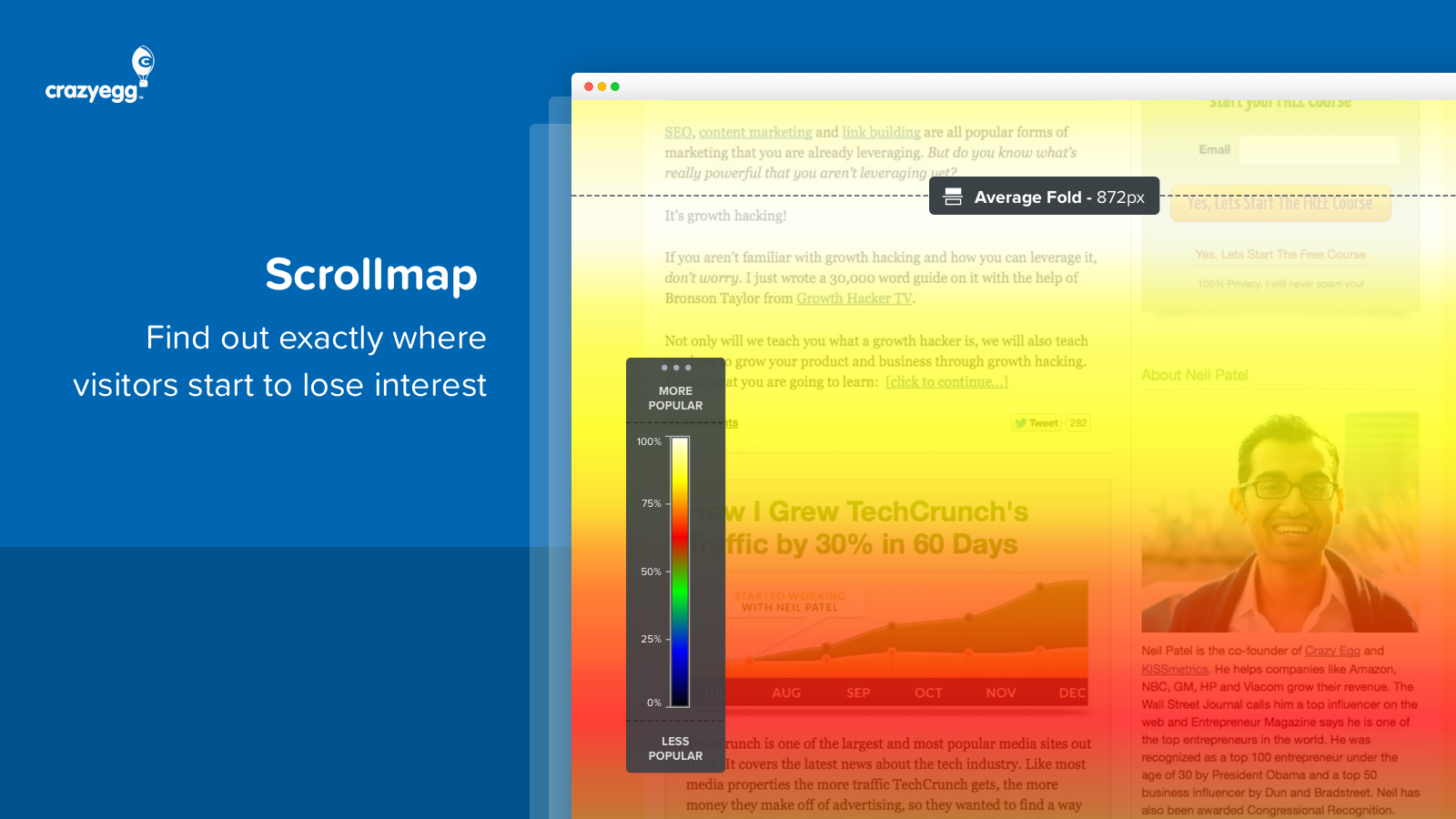
Action 2: Use scroll maps to see where to cut — but be careful!
Scroll maps use color to show you where your visitors drop off the page:
But drop off isn’t necessarily bad. It’s natural for drop off to increase as you go further and further down the page.
…are the visitors who go all the way down the page still clicking links?
Let’s say 100 out of every 1000 visitors make it to the bottom of your homepage.
But of those 100, 75 click on your call-to-action button. The drop-off rate is 90%. But the 10% who scrolled all the way down converted at a really high rate of 75%. That tells us not to worry about the drop off. The copy is doing its job.
On the other hand…
If almost no visitors convert after a sharp drop off, you either need to fix a section, or cut it all together. Repeat as needed.
One more note of caution: If you have a Log In button in your hero section, don’t forget to account for existing customers when you analyze your scroll maps. Otherwise, you might think prospects are dropping off when it’s actually your customers logging in.
Action 3: Write for both types of decision makers — fast and slow
“Write to one person.”
You may have heard that advice before. You might have heard that advice from this very website.
The idea is, the more targeted you are in your copy, the more your ideal reader will respond.
This rule still applies in web copy, but there’s more nuance.
Unlike email sequences or PPC ad campaigns, you don’t have all that much control over who’s coming to your website. Especially your homepage.
This means your homepage has to work for multiple personas who may have completely different needs and concerns.
You still want to write to one person, but you need to hedge your bet a bit more on your website.
In the Copyhackers 10x Web Copy course, Joanna teaches that you can divide your web visitors into 2 categories (and I’m simplifying here):
Fast decision makers
Slow decision makers
Fast decision makers rely on your hero section, search, navigation and other website shortcuts that help them quickly get to their goals.
Scannable hero copy is your ally for these visitors. You can expect that they catch some of your hero copy and crossheads. But not much else.
Slow decision makers, on the other hand, are readers. They don’t stop at the crosshead. They read the body copy too. Then they check some reviews on G2Crowd. Then they check your competitors’ websites. Then they come back to your website and read it again.
As Jo puts it in the course, for this audience, “details are everything.”
If you know that your audience falls into the fast or slow decision-making category, by all means, write for them and them alone.
But most of the time, you need to write for both.
Here are some quick tips to help you do just that:
Make the copy at the top of each page scannable. This helps fast decision makers move quickly.
Give them what they need to know in the hero section. Then rely on clear navigation, links and buttons so they can get where they need to go. Slow decision makers will keep reading down the page if you hit the right notes in the hero.
Tell a story with your crossheads. Fast decisions-makers won’t read paragraphs of body copy. But they may skim your crossheads. So don’t waste your crossheads on placeholder copy such as “Features” “Why us?” and “Trusted by”. Replace those with more specific, value-based crossheads.
For example, this crosshead on the Follow Up Boss homepage packs a lot more credibility than the standard “Trusted by”
Use 3rd-party social proof early on your homepage and other entry points. That way, you establish credibility with fast decision makers before they dart to the next page.
Use icons and images to draw the eyes of fast-paced decision makers to the most important messages.
Settle the “it’s too long” debate once and for all
Only a split test will reveal exactly what works and what doesn’t.
But the vast majority of SaaS marketers aren’t testing their web copy all that rigorously. Or at all.
So if split tests aren’t practical for you right now, you need to rely more on your research to build a winning messaging strategy.
When your team focuses on the 5 factors discussed earlier, the “copy length” debate will settle itself.
Or at least you’ll have a more productive conversation about which messages to include and which to omit. Instead of whittling your copy down until it’s generic and impotent.
When your team starts debating copy length, try bringing the discussion back to the messaging factors that truly matter:
Awareness & the customer journey: What messages do your ideal visitors need to read so that more of them get from point A to point B? What can you leave out?
Context: What is the context in which your ideal prospects visit your website? Do they just need to check if your software fits their use case? Or do they need to thoroughly evaluate the details?
Market sophistication: Do your ideal visitors already understand your product category? Or do you need to explain it?
Price, risk, complexity & trust: How many questions, objections and anxieties do you need to address?
Segments: Which messages will resonate with your ideal visitors rather than your average visitors? How can you target your most valuable visitors without completely alienating anyone important?